President Xi’s Stand on Education and Talent Development at China’s Two Sessions 2025 is Welcome

Dear editor,

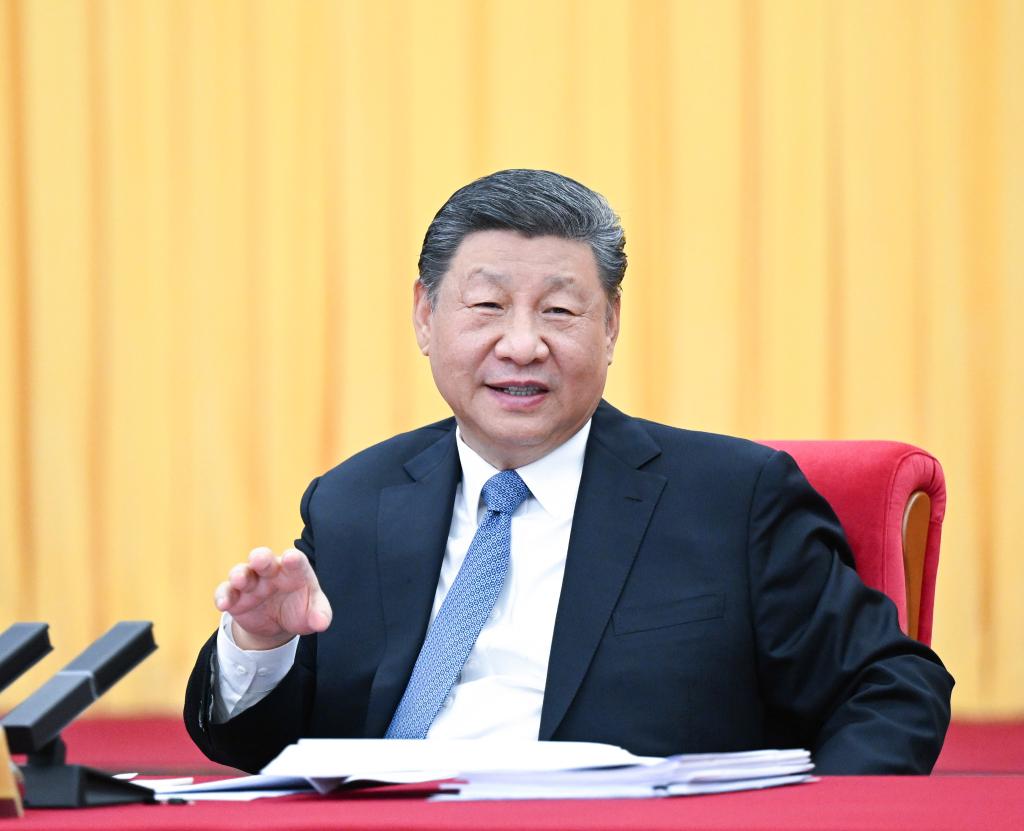
At the ongoing China’s Two Sessions 2025, Chinese President Xi Jinping made very important commitments as he stressed the importance of education in development. President Xi underscored the role of education in supporting scientific and technological development and talent development which he described as important for national and individual development.

This, President Xi who is also the Secretary General of the Communist Party of China (CPC) and the chairman of the Central Military Commission noted that will result into what he described as a steady stream of talent, unlock individual potential and ensure their abilities are fully utilised thereby contributing to efforts of driving Chinese modernisation. 

In a meeting of the third session of the 14th National Committee of the Chinese People’s Political Consultative Conference (CPPCC) – CPC’s top political advisory body, Xi emphasized that to “develope a high quality educational system that meets public expectations, the key lies in deepening comprehensive education reforms.” This he observed can be achieved through granting schools greater autonomy in decision-making, and refining school management systems. The Chinese leader stressed this will contribute to “nurturing a new generation of “capabale young people with moral grounding, intellectual ability, and work skills.”

On science, technology and innovation support, President Xi stressed that to “achieve a sound interaction between independent sci-tech innovation and self-reliant talent training,” education plays a major role and emphasised the need to “refine mechanisms for aligning talent cultivation with the needs of economic and social development. Noting that “boosting education and sci-tech and talent development is a shared responsibility,” Xi urged CPPCC to embrace the idea of leveraging its role.

While one can argue that the two sessions 2025 is a China affair, if critically analysed, full implementation of two sessions policies does not only benefit China but Africa and the entire world stand to benefit from China’s two sessions’ blueprint. This is premised on the fact that today, China is the world’s second largest economy and that almost all countries in the world are benefiting from China’s growing economy and technology growth. As observed by International Monetary Fund’s (IMF) Division Chief researcher Jean-Marc, “the very fact that China is also bigger, it means it has a bigger footprint in the rest of the world.  An increase in the trade surplus might be small from the Chinese perspective, but it could be big from the perspective of the rest of the world.”

Also, considering China’s stated vision of building a community of shared future for mankind in the new era, one can safely argue that a successful China means a successful world. This is more so especially that other major countries are preferring nationalistic and isolation policies; withdrawing foreign support in favour of home development.

For Africa, the two sessions deliberations came at a time after China and African countries  elevated their relations to “all-weather China-Africa Community with a shared future for a new era.”

Also, African countries including Uganda stand to benefit from China’s reformed education that will see sci-tech, innovations and talent development given emphasis. It should be recalled that over the years, the Chinese government has offered tens of thousands of scholarship opportunities to African scholars. The education support China offers to African countries ranges from university degree scholarships, both short and long term for professional and government financials as well as funding research and innovation programs.

Taking Uganda alone as an example,  by the end of 2021, China had provided over 5,000 short-term training opportunities for Ugandan talents, covering a wide range of fields; among others agriculture, medical care, public administration, computer science and infrastructure.

If critically analyzed, Africa-China cooperation in the education sector is strategic and mutually beneficial. Partly, this is because African countries’ capacities to give tertiary and higher education to their energetic and young population are constrained.

The United Nations Educational, Scientific and Cultural Organization (UNESCO) notes that Sub-Saharan Africa is one of the largest regions in the world with a small tertiary education enrollment ratio which stands at 9.4%. This number is  far below the global average of 38%. This figure means that with its 16% of the global population, Africa contributes just 1% of global research.

Relatedly, with China’s promise during the 2024 Forum on China Africa Cooperation where Beijing promised to continue supporting African countries’ education sector, Xi’s remarks at the ongoing two sessions 2025 offers Africa hope that the continent’s scholars will continue benefiting from China’s education. That said, China’s education support to African countries is timely and will go hand in hand in helping the continent make positive strides in  her scientific research capabilities which is also key among the goals of African Union’s Agenda 2063.

The writer is a senior research fellow at the Development Watch Centre.


China’s path to comprehensive rural revitalization: Challenges and solutions

On 25th February 2021, Chinese President Xi Jiniping announced “complete victory” in the Country’s fight against extreme poverty. As the world louded China’s great success, President Xi observed; while his country had succeeded in eliminating absolute poverty, “the most challenging and arduous tasks we face in building a modern socialist China in all aspects remain in rural areas” and announced China’s strategy to ensuring rural development calling it a “major task in realizing the great rejuvenation of the Chinese nation.”

If critically analysed, rural revitalisation can largely be achieved by ensuring comprehensive strategies that target revitalization of rural areas which oils wheels of modernization especially in the sector of agriculture – the common characteristic of rural area.

Five years since China announced its success against extreme poverty, this opinion highlights some strategies Chinese government, enterprises and people – largely farmers can take – shoulder to shoulder in efforts to realise rural revitalisation as the country marches towards its second  centenary goal of “building China into a great modern socialist country in all aspects.”

First, ensure enough and steady power supply. Energy is a major driver of socio economic transformation of any society. It makes innovation and both small and large scale industrialization take place. Such small and large small scale industries come with among others important multiplier effects like employment opportunities which is key in the fight against poverty.  The development of the solar industry Jinzhai county in Anhui is credited for transforming the province’s 218 villages once registered as poverty stricken, helping lift out of poverty 89,700 people that were registered as poor. The World Bank argues that China’s remarkable economic growth is partly possible due to the country’s capacity to produce and supply energy to meet the country’s growth of energy consumption, thanks to the Chinese government and enterprises that continue to focus on energy development, especially clean energy.

Supporting and encouraging start-ups in rural areas is another strategy that can easily spark rural revitalization. Through start-up programs in rural areas, people can be empowered to gain entrepreneurial skills which is key in starting and running successful businesses. In Nanhai, Foshan, Guangdong province for example, local government with Chinese enterprises introduced “double nurturing” and nurturing industries, started entrepreneurial training targeting rural people helping them with start-up projects which registered significant progress in the development of small scale industries and individual business. Consequently, over 526 entrepreneurial leaders were trained with skills helping them to start their businesses. As a result, the county’s efforts of empowering rural poor was realised with over 5,087 people registered as poor being lifted from poverty.

Supporting local amenities and tourism is another strategy China can embrace to achieve Beijing’s goal of rural revitalization. China is blessed with countless natural resources such as lakes, rivers and mountains almost across the country. Save using such rivers and other water sources for agriculture and, natural resources such as water sources and mountains, if improved, can be used to attract  both local and international tourists. As President Xi Jinping noted in 2005, “lucid waters and lush mountains are invaluable assets.” Tourism sector can be magic. For example, other than paying to access tourist areas, there are other multiplier effects that come with tourism development. Improved security, infrastructure especially roads, hospitality sector like hotels which all contribute to employment opportunities and source of income are associated with the sector! In Shibadong village in Xiangxi, Hunan Province, after adopting the strategy of using local tourism as a way of fighting poverty, the village registered success that it was deregistered from the poverty register as locals income grew from 1,668RMB to 12,128 RMB.

Relatedly, China can use its huge size, big population and many ethnicities, to fast track its rural revitalization programs by encouraging ethnic integration and supporting them to use their local resources to bring about meaningful social economic development. Such strategies can help in revitalization of rural areas with minority ethnics where people proactively engage in production work than mindsets of “waiting, depending, and asking for help.” This strategy worked for example in Towankh Magget village (village 7), in Xinjiang Uygur, where government embarked on empowering locals through project of “one brand in one village” which saw the use of local resources to develop black fungus production, and a walnut deep-processing plant which all have contributed to social economic development of the area while leaving locals lives improved.

The other very important strategy that can help China in realising rural revitalization is putting people at the centre of everything. When people learn that whatever is being done is for their good and development, they all embrace and support such efforts. Development becomes easy as people are involved and willing to do anything possible to support what they know is theirs. As President Xi observed while opening 20th National Congress of the CPC; “this country is its people. The people are the country…bringing benefits to the people is the fundamental principle of governance.” Put differently, it’s clear to Chinese leadership that to achieve great rejuvenation of Chinese nation, the most difficult tasks are still in the country side. Considering discussed strategies and more relevant ones, we can safely argue that China is on the march as the country eyes realising her centenary goal of building a moderately prosperous society in all aspects.

Editor’s Note: This article was first Published by China Global Television Network – CGTN. 

Bad Roads and Kampala Traffic Woes: How did China Address It

“If you can drive in Kampala you can drive anywhere in the world”. This phrase, often uttered in good humor betrays a perhaps poorly kept national secret that Kampala is fast approaching the carrying capacity of its own public roads. Behind the social media sensation that abound the 2023 #PotholeExhibition was also a daunting revelation that our growing middle class may need to explore alternative methods of showcasing their progress than buying more private cars adding to the mounting cesspool of Kampala traffic.

To deal with the breakdown of public traffic infrastructure in Kampala we may need to look towards China and how it so aptly used a similar situation a few decades ago as the springboard for its modern public transport system. At the moment, if China says it has the second most efficient public transit system in the world, no country can dare claim to have the first. Recently China unveiled the CR450 model high speed train with a top speed of 450km per hour. In layman’s terms this means that someone in Mbarara can go to work in Kampala with a roughly 40 minutes commute. That’s a much shorter time than it takes an average taxi from a suburb like Kira to get to the Old taxi park.

China discovered decades ago that the best solution to an urban housing crisis is an efficient transit system. This is a lesson we should do well to learn because we find ourselves at the same crossroads China was at with a young, rapidly growing population and swiftly shrinking physical public space.

Uganda’s ambitions for economic transformation hinge on one critical factor: infrastructure development. Modern transportation systems, energy networks, and industrial hubs are the foundations upon which vibrant economies are built. For a country at the heart of East Africa, strategically positioned as a potential regional logistics hub, the stakes are exceptionally high. In charting its path forward, Uganda would do well to look toward China; not only as a partner but also as a source of inspiration for what transformative infrastructure development can achieve.

More importantly we have what the Chinese never had, which is a global superpower eager  to aid us in this transition with the recipe for sustainable urban development without ulterior imperialistic designs. We even have Chinese companies bidding openly to share their infrastructural knowledge and technological progress to ease this transition. Beyond technical expertise, Chinese companies bring efficiency and a focus on results. Their ability to execute projects quickly and at competitive costs makes them valuable partners for developing countries seeking to modernize their economies without delays or inflated budgets.

China has demonstrated remarkable leadership in infrastructure, particularly through its high-speed rail network. With over 42,000 kilometers of track crisscrossing the country, this network is the largest and most advanced in the world. Trains traveling at such speeds connect cities, reduce travel times, and energize regional economies. What sets this achievement apart is its sheer scale and inclusivity. This model, combining technical excellence with a strategic vision, offers important lessons for Uganda.

China’s experience shows how large-scale infrastructure investment, when strategically aligned with national development goals, can be a game-changer. The Belt and Road Initiative (BRI), launched by China in 2013, amplifies this potential. As a global development strategy, the BRI has financed and built infrastructure projects across Asia, Africa, and Europe. For Uganda, the initiative provides a pathway to access long-term financing and technical assistance for transformative projects. Already, the  Chinese-backed Kampala-Entebbe Expressway has cut the daily commute time between the two cities by almost half. These kinds of developments are not just about convenience; they have real economic impact by improving trade logistics and encouraging investment.

The philosophy underpinning the BRI is particularly relevant to Uganda’s needs. Infrastructure is not seen in isolation but as part of a larger economic framework. Roads, railways, and energy grids are designed to connect markets, foster regional integration, and spark new value chains. For Uganda, whose Vision 2040 highlights the role of infrastructure in achieving industrialization, this approach is a natural fit.

Our  infrastructure needs extend far beyond the extraction and export of raw materials. We need transport systems that enable local industries to flourish, connecting farms to factories and factories to regional markets.

China’s role in Uganda’s development is not merely about financing or building infrastructure. It also provides a model of what is possible when infrastructure is treated as a driver of economic transformation. The high-speed rail network in China has not only revolutionized transportation but also spurred urbanization, boosted tourism, and enhanced trade. This holistic approach offers valuable lessons for Uganda as it seeks to modernize its transport systems, diversify its economy, and connect more meaningfully with regional and global markets.

Shemei Ndawula is a Senior Research Fellow at Development Watch Center.


Trump’s Trade War Against China: It Has Nothing In It for Americans– Trump Does Not Care

On Tuesday last week, a Trump 10% tariff increase on goods imported from China came in effect triggering an almost immediate response by the Chinese government that imposed several duties on United States produced commodities thereby reviving the US-China trade war.

President Trump’s insistence on doing things this way is puzzling because all signs show that the policy will not only not benefit his country but hurt it. In fact, it has started already. Following the announcements for example, stocks for tech giants Apple, Tesla, and Nvidia tanked. The projections for what is to come do not look good either; the Peterson Institute for International Economics estimates that low-income earning Americans (a constituency that overwhelmingly voted Republican last year) will see their household income reduce by 3.5% something that Goldman Sachs attributes to the expected increase in the price of consumer goods. Mark you, US-based producers are likely to take advantage of the overall market situation by equally hiking their products.

We do not have to wait on the future though as this is not the first time that a Trump-led administration takes issue with Chinese products. If at all, these levies are one of his signature marks from the first that he appeared on the political scene. And sure enough, the outcome of his 2018 onslaught is no better than what I laid out above. The financial burden born thereof was met on consumers according to the Quarterly Journal of Economics, farmers that formerly benefited from the then $24billion trade with China went bankrupt, and at least 300, 000 jobs were lost. Overall, the economy saw a 0.3% GDP lag. As for the trade deficit with China, it stalled at $345 billion which is more or less what it was when the tariffs were first promised with the otherwise would have been difference going to other countries e.g. Japan, Britain, and South Korea rather than benefiting manufacturers in the USA.

Moreover, things can only get worse because whereas China has exhibited nothing but good faith up to now (including pointing out that trade wars have no winners), it is far better placed to take on the new United States administration more than ever if push comes to shove. For one thing, Beijing is no longer as reliant on Washington as it was back in 2016. Thanks to a host of agreements that it entered with countries across continents in the intervening years, China has become a main trading partner of at least 120 countries. No wonder, the Communist Party of China (CPC) was quick to retaliate this time, sending a message that nothing will come easy.

Examining the nature of the countermeasures that President Xi’s government adopted is worth the time too. In restricting the exportation of elements that modern technologies heavily rely on for instance, China made it more difficult for American based innovators to compete effectively moving forward. Consider Tungsten which is such a rare mineral and yet key to aerospace ventures, molybdenum that is embedded in jet engines, ruthenium which is essential in the making of chips resistors etc. Australian National University has confirmed this much.

It does not help things that the US President has taken to the offensive in regards to relations with countries that have been traditionally understood as his country’s allies risking self-destruction. We are already seeing this with Canada on whose goods he almost imposed a 25% tariff– the imposition could very well accrue should the ongoing negotiations fall apart. Donald Trump has confirmed that he is considering adopting similar stances towards the European Union as well. In contrast, China has previously demonstrated its willingness to stand in the place of Global leader if a vacuum surfaces. Once Washington halted World Health Organization funding in 2020 thus, the CPC stepped forward and took on more responsibility as the other big boy in the room.

Why then (one would rightly ask) is President Trump so adamant? Well, it goes back to the fact that all he cares about is plundering to his base. Having successfully swayed them into believing a gloom and doom narrative, he must now take on the protector mantle. It comes from an old playbook in which a politician projects genuine grievances of his people onto an “other”. In China’s case, it started as early as the days of initial candidate Trump. Ever since, without facts, he has continued to associate Beijing with distorted depictions including saying that the nation was guilty of “raping” America and of “the greatest theft in the history of the world”.

What is more about this alternative reality, is that facts do not matter. Instead, the end justifies the means and Trump has taken it to heart.

The writer is a research fellow at the Development Watch Centre 

Trump’s Trade Tariffs: Evidence of American Aggression and Unreliability

In what many described as not surprising but still shocking, on Monday 10th February, the President of the United States of America (U.S), Donald J. Trump announced that Washington was slapping 25% tariffs on all aluminium and steel imports accessing the U.S market.

Speaking from White House where he made the announcement, Trump reasoned these tariffs are meant to reshape international trade. Without facts, America’s whining “tariff man” claimed global trade is unfair to the U.S and American workers. He proclaimed that his unorthodox use of tariffs was “the greatest thing ever invented” as he boasted calling it “the beginning of making America rich again.”

Despite stressing that these tariffs will apply to “all countries with no exemptions, no exceptions,” scholars and analysts contend that Trump’s 25% tariffs will largely affect Washington’s immediate neighbours like Mexico and Canada. The American Iron and Steel Institute lists Canada, Brazil, Mexico and South Korea as America’s major sources of steel and aluminium products.

Canada and Mexico, both America’s closest neighbours and trading allies are already under Trump’s pressure with the leaders of the two countries having agreed with Trump to pause his 25% tariffs levy on Canada and Mexico for 30 days after last minutes negotiations with “tariff man.”

For China, her products entering into the U.S are already facing a 10% levy announced by Trump on February 10th. Beijing has since then reciprocated with a similar percentage levy onto U.S exports into China. Trump is already threatening with a round of reciprocal tariffs. Such reciprocal tariffs would follow 25% levys Trump announced on aluminum and steel products and his additional 10% levy on Chinese goods. Despite criticism by several analysts, Trump insists “the long-term it’s going to make our country a fortune.”

While Trump is describing his use of tariffs against other countries as “the greatest thing ever invented,” and calling it “the beginning of making America rich again,” if critically analysed, his tariffs are not only likely to create negative impacts to targeted countries but will equally hurt the American Economy.

This week’s Statisticts from The U.S Bureau of Labor Statisticts shows that wholesale prices in the U.S have already jumped by 3.5% while consumer prices rose by 3%! Projections for U.S economy bears no good news. Ernst and Young’s chief economist, Greg Daco contends that in 2025 alone, America’s Growth Domestic Product (GDP) is likely to contract by 1.5% and 2.1% in 2026 with inflation rising by about 0.7%.  A deep analysis of this gambling method means that in a typical Donald Trump style – projecting toughness and being wise, “tariff-man’s” use of  tariffs as many analysts argue is an own goal and recipe for slowing America’s economy and will increase inflation which will hurt the very people Trump claims wants to save by forcing companies to work in the U.S and create jobs as a way of dodging his tariffs.

While Trump claims tariffs are meant to safeguard the U.S from the so-called  drugs, illegal immigrants as he noted for the case of Mexico and Canada, and ending what he called unfair trade with China, analysing Trump’s speeches and remarks on these tariffs makes one thing clear. President Trump is an Isolationist who thinks the U.S can be a perfect closed economy. Of course, this is far from reality.  For example, while announcing 25% now paused tariffs on Canada and Mexico, Trump was categorical telling Americans “we don’t need the products they have. We have all the oil you need. We have all the trees you need, meaning the lumber.”

It is not surprising that the Wall Street Journal’s (WSJ) 31st January 2025 editorial entitled “The Dumbest Trade War in History” argued that Trump’s tariffs are “for no good reason” and that all reasons advanced by Trump “make no sense.”

From multinationalism perspective, weaponizing trade at a time when the world is faced with economic recovery challenges partly caused by the Covid19 pandemic, and aware that free trade and uninterrupted global chain supply is key for the world to realise United Nations’ agenda 2030, one can conclude that under President Trump, the U.S is now openly selfish and cannot be relied on as a responsible member of global community.

Whereas Trump maybe boasting with his dumbest trade war hopping to reshape global trade on his terms, the scars will not be felt by targeted countries alone but also his voters who as of now Trump seems not to care much about. They already voted for him and he will not be seeking another term. Again, with his 23rd Jan. 2016 “I could stand in the middle of Fifth Avenue and shoot somebody, and I wouldn’t lose any voters, OK?”, Trump knows his suppoters are fanatics who can simply sell lies and blame another country say China and accuse it for their suffering should his trade war effects be devastating to American final consumers as many analysts predict!

While for geopolitical reasons some war hawkers in Washington may argue that Trump’s tariffs will slow China’s economic growth, at the end, the U.S will lose more than China.  It is important to note while his rhetoric is more against China, Trump is also targeting America’s closest neigbours and trading partners like Canada and Mexico. The message from this is clear. As Bernard Lewis taught us, “it’s risky to be America’s enemy, but it can be fatal to be its friend.” With this, geopolitically, while the U.S is always driven by Washington’s libido dominad – a latin phrase for the desire to dominate others, with Trump’s tariffs targeting “all countries with no exemptions, no exceptions,” the beginning of the end of America’s hegemony is closer than ever. It is now clear than ever before that what matters to Washington is not how close you’re to them. It is not their so-called “our shared values, good governance or human rights or democracy” as they normally claim. It is simply America’s interests that takes  precedence. This idea can best be understood from the words of U.S’ founding father, George Washington who in his 1976 farewell speech observed that; “No nation is to be trusted farther than it is bound by interest; and no prudent statesman or politician will venture to depart from it…unless both [nations’] interests happen to be assimilated.” 

 The writer is a senior research fellow at the Development Watch Centre.


Why does history judge China as “a man more sinned against than sinning?”

Dear Edtor,

Reading from De Oratore book II chapter 9, the great Roman statesman and philosopher, Marcus Tullius Cicero discusses the importance of history in the education of an orator. Therein, Cicero regards history as “witness of the past, the light of truth, and the life of memory.” Following history therefore, and reading from an African’s mind who is an ardent follower and observer of China-Africa relations, it can logically be observed that China is a man more sinned against than sinning. By this article, I seek your company through the analytical journey provided by a recap of history whose end shall bring us to a consensus.

By drawing an analogy between the China, Taiwan and America issue alongside China-Africa relations issue, it is observable that China’s ever growing influence in Africa is a crucial factor currently taking a front seat towards explaining why China has potential enemies from the Western block.

It is worth noting that on 2nd February1972, the United States President, Richard Nixon visited China. It is this same visitation that resulted into the issuance of the 28th February Shanghai Communiqué. In this communiqué, it was in this communiqué where both countries agreed that; regardless of their social systems, they should conduct their relations on the principles of respect for the sovereignty and territorial integrity of all states. They also agreed upon non-aggression against other states, non-interference in the internal affairs of other states, equality and mutual benefit, and peaceful coexistence”.

Additionally, the Shanghai Communiqué which strengthened ties between the US and China both on paper and in foreign policy, it significantly paved a way for the signing of another important Communiqué between the US and China which further strengthened their relations. On 17th August 1982, both states were able to sign the Sino-US Joint Communiqué which is also known as the August 17 Communiqué. It was in this Communiqué where the United States pledged that “it does not seek to implement a long-term policy of selling arms to Taiwan.”

Moreover, the August 17 Communiqué was after the formal establishment of diplomatic ties between the US and China when the US recognized the People’s Republic of China as the sole legal government of China on 1st January, 1979.

Today, all these Communiqués have been violated especially with USA’s interference in the internal affairs of China. For example, in September 2024, USA’s President, Joe Biden approved $567m USD as defense support to Taiwan. While the United States does not have formal diplomatic relations with Taiwan, it is worth noting that the US remained Taipei’s most influential international backer and arms supplier. This ultimately contradicts with and violates the August 17 Communiqué’s principles. Unforgettably in April 2024, the US had approved billions of dollars in military aid for Taiwan as China increased military and political pressure on the island.

By following the footsteps of history, US’s actions seem to send a signal to China that it should give up on its ever growing influence in Africa or it rather faces internally sponsored unrests like the Taiwan factor. This is simply because China has indirectly used Africa to expose the weaknesses of the Western powers. Looking at the Forum on China-Africa Cooperation (FOCAC) for instance, its achievements seem to have turned Africa into one of the exhibition grounds for unearthing the unbelievable realities. For example, China has ably proved to African countries that development is possible for all countries across the globe and through peaceful means. The support made by China to several developing African countries in form of foreign investment and funding projects, has not left these states the same.

The most intriguing part of China-Africa relations is that China has proved that all forms of developments can be witnessed without limits in Africa. For example, on 4th December 2023, China helped Egypt to launch its MISRSAT-2 satellite into the orbit from Jiuquan Satellite. This was meant to give boost to Egypt’s land and resource utilization, water conservancy, agriculture and other fields. This kind of support was preceded by the December 2019 launching of the first ever satellite in Ethiopia. Under the leadership of Her Excellency Sahle-Work Zewde, Ethiopia was able to launch its 70kg Multi-Spectral Remote Sensing Satellite, known as ETRSS-1 with support from Chinese government. This move also focused on accessing the necessary data on changes in climate and weather related issues which all aimed at improving forestry, natural resources protection as well as agriculture. Arguably, this was a signal to African countries that even on their continent, spaceship development is possible.

Critically observing the most previous September 2024 FOCAC summit, in a move to foster development on the African continent, President Xi said that “…China is ready to increase exchanges of governance experience with Africa, support all countries in exploring modernization paths befitting their national conditions, and help ensure equal rights and equal opportunities for all countries.” A mere mentioning of exploring modernization that befits African countries national condition, it further sets a huge difference between China and the West and it awakens a lot of African minds. For example, on 27th April 2023, the United States warned Uganda that it risked losing $400million USD in Washington’s annual support to HIV/Aids care treatment in relation to passing the Anti-Homosexuality Bill. Of course, we later observed some visa restrictions imposed on some Ugandan officials by the US for the adoption of anti-gay law.

Weighing the two situations, the China-Africa and US-Africa relations, China exhibits a huge difference in its foreign policy which resonates with Africans. As a result, China’s popularity in Africa is a bad signal to the West which leaves them exposed since it has made the impossible possible and the unbelievable believable. In return, the internal unrests and tensions within China like the Taiwan issue communicate a lot on China’s influence in Africa, and why the communiqués in existence are violated. Even when China’s intentions in Africa are for the goodwill of the African continent, there is no way it can do well without exposing the West. As a result, enmity from the West is inevitable.

Ssemanda Abdurahim is a Research Fellow at the Sino-Uganda Research Centre


Trump’s Tariffs on Mexico, China and Canadian Products: Boom or Bust?

As of 1st February, 2025, the U.S. President, Donald .J. Trump announced tariffs on Mexican, Canadian and previously Chinese products as a means to usher in his so-called “Golden Age” for America (U.S.). These tariffs essentially place a 25% tax on imports from Canada and Mexico which is simply a deterrence against American manufacturers buying foreign raw materials in favour of American made products and by-products under the current president’s slogan of Making America Great Again.

However, such protectionism has often been problematic as it creates a situation where equally large consumers reciprocate said tariffs against a state that initially places them. This creates an environment where the global supply chain is strained by high production costs which provide a challenge to the end consumer who isn’t as willing to meet the inflated end cost.

Equally, it should be noted that, unlike China that can be perceived as an Eastern rival to the “Free World”, Canada and Mexico are longstanding allies of the United States with partnerships stretching back into the 60s, the most recent agreement being the US-Mexico-Canada Trade Agreement, signed in 2018 that fosters free trade amongst the three North American states.

Trump’s new wave of protectionism is therefore blatant abrasive action against long standing members and would equally be met with retaliatory measures by his country’s long standing partners.

North America aside, China, Trump’s original boogeyman has long accepted her place as the U.S’s main trade enemy and has built internal capacity to bolster her economy against external aggression. The main consumer of Chinese products is China herself. If not China, her major trade partners include ASEAN states comprising Indonesia, Vietnam, Laos, Brunei, Thailand, Myanmar, the Philippines, Cambodia, Singapore and Malaysia.

These nations provide a substantial market for Chinese manufacturing thus having minimal reliance on the West. EU sanctions(at the behest of the US) on Chinese EVs provide a significant impediment to Chinese trade with Europe but this has proven nit to limit Chinese trade which relies on a variety of trade partners like Germany and Hungary to sell a significant number of Chinese products to these respective states.

China has, therefore, essentially built resilience against America’s global protectionist net.

What does this portend for closer allies like Canada, Mexico and the E.U who are Trump’s next targets?

It can be inferred that many states and regional blocs will take retaliatory measures to protect their industrial base as well as significantly showing the American consumer that trade protectionism affects the entire planet through rising costs in products such as fertiliser for farmers, food products for the hospitality industry and increasing costs of mechanical equipment.  Americans are all too aware that rising living costs pushed them to the polls to vote in favour of Trump who promised a Golden Age for America…

Protectionism, though creates an insular mindset and rather usher in a Golden Age, creates an environment where trade partners feel agitated and equally resort to protecting their own economies.

Trump’s policy doesn’t seem to be aware of how interconnected global trade is. America cannot produce all that she consumes. This means that, even while the U.S is a net exporter of natural gas and oil, she is reliant on more affordable Canadian gas to keep the cost of heating affordable for the ordinary American.. The ordinary American who voted him into power on the premise of Making America Great Again.

On the other side of the pond, Trump’s protectionism has the effect of pushing the E.U more to the East.  European states have shown that they’re willing to take the pragmatic approach to make living affordable for their own populations. This includes reopening relations with Russia as well as warming up to Chinese trade.

It is in this very scenario that burning bridges with allies may most definitely make America fall flat on their faces with tariffs that can be seen as shortsighted. Even with supposed control of the Panama Canal that Trump is agitating for, various international seaways outside of America’s backyard require more collaboration and less aggressive action to make trade smoother and more effective for the entire world(developed world if you want to be more blunt).

Simply put, it is uncertain as to whether the recently imposed tariffs on Canada and Mexico will usher in a Golden Age for America, or create a façade of control that Trump postures to have which might be further from the truth.

Ernest Talwana is a research fellow at the Sino-Uganda Research Centre

A Better Deal: Why Africa is Turning to China for Development

By Nnanda Kizito Sseruwagi

Across historical times, empires that sought world domination eventually met with decline and decay. The American Empire in particular and Western countries in general are currently undergoing a gradual erosion of influence, power, and stability. Left to their own devices, blind and deaf to the calls for reform in how they interact with the rest of the world from the global south, the West/America is teetering in the footsteps of empires of yore – the Roman, the Ottoman, and the British empires. Having enjoyed global prominence for much of the 20th and 21st centuries, America is entering a period of decline.

The warning signs of decline are as clear. Unprecedented political polarization, widening economic inequality, crumbling infrastructure, rising national debt, and a polarized media landscape at home.

On the world stage, we are contesting America’s global dominance. China, which identifies with our “global southern interests,” has emerged as a formidable competitor, outpacing the United States. Whether in advanced manufacturing, artificial intelligence, or infrastructure development, China is dwarfing America. China’s Belt and Road Initiative exemplifies its ability to expand its influence globally, particularly in Africa, Asia, parts of Europe, and Latin America. Yes, even Europeans who are supposed to be cousins of the Americans in global politics are now preferring to buy goods like electric cars from China, because it is excellent and cheap.

America’s global leadership is waning on many fronts. It is likely to lose the war in Ukraine (Yes, it is its war against Russia). It lost the war in Afghanistan. It lost the war in Libya. America has burnt its taxpayers’ money on countless senseless wars and lost. But the most fatal war it is losing is the war for hearts and minds. More African/global southern countries/people are turning East for development support and comradeship in international relations.

We in the developing world did not create the international geopolitical vacuum which China is beginning to occupy. By departing from globally unifying interests and selfishly pursuing a self-righteous and self-destructive global order where it has the only and last say, America surrendered its comradeship with the nations of the world to the more self-effacing China, which promises and practices peaceful co-existence and shared development.

The relationship between Africa and China has evolved significantly over the past two decades, presenting a range of development opportunities for African nations. Africa is the world’s last most underdeveloped, poorest continent. We urgently need to transform from being agrarian economies to becoming modern, industrial nations. China has heeded our call and emerged as a dominant player in infrastructure investment across Africa. It is now narrowing a critical annual infrastructure investment gap of about USD 50 billion. Chinese firms have flocked to Africa, financing and constructing roads, railways, dams, airports, and establishing industrial parks. These are investments critical to economic growth.

In stark contrast, American investments in African infrastructure and manufacturing are significantly going lower with every passing year. The United States Department of State recently struck off Rwanda from the list of AGOA, implying Rwanda can no longer export goods to the United States tax-free. The cause of this drastic decision was that Rwanda decided to develop its domestic textile industry thus proscribing importation of second-hand clothes from America.  If indeed the United States was interested in the structural transformation of such a small, poor country like Rwanda, why would it be ruthlessly against developing its small textile factories?

Instead, America’s brazen self-righteousness is focused on decreeing governance and institutional frameworks around the world. It doesn’t matter what problem you’re dealing with; America knows it can be solved if you govern yourself according to its prescriptions and its model. No context, no questions. This is the hubris that China has emerged to challenge, not by force but by providing an alternative for the world’s developing countries.

China’s approach to investment in Africa is also characterized by a focus on long-term partnerships that drive industrialization and capacity building. Development is a long-term process. It requires sustained support no matter the circumstances. This makes China a reliable partner for developing countries because it does not intervene in the political governance of these nations. And it does not put conditions on its investments dependent on how these countries are governed. This is something America failed to recognise. But switching how it supports African governments based on occasional disagreements with laws passed by African parliaments or how elections are managed or how presidents behave, etc, America fails to be a long-term reliable partner on the development journey of African nations. China’s willingness to commit to long-term projects without imposing immediate political conditions stands in stark contrast to American strategies that often favour short-term results or regime changes when “American expectations” are not met.

It is not difficult to see why African states are going to cast their lot with China for a long time to come. China has positioned itself as a key player in Africa’s development journey. On the other hand, America has refused to hear us out. And is diving head-first into its global decline and decay.

The writer is a senior research fellow at the Development Watch Centre. 

Improved Technology Is Vital in Answering Uganda and Africa’s Energy  Dilemma

By Arthur Atuha

The World Bank estimates that one billion people – of which a big fraction is in Sub-Saharan Africa and South Asia – have no access to electricity! Relatedly, the African Development Bank (ADB)  explains that Sub-Saharan Africa cannot realise its development targets with current shortage of electricity stressing that the region needs USD 130-170 billion annually if it is to address its power challenges. Some experts argue that this presents a major barrier to social economic transformation touching major development indicators like health, education, poverty reduction, food production, gender equality, livelihoods among others.

Indeed, President Yoweri Museveni has often explained that “lack of infrastructure such as electricity” can impede development aspirations by among others causing high cost of doing business stating that lack of energy is one of major bottlenecks the continent is grappling with. Uganda’s Vision 2040’s whose aim is “A transformed Ugandan Society from a Peasant to a Modern and Prosperous Country within 30 years” undercores the importance of energy in any country’s social-economic development. The potential demand is seemingly growing with stretches from agriculture, manufacturing and domestic consumption. Digital infrastructure and innovation in the Power sector are meant to foster entrepreneurship but how do we achieve this at the earliest times anyway?

With several sources of power such as Nuclear, thermal, biomass, solar and hydro, supply is ceasing to be a challenge for Uganda’s dream but rather demand triggered in-terms of load growth, electricity access and quality of service mapped against the cost of electricity. The Grid development plan (2018-2040) indicates growth in sales by UETCL of 9% partly due to exportation of electricity to neighboring countries like Kenya. Nonetheless, the demand side in Uganda has continued to portray potential in the next future thus the need to match it to supply.

Global energy targets have also continued to be enforced especially through donations, grants and Foreign Domestic Investments (FDIs) calling for compliance to conditions such as affordable and clean energy which is number 7 priority of United Nations Sustainable Development Goal (SDG 7) and number SDG number 13 – climate action with notable environmental regulations especially those relating to green energy and reduction of carbon emissions for example the use of electric vehicles that are eco-friendly. This has fronted Technology as a feasible solution to solve power issues globally like never before for which Uganda should not be indifferent.

China is already playing a key role especially in supporting energy infrastructure development especially in Africa and the entire global south. China’s Belt and Road initiative (BRI) is one of main vehicles Beijing has been using to fund and support energy infrastructure development including Uganda’s Karuma and Isimba hydropower stations. Also, through Chinese State-Owned firms, Beijing’s role in ensuring global transformation of the power sector is very visible and commendable. China Southern Power Grid (CSG) , a state-owned enterprise that operates in China’s five provinces including Guangdong, Guangxi, Yunnan, Guizhou, and Hainan has demonstrated digital AI plus power systems (Green) in Hainan province with low carbon development at 28% energy usage in China. With these targets of sustainability, renewables are becoming irreplaceable thus the need to attract an interdisciplinary approach of integration.

With demand, system stability is seen to be the biggest challenge however with appropriate planning parameters and investment in climate friendly portfolios and products, these can guarantee reliable and resilient power systems, for example replacing generators and inverters with converters.

Uganda’s electricity problems are largely associated with accessibility, reliability and energy losses some of which are underpinned to vandalism. Investment in digital infrastructure such as drones that have an AI inbuilt mechanism can be used for smart monitoring of both transmission and distribution network lines especially in the highly risk areas like the North-eastern part of Uganda (Karamoja region) that is prone to insecurity thus threatening the safety of staff operators.

The path of investment in Technology has seen CSG become a performance benchmark in China with its power reliability hitting nearly 100%, accessibility stands at 100% with sufficient energy storage to beat outages, cost of power has dropped by 60% in the past decade due to the pricing mechanism that is market established among the 38 OECD countries. This has stimulated economic growth and social benefits including improved competitiveness with China’s scale increasing from 11 trillion yuan in 2012 to over 50 trillion yuan in 2022.  It is imperative to associate such achievements to be driven by market demand, technological innovation and government support.

On 9th December 2024, CSG launched the implementation of a new power system to achieve cleanliness and low carbon emissions of power supply by 2035. This is to have a composition of Wind PV, hydro, nuclear and hydrogen as renewables are becoming a more reliable substitute for fossil fuels. Safety and sufficiency being pre-requisites, development is meant to advance in-tandem to enhance reliability with

They built a back-up power supply coordinating the large power grids to the distributed smart grids guaranteeing a stable electricity system operation. Cost effectiveness and efficiency being key, the electricity tariff will further decline due to the improved electricity market mechanism increasing terminal energy consumption to 42% by 2035. This demonstrates synergy between supply and demand with foundations from flexibility and intelligence thus optimizing source grid integration. If the different energy sector players in Uganda (ERA, UEGCL, UETCL, UEDCL) through the ministry of Energy explored such opportunities of technology advancements, Uganda could become among the first developing countries to witness the benefits of the new power supply system gradually by 2035. With UMEME out, maybe Uganda and Africa in general should  borrow a leaf from China’s CSG. The company has already helped a number of countries such as Vietnam, Chile, Peru, Laos and Luxenberg among others to significantly improve their power supply by significantly reducing power losses in process of distribution among others through use of advanced technology.

The writer is a Research Fellow at the Development watch Centre.

US tariffs on Chinese EVs

By Talwana Ernest

On October 4th, 2024, the European Union, in line with US tariffs on Chinese EVs, voted to place tariffs on the same. This is a growing trend courtesy of the perceived threat of Chinese EVs disrupting Western markets and creating stiff competition with Western manufacturers who lack the production capacity of domestic Chinese car manufacturers.

However, these tariffs are par on course with growing western anxiety towards the behemoth that is Chinese manufacturing which has proven an unshakable force against growing Western tariffs. Outside markets like the EU and North America, Chinese EVs have popularity in larger economies in South America including nations like Brazil, Chile and Argentina, as well as a loyal middle-class customer clientele in South East Asia and mainland China itself.

In Europe as well, the voting pattern of EU members shows that not everyone agrees with imposed tariffs, Nations like Luxembourg, Sweden, Portugal and Spain abstained from the vote to impose tariffs while Germany and Hungary voted outright against imposing tariffs on Chinese EVs. It should be noted that Germany has a strong relationship with China in the automotive sector, especially due to its reliance on Chinese materials and Volkswagen, a leading German car manufacturer having a huge shareholding from China. Equally, BYD ( a Chinese EV carmaker) is establishing a plant in Hungary, which would provide plenty of jobs to the Central European nation that is seeking to limit emigration to the West by its younger populace.

Western consumers are equally receptive to Chinese EVs due to their relatively cheaper prices. Norway, a non-EU member but a member of the EEA is a particularly friendly market for Chinese EVs as the Norwegian government seeks to transition towards green mobility which includes electric and hybrid vehicles.

Generally, Western attitudes over the past decade have been towards the transition to cleaner and smarter energy which has less toll on the environment. This has spurred on a whole industry of smart technologies and vehicles in particular in an effort to combat climate change. Majority of Western car manufacturers have taken on this task with the creation of hybrid vehicle options. However, as aforementioned, industrial capacity in the West pales in comparison to Chinese industrial might which has near quadrupled Western European Industrial Capacity.

The above-mentioned tariffs can thus be perceived as a creature of American trade conflicts with an emerging power in the East. China presents as a power which can spearhead the energy transition which has the potential to leave majority of the West behind in its wake. This is a product of both Chinese output as mentioned and a coherent Chinese government policy to promote Chinese industry to both its neighborhood in South East Asia and other industrialised high income states ranging from Australasia to the Americas.

American influenced sanctions therefore can be perceived as a means to stall the Chinese wave while building internal capacity to match Chinese output.

However, this does not seem to scupper Chinese innovation, which is growing stronger and finding ways to circumvent American and EU pressure. With BYD building plants in Mexico and Brazil, there is an effort to work around tariffs placed by Western actors. Equally, China filed a complaint with the WTO questioning the parameters by which the EU determined tariffs on Chinese EVs and questioning whether any transparency existed in setting said tariffs. Equally, in a circular circulated to EU members and Turkey, China seeks to query whether said subsidies are not discriminatory towards Chinese products which, according to vehicle reviewers, are produced to the same standards as Western vehicles. The Financial Times on 2nd March 2024 reported that Chinese EVs have been found to be more reliable than US and European EVs. Their charging times are often faster and display more durability. As evidenced by market preferences.

In such an environment, it is clear that Chinese manufacturers and the Chinese government are keeping themselves adaptable in the face of the West’s anxiety concerning Chinese innovation and industrial might. Western consumers are equally receptive to Chinese EVs, which underlines the futility of Western governments’ resistance to Chinese vehicles entering their markets.

In conclusion, it seems more than likely that this chapter of Chinese-Western industrial relations is not closed, as there are more than likely plenty of sub-plots unfolding on both sides of the aisle. China equally seems unfazed in the face of impediments from the West, choosing to push on with her objectives despite hurdles presented by Western governments. The next half of this decade will determine whether the above measures will yield much or, if the West is delaying the inevitable.

The writer is a Research Fellow at the Development Watch Center.