On China’s Lunar Ambitions

As I write this, one country is leading the world in application of robotics, not just on earth, but also on the moon. China’s robots are currently scrubbing the surface of the moon, harvesting and returning materials of scientific experiments. China is still the only nation to have performed robotic rendezvous and docking at the Moon.

In 2025, China’s Long March 5 rocket launched the world’s first spacecraft capable of retrieving samples from the far side of the moon. The Chang’e 6 spacecraft is revolutionary. Not only is it beneficial to China alone, but to other countries and collectively, for the survival of human consciousness. On its May 2025 mission, Chang’e 6 deployed Pakistan’s iCube-Q orbiter, which carries two optical cameras and a magnetometer designed to detect potential signs of water ice on the Moon’s poles.

The engineering excellence that makes Chang’e 6 possible is as mind-blowing as the engineering used in other lunar landers. To safely land on the moon, it uses a combination of technologies including; a variable thrust engine, optical imagery, onboard maps, hover phases to detect hazards, and shock-absorbing crush-core legs for the final freefall. It also uses a laser-based LiDAR sensor to map the local landing area in 3D before the final landing phase.

The accomplishments of Chang’e 6 from the 2025 mission are already registered. It collected up to 2 kg of soil and rock samples using a drill and a movable surface scoop, and deployed context-providing instruments including cameras, a ground-penetrating radar, and a mineral spectrometer. It then used its arm to move the samples to a sealed container, deployed a small 5 kg rover to photograph the landing area, and launched the samples to lunar orbit as part of an ascent module, which autonomously determined its position and orientation with aid from the Queqiao-2 communications relay lunar orbiter, then docked with the Chang’e 6 orbiter.

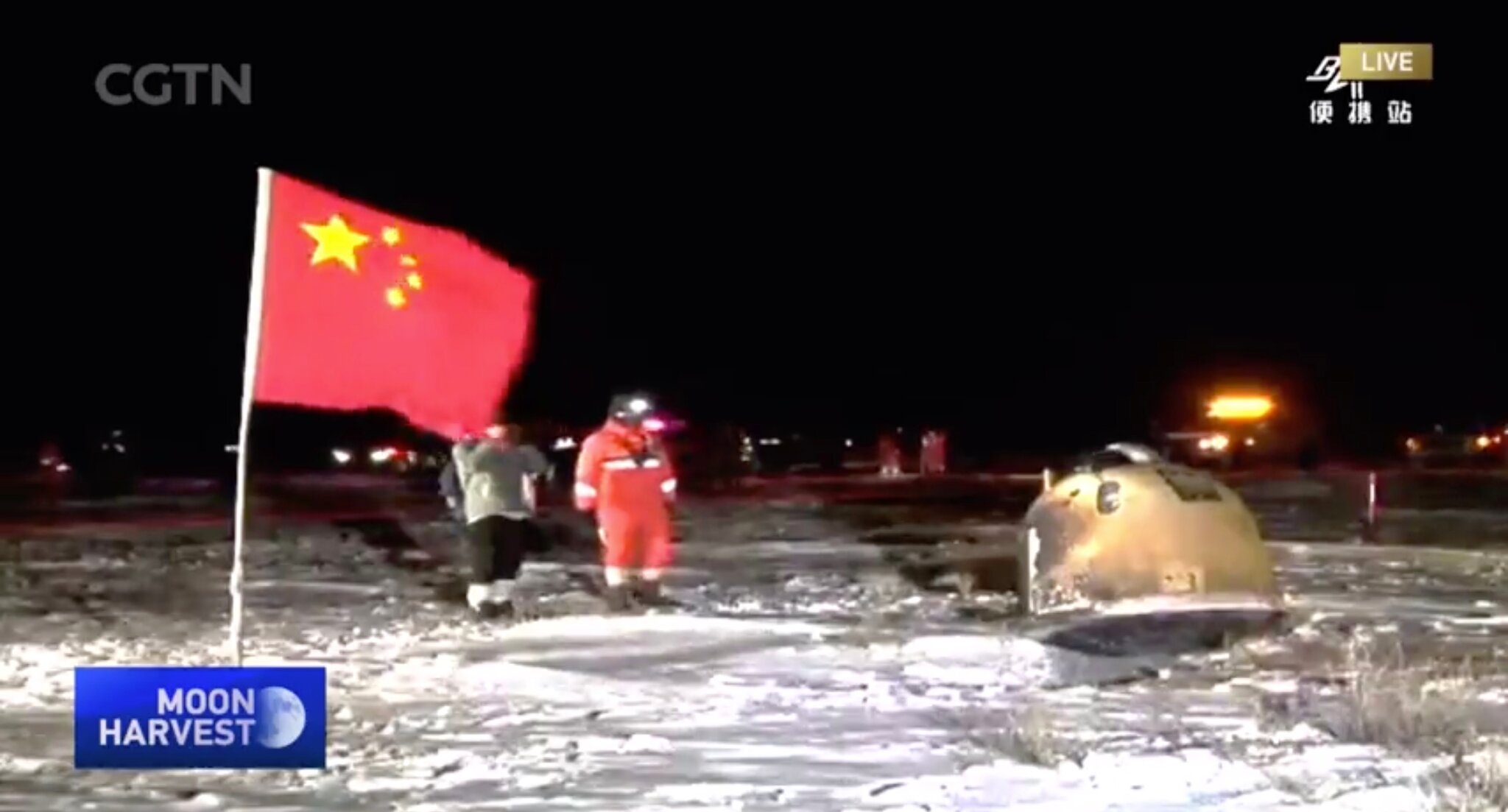
The samples were later transferred to the Earth return capsule, which safely descended and landed in China’s northern Inner Mongolia Autonomous Region. The successful execution of this complex mission raises hopes for the capabilities of China to eventually land humans on the Moon in the next few years.

Perhaps the most useful achievement from this mission is the in the study of volcanic activity on the moon’s far side, which is necessary in the wider understanding of the evolution of not just the moon but our solar system too.

The mission also led to the very first, and successful detection of negatively charged particles on the Moon’s far side. Experts explain that particles are produced when highly energetic solar wind particles slam the Moon’s surface and kick up secondary particles.

It is also inspiring that the instruments that made that detection belonged to European parties under NILS who collaborated with China on the mission, marking Europe’s first such collaboration with China. Lunar exploration is as such a uniting adventure, and we should work to keep it that way, for the long-term unity of humanity.

The China National Space Administration (CNSA) has also hinted on further collaborations with other world countries on space missions with the upcoming Chang’e 7 this year.  The orbiter is planned to carry a hyperspectral mineral mapping camera made by Egypt and Bahrain, a 3 kg instrument duo from Thailand to study solar storms and cosmic rays, and a Swiss AED radiation monitor to measure incoming and outgoing radiation to and from Earth. This will also be Egypt, Bahrain, and Thailand’s first missions to study of the Moon. The lander will carry a Russian lunar dust and plasma analyzer, a telescope from the International Lunar Observatory Association, and another retroreflector from Italy-based SCF Lab.

According to China’s plans, after Chang’e 7 helps scientists get a tactile sense of the true nature and accessibility of water ice deposits on the Moon’s south pole, it will launch Chang’e 8 in 2028, comprising a lander, a rover, and an operations robot, to collectively explore the local geology and environment with 14 instruments. The CNSA also aims to test technologies most relevant to sending crew to the Moon at the end of the decade using the Chang’e 8 mission.

China’s crewed Moon landing plan involves building a giant new rocket called Long March 10, capable of sending 27,000 kg of payload on a trajectory to the Moon, tripling China’s current best capacity from the Long March 5, from which the 10 is derived.

Following China’s first crewed Moon landing, estimated to happen in 2030, the country will focus on building the surface phase of the ILRS by 2035. Key to realizing this is a new super-heavy lift and eventually reusable rocket called the Long March 9. The rocket can put 50,000 kg of spacecraft hardware on a Moon-ward trajectory. Once the Long March 9 is operational, China intends to use it to deliver large amounts of cargo — and possibly even more crew — to the ILRS Moonbase. The rocket will deliver critical infrastructure via missions named ILRS 1 through 5, including infrastructure for energy, communications, transportation services (landers, rovers, hoppers, and ascent vehicles), scientific research equipment, and more.

Senior Research Fellow, Development Watch Center

China’s Rise as a Global Science and Technology Superpower

By Nnanda Kizito Sseruwagi

President Xi Jinping has articulated the strategy of China in the 21st Century as including adherence to science and technology as the number-one productive force, talent as the number-one resource, and innovation as the number-one driving force. China’s national-strategy is to be-the world leader in AI by 2030.

Today, the United States and other Western nations are no longer distant leaders in Artificial Intelligence (AI) research. Chinese Universities like Tsinghua and Peking publish more research on AI than any other academic institution in the world. In volume of publish AI research, China has the most highly cited and impressive papers. Chinese academic and research institutions publish almost five times more AI papers than the U.S. and more than the U.S., U.K., India, and Germany combined.

China’s investment in fundamental technologies like bioscience and cleantech is peerless. By 2008, China had overtaken the U.S. in number of PhDs produced, while at the same time producing double the number of STEM PhDs than America. Since 2020, China’s R&D spending is 90% of the U.S.’s, and it remains in a distant lead on the number of patents applications registered.

China has more of the world’s top 500 supercomputers than any other country in the world. China is home to the BGI group – one of the world’s leading life science and genomics organizations. BGI has extraordinary DNA sequencing capabilities and capacity, employs thousands of scientists, and holds vast reserves of DNA data and computing capacity. The rest of the world altogether has fewer robots than China. In terms of technology, the U.S. is several years behind China’s supersonic missiles development. China remains the world leader in 6G communications and photovoltaics – the technology that converts of light into electricity using semiconducting materials. China’s expertise in quantum computing is also notable. Since 2018, China has filed twice as many patents in quantum technology as the United States.

In 2016, China launched the Quantum Science Experiment Satellite. The Quantum Experiments at Space Scale (QUESS) project was designed to facilitate quantum optics experiments over long distances to allow the development of quantum encryption and quantum teleportation technology. Under this project, China sent the world’s first quantum satellite, Micius, into space. Micius is expected to provide a more secure communications infrastructure.

In 20117, China built a two-thousand-kilometre quantum link between Shanghai and Beijing for transmitting secure financial and military information. The country is also building the National Laboratory for Quantum Information Sciences in Hefei, which will be the world’s biggest such facility. Hefei scientists even claimed to have built a quantum computer that is ten times faster than Google’s Sycamore superconducting quantum processor.

The persistent stereotype against China, circulated by the West, was that China is just good at mimicking, lacks creative capabilities and is too restricted for transformative ingenuity. All this turns out to have been wrong. China has instead emerged as a contemporary titan of science and engineering.

In the field of synthetic biology, China is also leading innovative medical applications. In 2025, the Children’s Hospital of Fudan University in Shanghai successfully treated a 4-year-old Pakistani girl with severe thalassemia. Using Chinese-developed gene-editing drug, her dependency on blood transfusions ended and she has returned to living a normal life. The treatment used a base-editing drug called CS-101, designed to target severe beta-thalassemia. Professor Zhai Xiaowen, in collaboration with CorrectSequence Therapeutics, a Shanghai-based biotech company, had launched the clinical research project in 2023.

Chinese scientists have showcased the possibility of integrating AI with synthetic biology to speed up innovation. They have reduced the process of designing novel proteins to weeks rather than months, and there is potential applicability for these lad-ready proteins in drug development, diagnostics, and other biotech tools. China’s advances cell and gene therapies are also top notch, ranking the country second globally. By 2020, it had conducted approximately 1,000 clinical trials, targeting diseases like cancer, HIV, and hereditary disorders.

The field of nanotechnology is also being conquered by Chinese researchers. Recently in June 2025, researcher at the College of Integrated Circuits and Micro-Nano Electronics at Fudan University in Shanghai harnessed the mineral tellurium to create nanowire implants used in a biocompatible device that restored vision in genetically blind mice as well as a monkey, while giving them the ability to see “invisible” light. By this innovation, China has been able to not only create an artificial retina that restores sight but one capable of giving super vision – the extraordinary ability to see infrared light.

The author is a senior research fellow at the Development Watch Center.


US tariffs on Chinese EVs

By Talwana Ernest

On October 4th, 2024, the European Union, in line with US tariffs on Chinese EVs, voted to place tariffs on the same. This is a growing trend courtesy of the perceived threat of Chinese EVs disrupting Western markets and creating stiff competition with Western manufacturers who lack the production capacity of domestic Chinese car manufacturers.

However, these tariffs are par on course with growing western anxiety towards the behemoth that is Chinese manufacturing which has proven an unshakable force against growing Western tariffs. Outside markets like the EU and North America, Chinese EVs have popularity in larger economies in South America including nations like Brazil, Chile and Argentina, as well as a loyal middle-class customer clientele in South East Asia and mainland China itself.

In Europe as well, the voting pattern of EU members shows that not everyone agrees with imposed tariffs, Nations like Luxembourg, Sweden, Portugal and Spain abstained from the vote to impose tariffs while Germany and Hungary voted outright against imposing tariffs on Chinese EVs. It should be noted that Germany has a strong relationship with China in the automotive sector, especially due to its reliance on Chinese materials and Volkswagen, a leading German car manufacturer having a huge shareholding from China. Equally, BYD ( a Chinese EV carmaker) is establishing a plant in Hungary, which would provide plenty of jobs to the Central European nation that is seeking to limit emigration to the West by its younger populace.

Western consumers are equally receptive to Chinese EVs due to their relatively cheaper prices. Norway, a non-EU member but a member of the EEA is a particularly friendly market for Chinese EVs as the Norwegian government seeks to transition towards green mobility which includes electric and hybrid vehicles.

Generally, Western attitudes over the past decade have been towards the transition to cleaner and smarter energy which has less toll on the environment. This has spurred on a whole industry of smart technologies and vehicles in particular in an effort to combat climate change. Majority of Western car manufacturers have taken on this task with the creation of hybrid vehicle options. However, as aforementioned, industrial capacity in the West pales in comparison to Chinese industrial might which has near quadrupled Western European Industrial Capacity.

The above-mentioned tariffs can thus be perceived as a creature of American trade conflicts with an emerging power in the East. China presents as a power which can spearhead the energy transition which has the potential to leave majority of the West behind in its wake. This is a product of both Chinese output as mentioned and a coherent Chinese government policy to promote Chinese industry to both its neighborhood in South East Asia and other industrialised high income states ranging from Australasia to the Americas.

American influenced sanctions therefore can be perceived as a means to stall the Chinese wave while building internal capacity to match Chinese output.

However, this does not seem to scupper Chinese innovation, which is growing stronger and finding ways to circumvent American and EU pressure. With BYD building plants in Mexico and Brazil, there is an effort to work around tariffs placed by Western actors. Equally, China filed a complaint with the WTO questioning the parameters by which the EU determined tariffs on Chinese EVs and questioning whether any transparency existed in setting said tariffs. Equally, in a circular circulated to EU members and Turkey, China seeks to query whether said subsidies are not discriminatory towards Chinese products which, according to vehicle reviewers, are produced to the same standards as Western vehicles. The Financial Times on 2nd March 2024 reported that Chinese EVs have been found to be more reliable than US and European EVs. Their charging times are often faster and display more durability. As evidenced by market preferences.

In such an environment, it is clear that Chinese manufacturers and the Chinese government are keeping themselves adaptable in the face of the West’s anxiety concerning Chinese innovation and industrial might. Western consumers are equally receptive to Chinese EVs, which underlines the futility of Western governments’ resistance to Chinese vehicles entering their markets.

In conclusion, it seems more than likely that this chapter of Chinese-Western industrial relations is not closed, as there are more than likely plenty of sub-plots unfolding on both sides of the aisle. China equally seems unfazed in the face of impediments from the West, choosing to push on with her objectives despite hurdles presented by Western governments. The next half of this decade will determine whether the above measures will yield much or, if the West is delaying the inevitable.

The writer is a Research Fellow at the Development Watch Center.

China’s clean energy excellence: Reflecting on Kiira Motors

By Nnanda Kizito Sseruwagi

It is said that when you owe the bank one million shillings, you have got a problem, and when you owe the bank 1 billion shillings, the bank has a problem. The narrative of China’s Belt and Road Initiative (BRI) as a “debt trap” for developing nations has gained significant traction. However looking specifically at Uganda’s case with Chinese investment reveals a more nuanced picture, where China’s infrastructure investments are fostering sustainable development, not financial suffocation.

Contrary to popular belief, China can not pack up an airport or Hydro dam and ship it to Guangzhou. Aside from the physical extremities that such an ambitious project would demand there’s no provision in international and diplomatic law that would sanction such a venture.  With such a precarious state of affairs China is one of the few of our development partners who are genuinely rooting for our success because that is the only way they can ever recover their loans and get out of the “debt trap” we have put them in.

This is probably why Chinese investment in Uganda is always geared towards parts of the economy that compound development. Uganda, like many developing countries, faces a significant infrastructure deficit. Limited access to reliable power,transportation networks, and communication technology hinders economic growth and social progress. China’s BRI steps in by offering loans for projects that directly address these needs and Chinese state affiliated companies also occasionally tender cost effective bids for the projects.

Additionally Chinese projects in Uganda usually focus on revenue generation. Many of China-funded projects in Uganda, like the Entebbe Expressway or the Karuma hydropower dam, are designed to generate revenue and pay for their own setup cost.  Tolls collected from the expressway directly contribute to repaying the loan, while the hydro dam increases electricity production, leading to increased export potential and government income.

Our country’s debt-to-GDP ratio, while on the rise, largely  remains below internationally recognized thresholds for “debt distress”. The Ugandan government prioritizes responsible borrowing and actively works with international institutions to monitor debt sustainability. The Chinese government also does a forensic feasibility study on each and every project before it’s implementation because as I may have pointed out earlier, it is in the Chinese best interest to avoid bad debts.

This is why China implements a zero tariff policy on 99% of Uganda’s export goods. Since China is a manufacturing economy, it is in their best interest to make sure that the farmer in Bududa has got a good road connection to the agro processing factory in Mbale industrial park to add value to his products before being exported to China and the rest of the world because then he’ll have the disposable income necessary to buy Chinese manufactured goods. It is hard to get similar concessions from countries who’s biggest exports are “democracy and liberalism“.

Without the pomp and funfare with which many other development partners launch their collaborations with domestic players; China goes a long way in collaborating with Ugandan companies and individual players and provides training programs, fostering technology transfer and creating skilled local workforces. This is geared towards empowering Uganda to maintain and manage infrastructure projects in the long run, reducing dependence on external expertise. An outstanding example is that many of the Ugandans working in  the Tilenga oil enterprise have benefited from Chinese trainings many even going to China on full state scholarships.

In many ways Uganda’s collaboration with China devolves a lot from it’s usual bilateral relationships with its traditional development partners because this is a story of Collaboration, Not Control. The Ugandan narrative goes beyond simply acting as a conduit for surplus Chinese capital. It’s a story of collaboration, with Uganda actively negotiating loan terms and prioritizing projects that align with its own development goals. Uganda retains ownership and control over its infrastructure assets as well as its national economic/ political identity and outlook.

As Uganda and China’s partnership grows, focusing on transparency, environmental sustainability, and capacity building will be crucial. The evidence from past and ongoing projects suggests that China’s investments, when carefully managed, can be a powerful tool for accelerating Uganda’s development journey. We need to; beyond infrastructure and economic ties look towards a cultural synergy that can merge the Ugandan(African) spirit of community (Ubuntu) with the Chinese Confucian culture.

This reductive approach to China’s role in Africa fosters a more constructive dialogue, moving beyond the simplistic “debt trap” narrative and highlighting the potential for mutually beneficial partnerships that pave the way for a more prosperous future. For every false alarm ringing in Kampala, there should probably be a tenfold alarm in Beijing because if the bank has a problem when you owe it a billion, imagine how much more worried the Chinese should be who’s “debt-trap” is in the trillions.

Nnanda Kizito Sseruwagi is a senior research fellow at the Development Watch Centre.

China’s Collaboration Propels Uganda’s Internet Revolution: A Tale of Technological Transformation

By Yasiri J. Kasango

In recent years, Uganda has embarked on a journey towards digital transformation, with a strategic partnership with China serving as a catalyst for revolutionising the nation’s internet landscape. This collaboration, driven by a vision to bridge the digital divide and foster inclusive growth, has become a beacon of connectivity, propelling Uganda towards a future defined by innovation and economic prosperity.

At the core of Uganda’s digital revolution lie the monumental National Data Transmission Backbone Infrastructure (NBI) and Electronic Government Infrastructure (EGI) projects, spearheaded by China’s Huawei Technologies. This transformative initiative has witnessed the laying of fiber optic cables across Uganda, connecting major towns and government entities into a cohesive digital network. Funded in part by a $106 million loan from the Export-Import Bank of China, this infrastructure backbone has laid the foundation for Uganda’s digital future, facilitating seamless connectivity and enabling access to vital online services.

Dr. Aminah Zawedde, the Permanent Secretary for the Ministry of ICT and National Guidance, highlighted the significant progress made in Uganda’s telecommunications and ICT industries. In January 2024, Uganda boasted 13.3 million internet users, with an internet penetration rate of 27 percent. Dr. Zawedde emphasised that such advancements accelerate Uganda’s digital transformation agenda, improving communication and reducing the cost of doing business.

Moreover, the launch of Uganda’s Digital Transformation Roadmap in August 2023, anchored on the Uganda Vision 2040, underscores the country’s commitment to harnessing the abundant opportunities within the Information and Communications Technology (ICT) sector. The roadmap aims to strengthen the implementation of enabling policies and laws to accelerate Uganda’s Digital Revolution, providing an overarching framework for a well-connected Uganda that leverages various technologies.

The Ministry of ICT and National Guidance’s implementation of the NBI/EGI project has been instrumental in connecting major towns and government departments to an optical fiber cable-based network. Dr. Zawedde noted that over 12,000 kilometers of optical fiber cable have been laid across the country, laying the groundwork for further expansion and connectivity.

“Through this project, the laying of over 12,000 km of optical fiber cable across the country has been achieved,” said Zawede.

China’s technical and financial support has been pivotal in accelerating Uganda’s ICT development, according to Ugandan experts and officials. Kwame Rugunda, chairman of the Blockchain Association of Uganda, highlighted the critical role played by Chinese companies in establishing the core infrastructure of ICT. He emphasised the importance of continued collaboration and support from China for Uganda’s technological advancement.

“The core infrastructure of ICT is where the Chinese play a critical role, the backbone upon which everything else is built,” said Kwame Rugunda, chairman of the Blockchain Association of Uganda, in a recent interview with Xinhua.

John Nasasira, head of a national task force advising the government on emerging technologies, stressed the importance of connectivity across the country for leveraging ICT as an enabler for economic development. Nasasira emphasized Uganda’s reliance on technical expertise from countries like China as it strives to develop its ICT infrastructure.

Robin Bai, Chief Technical Officer of ZTE Uganda, discussed Uganda’s progress in adopting 3G and 4G technologies, with plans underway to launch 5G technology trials. Bai highlighted the role of Chinese companies in advancing Uganda’s ICT capabilities and bridging the digital divide.

In rural Uganda, where internet penetration remains relatively low, initiatives like Huawei’s DigiTruck project are making significant strides in promoting digital inclusion and empowerment. The DigiTruck, a mobile training hub, travels across regions, training youth, women, and small business owners in e-commerce and online research. Sandra Apio, a young farmer in the Katakwi District, expressed optimism about accessing online markets for her produce, thanks to the digital skills she acquired through the DigiTruck program.

“I am proud to say that the Huawei DigiTruck project plans to benefit over 10,000 people in a span of three years,” Yi Junsong, subsidiary board director of Huawei Uganda, said. “We hope that those who have benefited from these skills in this cohort can use them to improve their livelihoods. Just keep in mind that these skills you have obtained are to open up your minds to understand the importance of ICT (information and communications technology) and what it can do to improve yourself and your surroundings.”

Robert Otuke, a small business owner, shared how the DigiTruck training transformed his bookshop business by enabling internet usage for commercial purposes. He emphasised the impact of acquiring digital skills on improving livelihoods and expanding business opportunities in rural communities.

“Initially, we never had internet in our bookshop, but when I learned about using the internet and how it can make you money, we had to buy a simple Wi-Fi device. That thing helped us to commercialise internet usage in our bookshop,” said Otuke.

Ugandan Vice President Jessica Alupo commended Huawei for empowering the country’s youth and entrepreneurs through initiatives like the DigiTruck project. She emphasised the government’s commitment to involving more stakeholders in promoting digital inclusion and fostering economic growth.

The impact of China’s contributions to Uganda’s internet growth is evident in the statistics. According to data from the Ugandan Ministry of Finance, the number of internet users surged by 45% to 18.8 million in 2017, with active telephone and mobile money subscribers witnessing significant growth. This exponential rise in internet penetration underscores the transformative influence of China’s technological expertise and investment in Uganda’s socio-economic landscape.

Looking ahead, the collaboration between Uganda and China is poised to scale new heights, with plans underway to expand internet accessibility further nationwide. Through recent funding secured from the World Bank, Uganda aims to ensure universal internet access, with a focus on reducing costs and enhancing affordability, particularly in rural communities.

Initiatives like MiOne’s launch of smartphones assembled in Uganda exemplify the tangible outcomes of this partnership, providing citizens with access to affordable and quality digital devices. As Uganda charts its path towards a digital future, China’s partnership remains indispensable, catalysing innovation, growth, and progress. With a shared commitment to harnessing the transformative power of technology, Uganda and China stand poised to write a new chapter in their collaboration, one defined by connectivity, opportunity, and prosperity for all.

The writer is a research fellow at the Sino-Uganda Research Centre

Revolutionizing Cancer Diagnostics with Urine and Blood: China’s Story

By Dr. Ham Wasswa M.

The world of cancer diagnosis has witnessed a paradigm shift in the way cancer is detected and diagnosed. Traditional methods such as biopsy of tissue and costly imaging have dominated the medical world for a longtime.

However, the emergence of innovative techniques and the integration of cutting-edge technology have redefined the field. One such game changer is Targene Biotech Company in Huangpu district, Guangzhou, China which I and a team of the Development Watch Centre researchers visited during a seminar on Chinese Modernization and China-Africa Joint Development which was organized by China-Africa Institute (CAI). Targene Biotech, a pioneering and budding Chinese company is at the forefront of cancer diagnosis using urine and blood.

Cancer is a global health concern ravaging millions of lives every year especially in Africa. According to the World Health Organization (WHO), cancer is the second leading cause of death globally killing nearly 1 in 6 persons and approximately 70% of these deaths are from low- and middle-income countries.  The early detection therefore is very vital for successful treatment and outcome of the affected. The approach used by Targene is poised to transform the landscape of cancer diagnosis to make it more accessible, non-invasive and economical. Targene’s work holds a promise for the future where early cancer diagnosis is within reach for all. The incredible work at Targene Biotech is in tandem with WHO’s two components of early detection that is; early diagnosis and screening.

Targene Biotech Ltd., is the brainchild of Mr. Shao Jian Yong who is the current President and Chief Scientist of the company. He recognized the need for less invasive methods and cost-effective means of diagnosing cancer. He therefore set out with a team of researchers to explore the power of liquid biopsy especially urine and blood to detect cancer in its early stages. The concept of this biotech company is ingenious: cancer cells shed DNA fragments into bodily fluids carrying with them genetic information about the tumor. By analyzing these DNA fragments, scientists at Targene are able to identify specific cancer mutations and alterations associated with different cancer types including urinary bladder cancer, colorectal, cervical, liver, prostate and esophageal cancers. All that is needed is circa forty milliliters of urine sample to detect one of these cancers.

The advantages of targene’s approach includes but not limited to; First, non-invasive; traditionally, biopsies have been done and they are very painful. For example, the bone marrow biopsy. Targene’s method being entirely non-invasive, patient is free of pain requiring only a blood and or a urine sample. This without doubt, reduces patient discomfort and associated complications.

Secondly, early detection; targene’s tech is highly sensitive, capable of detecting cancer at its earliest stage when treatment can be most effective and survival rates higher. A 95% survival rate has been reported if detection is done early among the cancers mentioned.

Thirdly, by identifying specific genetic alterations, this allows for treatment to be tailored individually to their unique cancer profile; and the fifth is that the method being used by Targene is cost effective compared to the costly traditional imaging and invasive biopsy picking.

The clinical impact of Targene’s approach cannot be underestimated as the ability to diagnose cancer at an early stage is crucial since this often times leads to better treatment outcomes and for the most part, complete remission of the cancer. This minimally invasive approach makes it easily acceptable and accessible to a larger population. Early diagnosis is relevant in all settings and in its absence, patients are diagnosed late when curative options may not hold much water.

Targene’s technology has showed significant promise in detecting a wide range of cancers including breast cancer, cervical cancer, esophageal cancer, prostate cancer and liver cancer which are very common in our Motherland-Uganda. Cervical cancer is the leading cause of cancer in the African region accounting for 22% of all female cancers and 12% of all newly diagnosed cancers. This method is especially suitable for such cancers that are notorious and often asymptomatic in their early stages.

It goes without saying that Targene’s future is a bright one as well as other partners that will get on board to explore this game changer in the field of cancer diagnosis. Despite this, there are some hurdles that Targene has to jump to be able to achieve successful outcomes. As with any emerging technology, standardization and validation are crucial ensuring that the method is consistent and delivers accurate results. Technology must undergo rigorous regulatory approval processes in areas where it will be embraced and considered. Collaboration with health authorities comes in handy in this case. Affordability and accessibility for a wide range of patients remains a valid concern especially in Africa where economies are just developing. Achieving the highest level of sensitivity and specificity is essential to minimize false positives and false negatives. Amazingly, the chief researcher at Targene, Mr. Binjie Xu, reported that the sensitivity of this cancer diagnosis method is at 95% while the specificity at 89%. Despite these challenges, the future prospects are promising with potential for early diagnosis to become a standard of care in our oncological practice so as to have better outcomes. Since 2012, China set up policies on early cancer diagnosis and the goal was to reach about 60% early screening rate amongst its population. This was only slowed down by the COVID-19 pandemic. However, there is no turning back and Targene reports show that there is steady progress to achieve this target by 2035.

The clinical impact of Targene’s cutting edge technology is very vital for cancers like liver cancer, bladder cancer that are often diagnosed late and hence poorer outcomes. However, the field of cancer detection using non-invasive methods faces challenges as mentioned above. Nonetheless, Targene’s future is bright and will even be brighter if African nations partnered with her so as to have better clinical outcomes for its people. For Uganda, the journey could start with the Uganda Cancer Institute benchmarking at Targene Biotech in China so that together, we continue efforts of building a community of shared prosperity for future of mankind in the new era of cancer diagnostics.

Dr. Ham Wasswa M. is a medical doctor and a Research Fellow at the Development Watch Centre.

Email: hammatovu@hotmail.com


How U.S Tech Sanctions on China Present an opportunity for Africa

By Tarwana Ernest

As far back as 2019, the US placed sanctions on Chinese Tech Company, Huawei alleging spying and industrial espionage against US Tech companies. This led the Americans to place sanctions on Chinese Tech firms which subsequently led to subsequent Huawei mobile devices starting from their flagship P and Mate series being disabled from Google Android infrastructure. These events could be construed as a product of the US China Trade War.

Among others, the U.S has claims that the decision to sanction Chinese tech giant – Huawei is a result of the company’s tight collaboration with Chinese government and therefore cannot trust them in terms of security. Huawei strongly denies U.S’ accusation arguing that they are victims of America’s tech-nationalism which is meant to shield U.S tech firms from stiff competition Huawei is putting up using security concerns as a cover up. Beijing also accuses Washington of launching what they call unfair attacks against Chinese tech firms in what China sees as America’s efforts to contain China’s technology growth.

The U.S has also succeeded in convincing allies to isolate Huawei with the United Kingdom (UK) government blocking the tech giant from its G5 network rollout. While the U.S explicitly mentioned national security concerns as a reason for banning Huawei, in 2020, the UK’s security agencies concluded that any risk posed by Huawei was manageable. Indeed, while announcing the decision to side-line Huawei, then UK’s Secretary of State for Digital, Culture, Media and Sport, Oliver Dowden explained that London decided to lockout Huawei out of its market as a result of U.S’ sanctions against the firm which meant that Huawei could no longer use American chips in their kits.

However, China’s growth in the tech sector has hardly been impeded. Over the past few years, China has worked quietly to build internal capacity and wean itself off dependence to US firms. Huawei has been at the forefront of this progress.

Equally, Huawei infrastructure has aided most European countries in building their 5G networks. Some of these include Ireland, Portugal, Spain and Switzerland.

Due to the reputable nature of the Chinese firm and its infrastructure, this presents an opportunity for African nations to look aggressively towards China in building their data infrastructure and connectivity.

South Africa has been at that forefront after the recent BRICS Africa Summit, 2023. This including signing bilateral agreements with Huawei to build South Africa’s data infrastructure. If all goes according to plan, South Africa will be one of the few African nations with the most robust 5G networks on the continent.

The Chinese firm also partnered with Saudi Arabia to build cloud data centres serving the Middle East, Central Asia and North Africa. This presents a chance for African nations to liaise with Huawei in having their data held closer to the continent. In the near future, an African country with capacity could ewaully position itself to host data centres serving the continent or a particular region.

African nations can equally rely on Chinese Tech infrastructure to push for bilateral deals to encourage technology transfer which aides education and innovation on the continent. This can be through setting up innovation hubs and subsequent educational scholarships for students with interest and desire to harness their talents in a technologically advancing world. China presents itself as an opportunity for African youth to build indigenous expertise by learning from an advanced economy with historic links to the continent.

While U.S’ is still trying to convince more countries including in Africa to follow their suit and disengage from Chinese tech firms, African countries should not join this loosing battle. They should grab any opportunity should Chinese tech firms show readiness to work with them.

According to a paper published by Carnegie Endowment for International Peace, which is ranked as the world’s third most influential Think Tank, the formerly technological giants; “Japan and the United States have watched warily as China’s economic heft has grown and as the technological sophistication of its manufacturing base has increased” leaving the U.S worried that Beijing may soon overtake Washington in this important technological revolution. The paper concluded that presently, apart from China, no other country on its own can outcompete China’s determination in technology advancement and suggested that for the U.S to make it, they must form alliances with other like-minded countries as Japan and “update their decades old technological cooperation and deepen funding pools on certain shared strategic priorities, such as artificial intelligence and quantum computing”.

As James L. Schoff, a senior fellow in Carnegie observed; “fear of “losing” this competition (Technology) is fuelling an unprecedented scale of investment and a zero-sum mentality that could tempt countries to overreact in ways that would damage their national interests and broader global interests,” stressing that it is better to work with China than in technological advancement than attempting to isolate them.

To conclude, China’s trade conflict with the West presents a chance for Africa to develop her data and technological infrastructure with the aid of Chinese tech firms. This does not mean that if the West presents a fair proposal to support African countries technology adavancement support they should not take it. What must be avoided is U.S’ tendence of attempting to force other countries to deoulple from China’s techology.

Talwana is a Digital Research Fellow at the Deevelopment Watch centre.