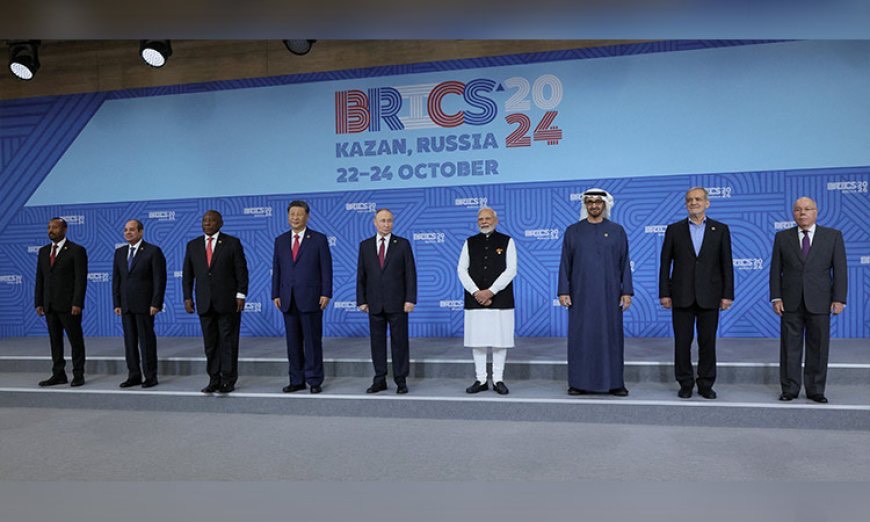
2024 BRICS Summit: Geopolitics, Geoeconomics and Supply Chains; the Group to Set New World Order

By Musanjufu Benjamin Kavubu

Many experts have reduced BRICS to a mood, Economists are even saying dollarisation is a myth for left sympathisers and a new enchantment for the global South. Those who take it seriously see it as a threat to the World Bank and the IMF, the former dealing with short-term development plans across the world and the latter dealing with long term fiscal policies, this sets the dollar as the global leading currency and a tool for Western hegemony.

The USA’s economy is based on their military might and NATO. As the world changes there have been many developments and to counter Western led multilateral groups the global South has BRICS, which as of 2023  expanded to 10 countries.

The current BRICS Summit is today 22nd to the 24th of October 2024. For starters it’s reported that 34 countries in one form or another have applied to join the group. The is being viewed as a counter to the G7 and it’s taking even a grander shape on the security front which is a key pillar of its founding.

From the 10th of September to the 12th 2024 the Russian President Vladimir Putin hosted a meeting of National Security Advisors of all the members of the BRICS and that meeting was under the organization’s Political and Security Pillar of Cooperation. There are about 53 conflicts raging in the world today, the Russia-Ukraine and the Israeli brutal occupation of Palestine are the most outstanding causing seismic Geopolitical shockwaves world over. These conflicts disrupt global supply chains that are very vital to globalization in terms of trade especially amongst BRICS and the global South.

Let’s understand what Supply Chains and Geopolitics are first. A supply chain is the network of organizations, people, activities, information, and resources involved in the creation and delivery of a product or service from the supplier of raw materials to the end customer. It encompasses all the processes involved in sourcing raw materials, manufacturing, logistics, distribution, and retail, including the management of these activities to ensure efficiency, cost-effectiveness, and customer satisfaction. Basically the definition of Supply Chains can be swapped for the essence of the Belt and Road Initiative by China that is now a decade and has facilitate development of the world in general.

On the other hand Geopolitics that refers to  how geographical factors, such as location, natural resources, and physical terrain, influence the political power, decisions, and relationships between countries basically international relations. Geopolitics is how nations use their geographical advantages and go about challenges to pursue economic, military, and strategic goals on the global stage. If you look at the foundation of BRICS, you will notice how geography affects global politics and international relations.

Security situations throughout history have proven far and wide effects across the world, effects on every aspect of life, from social to economic. And in the last about 24 months there have been military drills amongst BRICS members aimed at safe guarding trade routes and ensure smooth flow of supply chains that are vital for humans civilization. In 2023 the Russian and South African Navies got together for a drill, in the Second quarter of 2024 the Russian Navy conducted drills with Cuba a vital global South country and very recently the Chinese Navy joined Russia for the Ocean 2024 drill. These drills are aimed to prepare for eventualities that may affect sea trade routes, that’s why they were conducted in the Arctic, Mediterranean, Pacific, Caspian and Baltic water ways.

The world geography has these areas that are prone to military and naval blockages during times of conflicts. Areas like the Strait of Hormuz controlled Largely by Iran and BRICS member in the Middle East, connects the Persian Gulf to the Arabian Sea vital for global oil supply a lot of it ending China. It one the reasons China had to bring Saudi Arabia and Iran together through its Global Security Initiative GSI for normalizing diplomatic relations. The Strait of Malacca connecting the Indian Ocean to the South China Sea, essential for trade between Asia and Europe. The Suez Canal that connects the Mediterranean Sea to the Red Sea helping to bypass the longer route around Africa. The Bab el-Mandeb Strait  between Yemen and Djibouti, connects the Red Sea to the Gulf of Aden, vital for shipping between Europe and Asia, has almost all major Navies operating in the area.

The Panama Canal that Connects the Atlantic and Pacific Ocean, Bosporus and Dardanelles Straits in Turkey a member of NATO but also seeking BRICS membership bridges the Black Sea to the Mediterranean, vital for Russian and Eastern European exports. The Cape of Good Hope on the South African coast serves as an alternative route if the Suez Canal is blocked, crucial for global trade. The Lombok Strait in Indonesia which is an alternative to the Strait of Malacca. All are Geopolitical chock points that are pivotal to global supply chains.

As the new world order faces off with the Western hegemony and developments like the BRICS bank being formed to counter the Bretton Woods another aspect is brought into play. Which is Geoeconomics that is basically about how countries use economic tools, policies, and strategies to advance their geopolitical goals. These tools range from trade agreements and investments for example the $ 50 Billion announced at FOCAC 9 in Beijing, to control over vital resources, like energy or rare earth metals.

Economic strength is a powerful asset in shaping global political power and achieving strategic ambitions. Sadly the West led by the USA and the whole EU see sanctions as the best tool to further this endvour. Today USA sanctions are used to disrupt global South supply chains which hinders development. It’s through embargoes that supply chains have taken the hit affecting even the most basic of traders in your local market to all kinds of consumers.

Supply Chains controls and disruptions even take extreme measures for example the latest case of Israeli operations in Lebanon, when a whole supply chains was compromised to plant explosives across the country.

The cross roads of supply chains, geopolitics, and geoeconomics is going  to shape the Multipolar world order, and the BRICS formation as a counterbalance to Western hegemony. Its going to take everything for example naval drills and economic partnerships. Multipolarity is going to redefine everything. The current situations, mostly driven by the West, show how supply chains are no longer just about movement of goods but affect every aspect of modern human civilization.


Benjamin is a research fellow at the Development Watch Centre.


FOCAC 2024: Tracing the origins of constructive China-Africa Cooperation

By Ernest Jovan Talwana

Since 2000, the Forum on China-Africa Cooperation (FOCAC) has been a constructive multilateral platform for China and African countries to conduct symbiotic cooperation. Let us trace the origins of this forum, which is most certainly one of the most consequential summits for African states as far as addressing pertinent challenges, and opening doors to our individual and collective development is concerned.

Following centuries of mutual cooperation, FOCAC was established jointly between African nations and China as a high-level Sino-African relations mechanism at the beginning of the 21st century.  FOCAC sits on a strong foundation of organic relations, unadulterated by the imperialistic undue influence of China over Africa, unlike Western powers.

When China opened up in 1978 under Deng Xiaoping, it experienced one of the fastest levels of economic development ever registered in human history.

It was thus ripe to venture more exponentially into Africa by the early 1990s. By mid 90s the Chinese economy had sufficiently matured and could afford to extend subsidized concessional loans to enable Chinese businesses to compete in the African market. Around the same time, the Chinese leader then, Jiang Zemin visited half a dozen African countries and made a speech at the headquarters of the Organization of African Unity (OAU), articulating a five-point proposal for the development of “a 21st century-oriented long-term stable China-Africa relationship of all-round cooperation.”

Recovering from the Cold War bickering among Western powers, a number of African countries took the initiative to propose the establishment of a form of China-Africa multilateral cooperation. They had experienced cooperation with other foreign countries for long without any practical, tangible benefits, and had also grown weary of lectures on governance from their former colonial masters and oppressors.  On the other hand, African nationalists in various countries had been supported by comrade Mao Zedong and the Chinese people to fight against Western imperialism during the struggle for independence. China had also emerged as a towering example of transformative leadership which saw them beat centuries of industrial development in less than fifty years. As such, their development experience was most inspiring for poor, agrarian African economies. Many African countries therefore started looking forward to joint development with China, hoping to turn the scales at home too.

When some African countries put up a proposal to China asking for a cooperation mechanism, China responded by organising a conference that would value African countries’ wishes, consider the unique political economy in Africa, focus on practical results, and strive for joint development. It thus invited foreign ministers or ministerial officials in charge of international cooperation or economic affairs to the conference in 1999.

At the conference which was popularly attended by African leaders, the working documents agreed on reflected nuanced differences between the FOCAC and other international mechanisms for cooperation with Africa. The FOCAC document put a high premium on the opinions of African countries, for the first time respecting the kind of development support Africans deemed for themselves, unlike the previous dictates they would get from Western similar mechanisms. There was also a deliberate effort to ensure that there were realistic execution mechanisms to achieve practical results from the initiatives discussed at the conference.

This inaugural conference held in 2000 in Beijing led to the adoption of the Beijing Declaration of the Forum on China-Africa Cooperation and the Program for China-Africa Cooperation in Economic and Social Development. This was the first step on a long journey of establishing a stable partnership of equality and mutual benefits in the 21st century between the two parties.

It is now already 24 years down the road since that step was taken. Within that time, several African countries have doubled their trade volumes with China. Africans now trade more with China than all Western countries combined. A number of them have also experienced a steady growth of the economy, including Uganda which has grown at a rate of 6 per cent per annum for over a decade.

This transformation has been partly aided by initiatives agreed upon in the different FOCAC summits. For instance, China has over the years relieved the outstanding debts of African governments, and also issued interest-free loans to avail them of long-term development finance. It has also trained the African human resources, helping African countries improve their communication infrastructure by education engineers, as well as training experts in other fields such as education and health.

If there is anything to learn from the FOCAC 2024 Summit, it is that there is a deepening relationship between China and African countries. This relationship is healthy because of its unique characteristics mutual benefit, mutual respect, and a sense of shared prosperity and a common future. This has set an irrevocable trend in partnership. The practicality of results from this relationship raises the bar high for Western development partners who are constantly involved in self-righteous lectures on how Africans should govern themselves.

The writer is a research fellow at the Development Watch Center.

CCCC’s Environment, social and Governance Report; Tightening the Knot of Uganda-China Economic Cooperation

By Moshi Israel

The China Communications Construction Company officially launched its 2023-24 ESG report on October 17th 2024 at Silver Springs Hotel in Bugolobi. The event was graced by a number of key guests from the corporate world and Governments of both countries. China at the highest level was represented by his Excellency Ambassador Zhang Li Zhong while Uganda was adequately represented by the Minister of Finance, Hon. Matia Kasaija, the Hon. Mwebesa Francis, Minister of Trade, Industry and Cooperatives and the chief guest; Vice President of Uganda her Excellency Jessica Alupo represented by the Hon. Lukia Isanga Nakadama the third Prime Minister and Minister without portfolio of the Government of Uganda.

The report comes at the heel of increased cooperation between Uganda and China that has seen the latter become one of the biggest investors in Uganda’s economic development. Just recently the IMF acknowledged that Uganda’s economy will continue to grow at a high rate and in double digits. This success can be acknowledged by many Ugandans to be in no small part a spillover effect from the numerous investments from China. The CCCC is one of many such companies that have contributed to Uganda’s continued economic success.

In a more specific way, CCCC has its name chiseled in many iconic infrastructure projects in Uganda including the Express high way and its breathtaking Nambigirwa bridge, The Entebbe International Airport, The KBE project in Kampala and many other road networks around the country.

The ESG report is perhaps one of the most important yardsticks to measure a company’s true success. This is because this is where the ethics and moral standing of a company are truly weighed beyond the profit making. CCCC has effectively incorporated Environmental stewardship, Social Responsibility and Governance and ethics at the center of their operations culture. ESG ensures that a company’s activities go beyond profit making and support sustainable development that does not come at the expense of the environment and human rights.

CCCC Uganda currently has 26 ongoing and planned projects valued at $1.7billion. The company operates across numerous sectors and is involved in the construction of highways, bridges, Airports, water supply and factory construction. It has led other companies for four years straight in the Chinese Chamber of Commerce in Uganda. The company is engaged in charitable activities including contributions to SOS orphanages. Additionally, CCCC Uganda has also played a major role in the advancement of Uganda’s education sector where they have signed an MOU with Makerere University and Wuhan City Polytechnic aimed at creating a model school-enterprise cooperation. They also launched the seagull Talent Training project to cultivate ‘internationally minded professionals with specialized skills for Uganda’s future.’

To put the achievements of CCCC Uganda into perspective, one has to point out that the company has completed 16 projects, has accumulated 1000km in construction mileage, has led to an 80%+ portion of Ugandan employees participating in construction whilst creating over 10k jobs. Much has to be done but CCCC is actively on the right track and serves as an example of investment gone right. For many years, developing countries have been faced with a problem of ‘unserious’ investors who are mostly crooks looking for a quick buck. However, the tide is ever so slowly changing and the government is increasingly looking in the right places to find genuine investors with a proper international standing.

Furthermore, what CCCC is doing also reflects well on China as a country and is in line with the 10 Action points emphasized by President Xi Jinping during the Beijing Summit and Ninth Ministerial Conference of the Forum on China-Africa Cooperation (FOCAC) held in September. Some of President Xi’s points of emphasis were on Green Development and connectivity. CCCC is actively contributing to these action plans by engaging in construction that is friendly to the environment and building extensive road networks under the umbrella of the Belt and Road Initiative.

Going forward, the Government of Uganda should continue to develop a strategy that increases the trust of international investors in the profitability, stability, security and sustainability of doing business in Uganda. Once the message is out there that Uganda is safe and open for business, more companies like CCCC from all over the world will continue flocking into the country and contributing significantly to its economic growth. Just like CCCC has been a good representative for China, Ugandan citizens and Businesses can be great ambassadors for the country everywhere they go. The ESG report has shown us how much of an impact a foreign company has had on the economic and social progress of our country and now the ball is in our hands.

The Writer is a Senior Research Fellow at Development Watch Center.

China at 75: What lessons can Africa Draw from People’s Republic of China

By Musanjufu Benjamin Kavubu

On the 1st of October 2024, China celebrated its 75th independence day. Seven (7) decades back, it was Ethiopia that was never colonised and its flag inspired almost all West African flags, Liberia that was set up in 1847 by a United States Secretary of state, Egypt, Libya, and Sudan that had attained their independence. Most African countries gained their independence in the late 1950s and 1960s meaning around the same time when the China we see today started taking shape after being used as a second world war battle ground because Japan had occupied most of the country and United Kingdom had interests in its coastline.

After devastating wars to expel foreign influence and dominance and a very brutal civil between the Communist Party of China (CPC), led by Mao Zedong and Kuomintang (KMT) forces, led by Chiang Kai-shek, that ended in 1949. The CPC went a head to established the People’s Republic of China that we know today.

Today the school of thought especially in the resurgence and renaissance of Pan Africanism is that African Problems should be solved by Africans through African solutions researched by African scholars and institutions. This is true because Africa is unique and the Chinese Global Civilization Initiative Model does advocate for such a pathway to a shared future for humanity. It also explains why the Chinese model of Maoism or Communism with Maoist principles was adopted from Marxism-Leninism.

African Renaissance will mostly likely be characterised by Ubuntu and nativism, as driving values of economics, society and governance from a pragmatic point that will be driven by academia and the resultant policy. The Chinese through the 75 years of lived experience can offer Africa the blue print. There is a lot we can learn from them and through partnership instead of an alliance can have a shared future too.

From the independence decade of Africa of 1960-1970 the continent saw war after war, Civil wars, insurgencies, and interethnic violence. Africa has been plagued by a gun culture that was introduced during the 400 years of slave trade and sadly it continues up to now. Out of the about 53 major conflicts in the world by 2024 about 15 to 20 are on the African continent, for example in Sudan, Ethiopia, Democratic Republic of Congo (DRC), Mozambique among others. Of course there is hope that these will stop since most of the fighting is being fuelled by forces off Africa. As a continent we need to pause and find out how much we invest in war because our counterparts in China even with a strong military are mocked for having no battle experience simply because they don’t have the thirst for war and they have made that clear, in their Global Security Initiative (GSI) model they used to end the cold war between Iran and Saudi Arabia.

Africa is trying to build the African Continental Free Trade Area (AfCFTA) to connect the continent, promote unity, trade and alleviate poverty. China has lifted 770 million people out of poverty according to world Bank data, which is 75% of the world’s poverty reduction, this is something that as a continent we should look into because at the moment this continent is estimated to have about 1.5 billion people and about 490 million live on less than $ 2 a day. The numbers suggest we too can easily reach the Chinese mark.

China through its Belt and Road Initiative (BRI) is funding the construction of roads, railways, deep sea ports, airports and other transportation hubs across the African continent, back in China their record over the 75 years has been 5.4 million kilometers of roads, 160,000 kilometers of railways, and 38,000 kilometers of high speed rails across China, surely this is commendable and something worth copying to make Africa connectivity a thing instead of a dream.

What is the likelihood that you are reading this article from a Chinese produced device, today even European and American firms run to China for manufacturing, the blue print is in place and Beijing has availed all these through their Global Development Initiative (GDI), an opportunity for Africa to have its own industrial revolution after all we have the raw materials and the potential for support infrastructure to also be a global player in manufacturing.

China was a poor as Africa 75 years ago and it’s the second largest economy, they are leading in electric vehicles putting them at the forefront of Renewable energy technology an area that many African countries have explored already. China is leading in space technology and aeronautics and astrophysicists say the equator is important in this sector, meaning Africa can just jump into the field and thrive.

Over the past seven decades, China’s diplomatic capacity has grown through the setup of comprehensive bilateral relationships, active participation in multilateral organisations like BRICS, and initiatives like the BRI, which promote global trade and infrastructure. China’s role as a major contributor to UN peacekeeping missions even on the African continent, promotion of soft power through sports for example, the term Bird’s Nest is synonymous with the 2008 summer Olympics in Beijing and save for South Africa, Africa is yet to host a major sporting event for the last 70 decades yet the continent boasts of the talent in sports and leisure a major cultural aspect of life. China’s involvement in crisis management and international negotiations on issues like climate change further demonstrate its growing influence and commitment to global governance and stability and its this table that Africa needs a seat too.

With a young and promising academia like China was 75 years back, research should guide African policy making. African governments and the African Union can, just like the State Council of the People’s Republic of China and Politburo of the Communist Party of China and its Standing Committees be dedicated to improving the well-being of African people, invest in development instead of warfare to attain that shared future that the world deserves.

As China enjoys its 75th independence festivities Africa can look on and pick ideas to make Africa solutions by African a reality.

The writer is a research fellow at the Sino-Uganda Research Centre