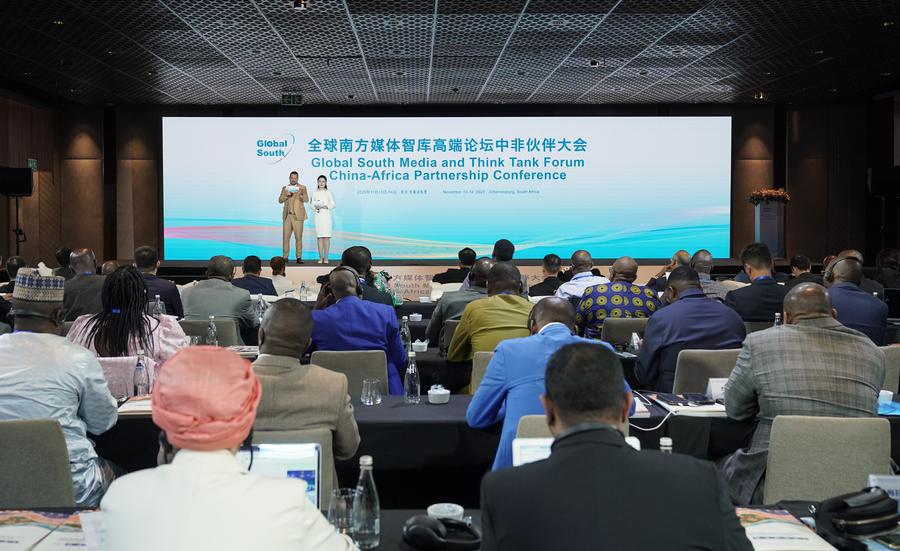
The Global South Media and Think Tank Forum China-Africa Partnership Conference which was held in South Africa-Johannesburg on November 13, 2025, was a perfect step made at a perfect time. For some bold reasons as elaborated below, I will confidently say that this is yet another great step of China-Africa partnership whose results must help a lot to shape Global diplomacy.
Reechoing the words of America’s author and entrepreneur, Amy Jo Martin, “ Social media is the ultimate equalizer. It gives a voice and a platform to anyone willing to engage,” I can emphatically say that social media had ruined and is ruining global diplomacy and such a conference, plays a big role in restoring order.
For instance, the conference whose theme was “ Reforming Global Governance: New Roles and Visions for China-Africa Cooperation,” the conference’s main target was to analyze how the collaboration between media and think tanks could result into a better-for-all global governance.
This implies that the conference created enough room for mass awareness of the roles of think tanks vis-à-vis media, especially print media like newspapers. Culturally, newspapers have been one of the most dropped sources of providing information over the ages as civilization advances. This has made the print media to be left aside for a few elites, topped by digital media like TikTok and Facebook. This ultimately points out the view that the conference’s masterminds identified a crucial problem of information disorders largely engineered by digital media.
The simplest response to the why-question that has popped up into your mind especially after my opinion on digital media is; the reading culture is decaying. People, especially the biggest percentage of the world’s population which is made up of the youth prefer scrolling up and down on their devices to watch short videos for information, and tapping other pieces of information from platforms like Facebook than reading newspapers.
How this is a constraint to global diplomacy can easily be seen through the lens of foreign policy, aware that foreign policy feeds global diplomacy. As reflected in the words of Amy Jo earlier, social media especially digital media, “ Gives a voice and a platform to anyone willing to engage.” This makes it the easily manipulated type of media because “anyone” is given a voice and platform to engage. It does not matter whether you are academically qualified to discuss pertinent issues as long as you are able to speak. This trend cannot be found within the print media where think tanks and media houses must write and research in order to provide thoroughly analyzed and well backed up information.
Two forms of information disorders heavily influence how information trends under digital media because it is often mishandled in the name of “content” yet it is greatly consumed by the biggest number of audiences who believe that such information is true without verification.
Misinformation is the biggest problem in Uganda and it greatly affects diplomatic ties of several countries. This is where the information being spread is false, but the person disseminating it believes it is true. In other words, they also do not know if the information is true or not, but for the love of likes from the audience, they go ahead and circulate such information. Remember social media gives a voice and platform to “anyone.”
I cite China-Uganda relations as a key example where social media has for some good number of times sabotaged the relations of these two states. In 2021, earth-quaking headlines emerged on various social media platforms and on social media handles of prominent bloggers in Uganda. The invalid but widely believed news that Chinese bank had taken Uganda’s only international airport spread like wildfire.
The misinformers picked on an interesting bit of information, clung on it, and made the public to believe them. HUEN—which is an International Civil Aviation Organization location indicator code for Entebbe international airport, became their mask of support. Since the airport had been expanded to fit the international standards with the help of loans from the Exim Bank of China under the Belt and Road Initiative, upon its completion, the airport gained that code.
However, to the misinformers, the code sounded like a Chinese name replacing “Entebbe”. Maybe we could say “Chen,” one of the commonest Chinese names. Little did they know or bother to make research to realize that each letter in that code implies something. For instance, “H” is a locator for all airports in Africa according to ICAO. “U” indicates Uganda as the main location of the airport. “EN” represents the real name of the airport (Entebbe) since ICAO normally uses the first two letters of the airport to award it a code.
Such information was easily believed owing to the nature of the code’s pronunciation and given the fact that by then, the Western narrative of “debt trap” slapped against China was waving across the globe.
With disinformation, where the information is false and the person disseminating it knows it, but intentionally goes ahead to lie, is also common. We can refer to the previous example. Since 2021 was a season of politics in Uganda, some political opportunists saw this as an advantage to achieve their agendas. Of course, this affected the least informed biggest percentage of people on ground who depend on social media as their source of information.
Previously, the same issue has reappeared. On 17th August 2025, President Museveni comissioned the Wagagai gold mining project in Busia District. The project is believed to achieve 99.9% purity in gold processing locally and create over 5,000 jobs for Ugandans. To achieve this, Uganda collaborated with China, seeking provision of capital-intensive infrastructure and resource extraction projects to secure access to critical minerals, foster economic ties, and promote local value addition. However, bloggers were too quick to say that a clique of people in power were secretly selling gold to China.
This was based on the assumption that there was little information available about this project. Little did they know that official handles of China’s embassy in Uganda had already provided this information. The only problem was—such information was provided on twitter where there is fewer audience unlike on Facebook and TikTok where the audience is big and exploited by bloggers.
Therefore, the Johannesburg conference was remarkably important for letting the audience know of other sources of information like think tanks where one can find trusted information. It also gave a green light to think tanks to know that they are also trusted pillars to the media towards shaping coherent and inclusive global diplomacy. In the end, this will not support China and Africa alone, foreign policy feeds global diplomacy.
The writer is a research fellow at the Development Watch Centre.