
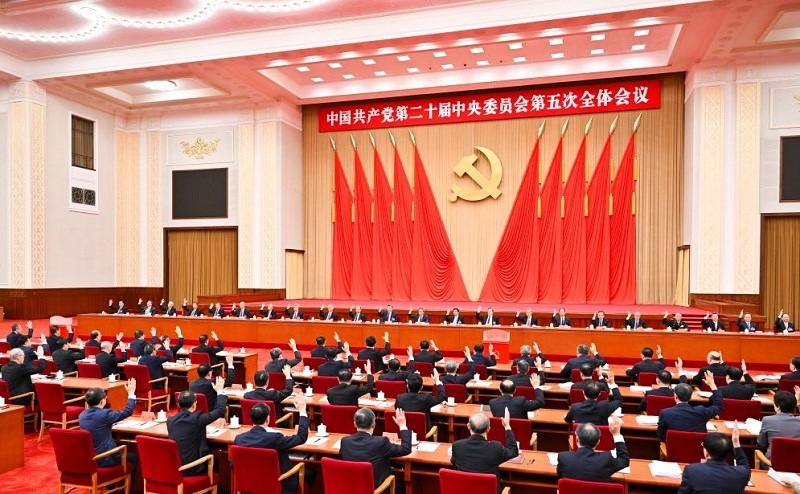
The 20th Central Committee of the Communist Party of China has just concluded its fifth plenary session in Beijing, where the party reaffirmed its commitment to persevering with full and rigorous Party self-governance.
The session reappraised the performance of the party, examining its achievements and setting out the fundamental responsibilities, guiding principles and plans needed to sustain that effort going forward.
One of the reasons why the Communist Party of China (CPC) holds this session is to ensure that it keeps reinvigorated, alert to the needs of the Chinese people, and does not get lulled by its own success, despite it being the largest ruling party in the entire world with more than 101 million members.
The CPC has made it a solemn responsibility to stay vigilant and never lose sight of potential risks that usually come with long-term governance. It is easy for a political party that enjoys great support of the citizens, with a long history of holding power, to become complacent, to tolerate inadequate competence, and even to become estranged from the people and get eaten up by the vice of corruption. The CPC is alive to these risks, that’s why it chooses to confront them head-on.
Since 2014, when the party first adopted the term “full and rigorous Party self-governance”, sceptics and cynics from different quarters around the world criticised and scoffed at it as likely to be a passing gust. However, more than a decade later, time has proven that the CPC’s campaign was serious, and it has neither stopped nor softened.
There is latent evidence in the numbers of what the party has done to sustain that effort. In 2026, just between January and September, the party conducted disciplinary inspection and supervision in various state organs across the country, culminating in the opening of 800,000 cases and the disciplining of 680,000 people. These are figures far above the totals of the efforts undertaken in 2014 when this exercise began.
To uncover more violations, the Party has broadened oversight and strengthened enforcement with the aid of big data and technology. It is now apparent that President Xi Jinping’s anti-corruption crusade is an ongoing and sustained effort, aimed at preventing new abuses of public resources.
Nevertheless, it has been the CPC’s historical pattern to combat corruption, and evidence goes back to 1926, when the party was just five years old. It was already paying attention to self-governance, and its Central Committee was already issuing its first document aimed at combating corruption.
It has become customary in recent decades for almost every Central Committee of the Party to convene a dedicated plenary session on Party building. Whereas the emphasis has shifted with changing circumstances, the issue has remained a priority on the core political agenda of the Party.
During this year’s plenary session, members stressed the abundance of favourable conditions which are now in place for advancing full and rigorous Party self-governance, while they also recognised the many new circumstances and new issues they faced in this endeavour.
They were cognisant of the profound changes in global, national, and Party conditions which have made the Party’s tasks of uniting and leading the Chinese people in safeguarding China’s sovereignty, security, and development interests, of uniting and leading them in promoting reform and development and maintaining social harmony and stability, and of maintaining its advanced nature and integrity even more arduous.
The delegates recognised that this poses formidable challenges to the Party’s governance and leadership capacity, the quality of its membership, and its resistance against corruption and moral decline under the new circumstances.
They also observed that the “four tests” and “four dangers” confronting the CPC are still protracted, complicated, and serious.
As China works on the new ambitious goal of national modernisation 2026-2030, the Plenary Session emphasised the importance of persevering with full and rigorous Party self-governance, and the capacity of CPC members to lead the country to modernisation.
The Party recognises that there is a lot more that needs attention. There is a need to cultivate higher-calibre officials, to build a well-knit organisational system characterised by cross-level alignment and effective implementation, and to take firm and coordinated action against corruption, and ultimately to refine the Party and state oversight systems.
The conduct of the CPC deserves global attention, if not admiration. Where else in the world do you find a ruling party with such a long-term, fundamental strategy for ensuring full and rigorous internal self-assessment and audit? Which political parties in the world enforce such strict management of their officials and members’ discipline?
Additionally, the world also has something to benefit from the discipline and stability of the CPC. As China’s governing organisation, the CPC is directly and indirectly a major contributor to and stabiliser of global economic growth, because it directs how China’s market functions and institutes stable policy expectations and a sound security environment not only to advance Chinese modernisation, but to benefit all the countries of the world that trade with China.
The writer is a Senior research fellow at the Development Watch Centre.

