3rd Plenary Session of the 20th Central Committee of the CPC: Announced New Reforms Will Ignite Global Cooperation

By Allawi Ssemanda

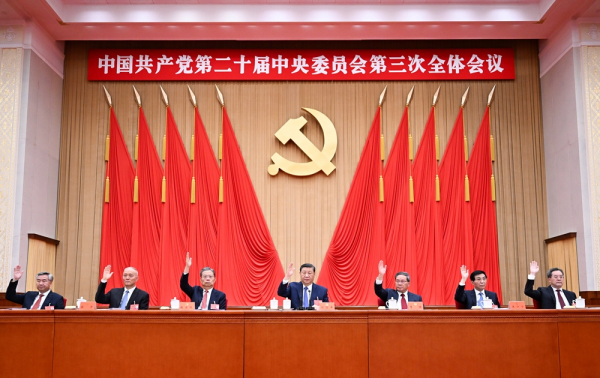
From July 15 to 18, the third Plenary Session of the 20th Central Committee of the Communist Party of China (CPC) was held successfully in Chinese capital, Beijing. This plenum came at a time when the world is faced with grave and complex challenges such as slow economic recovery, confrontation, power politics by some countries, and block formation. It also came at a time when tens of thousands of people have died in avoidable wars like Israel’s war against Gaza which the UN has described as “terrible” and bringing the strip closure to “human catastrophe.”

The plenum saw discussion of a report on the work of the Political Bureau. President Xi Jinping who is also the General Secretary of the CPC Central Committee attended and made some important comments. At the end, the plenum unanimously adopted the Resolution of the Central Committee of the CPC re-affirming on “Further Deepening Reform Comprehensively to Advance Chinese Modernisation.”

While one may argue that the third plenary session of the CPC Central Committee which is normally held once every five years concerns China alone, if critically analysed, it is of great significance not only to China but entire world. This is because, it is during this time that that the world’s second largest economy – China under the CPC leadership meet to plan and strategise for the country’s short and longterm socio-economic policies. As the second largest economy and Africa’s largest trading partner and financier of the continent’s most infrastructure projects, in all ways, policies made in Beijing also have direct bearing on economic development of the rest of the world.

Indeed, just a day after the commencement of the third Plenary Session of 20th Central Committee of the CPC, the International Monetary Fund (IMF) on the 16th July 2024 upgraded China’s 2024 economic growth forecast to 5% beating the U.S’ economic growth projection which IMF downgraded from April’s 2.7% to 2.6%. In the same forecast, IMF put 2024 growth forecast for the 20 Europe’s countries that share the euro currency at just 0.9%, while Japan’s outlook was downgraded from 0.9% to 0.7%!

Noting that Chinese economy has been doing well, the IMF attributed China’s continued good economic performance to among others what the IMF called China’s “program of of trading and equipment upgrade.” Announced in March this year, Beijing says the program will boost consumption and investment and growth at the same time.

When analysed, the adopted resolution which was announced in the communique talks about “Deepening Reform Comprehensively to Advance Chinese Modernisation,” it is an open secret that religiously, China has not been selfish in their development plans and they have consistently executed plans and strategies that also look at the well being and development of the rest of the world. A case in point is the Global Development Initiative (GDI) announced by President Xi Jinping in 2021 to accelerate efforts in achieving the Sustainable Development Goals of 2030. The GDI suggests ways to address key human challenges.

Also, China introduced the Belt and Road Initiative (BRI) which several studies have concluded is helping in sparking economic growth in all implementing countries. Indeed, a World Bank study – “How Much Will the Belt and Road Initiative Reduce Trade Costs?” conducted in 191 countries concluded that BRI projects have made trade easier in BRI participating countries by “reducing shipment times and trade costs at country-sector level.” BRI stands as a testament to China’s commitment to enhancing five connectivities or “five C” experts describe as key drivers of economic take off. The “five Cs” are; Policy Connectivity, Trade Connectivity, Infrastructure Connectivity, Financial Connectivity and; People-to-People Connectivity.

Such is enough evidence that while the 3rd Plenary Session of the 20th Central Committee of the CPC primarily benefit, if well implemented such polices by all means have a significant contribution as far as economic development of the rest of the rest of the world is concerned.

Indeed, while describing China’s economic growth projection as positive on the 16th of July, the IMF observed that led by China, “Asia’s emerging market economies remain the main engine for the global economy” stressing that today, China and India  “accounts for almost half of global growth.”

“The very fact that China is also bigger, it means it has a bigger footprint in the rest of the world.  An increase in the trade surplus might be small from Chinese perspective, but it could be big from the perspective of the rest of the world,” emphasised IMF’s Division Chief researcher Jean-Marc.

Looking at the communique from the plenum, one can safely argue that the new reforms will generate economic growth opportunities and hence, a firm foundation as the country intensify efforts to become a modern socialist country by the mid-century.

From historical perspective, the opportunities these reforms will bring will as well benefit the world as we race to achieve the United Nations’s 2030 SDGs agenda. This is premised on the fact that for the last several decades, China’s economic growth has left different parts of the country enjoying the same benefits. For example, to date, the country remains a major source of  trade, investment, and innovation to the world especially the global south.

It is important to recall that, the  3rd plenary session of the 11th CPC Central Committee of 1978 introduced these reforms, laying a foundation to transform China from a peasantry and made it economic power house as the rest of the world shared benefits of China’s economic growth.

Today, the country’s economic transformation which came as a result of Beijing’s reforms has seen China’s over 800 million people lifted out of extreme poverty – a record praised by different scholars and UN as historic.

To conclude, from historical perspective and the current trend characterised by China’s desire of building a community of shared prosperity and a community of shared future for mankind, one can safely argue that the resolutions adopted at the just concluded 3rd Plenary Session of the 20th Central Committee of the CPC will not only help shape China’s future but will help Ignite Global Cooperation and development in the new era.

The writer is a senior research fellow at the Development Watch Centre.

China’s clean energy excellence: Reflecting on Kiira Motors

By Nnanda Kizito Sseruwagi

It is said that when you owe the bank one million shillings, you have got a problem, and when you owe the bank 1 billion shillings, the bank has a problem. The narrative of China’s Belt and Road Initiative (BRI) as a “debt trap” for developing nations has gained significant traction. However looking specifically at Uganda’s case with Chinese investment reveals a more nuanced picture, where China’s infrastructure investments are fostering sustainable development, not financial suffocation.

Contrary to popular belief, China can not pack up an airport or Hydro dam and ship it to Guangzhou. Aside from the physical extremities that such an ambitious project would demand there’s no provision in international and diplomatic law that would sanction such a venture.  With such a precarious state of affairs China is one of the few of our development partners who are genuinely rooting for our success because that is the only way they can ever recover their loans and get out of the “debt trap” we have put them in.

This is probably why Chinese investment in Uganda is always geared towards parts of the economy that compound development. Uganda, like many developing countries, faces a significant infrastructure deficit. Limited access to reliable power,transportation networks, and communication technology hinders economic growth and social progress. China’s BRI steps in by offering loans for projects that directly address these needs and Chinese state affiliated companies also occasionally tender cost effective bids for the projects.

Additionally Chinese projects in Uganda usually focus on revenue generation. Many of China-funded projects in Uganda, like the Entebbe Expressway or the Karuma hydropower dam, are designed to generate revenue and pay for their own setup cost.  Tolls collected from the expressway directly contribute to repaying the loan, while the hydro dam increases electricity production, leading to increased export potential and government income.

Our country’s debt-to-GDP ratio, while on the rise, largely  remains below internationally recognized thresholds for “debt distress”. The Ugandan government prioritizes responsible borrowing and actively works with international institutions to monitor debt sustainability. The Chinese government also does a forensic feasibility study on each and every project before it’s implementation because as I may have pointed out earlier, it is in the Chinese best interest to avoid bad debts.

This is why China implements a zero tariff policy on 99% of Uganda’s export goods. Since China is a manufacturing economy, it is in their best interest to make sure that the farmer in Bududa has got a good road connection to the agro processing factory in Mbale industrial park to add value to his products before being exported to China and the rest of the world because then he’ll have the disposable income necessary to buy Chinese manufactured goods. It is hard to get similar concessions from countries who’s biggest exports are “democracy and liberalism“.

Without the pomp and funfare with which many other development partners launch their collaborations with domestic players; China goes a long way in collaborating with Ugandan companies and individual players and provides training programs, fostering technology transfer and creating skilled local workforces. This is geared towards empowering Uganda to maintain and manage infrastructure projects in the long run, reducing dependence on external expertise. An outstanding example is that many of the Ugandans working in  the Tilenga oil enterprise have benefited from Chinese trainings many even going to China on full state scholarships.

In many ways Uganda’s collaboration with China devolves a lot from it’s usual bilateral relationships with its traditional development partners because this is a story of Collaboration, Not Control. The Ugandan narrative goes beyond simply acting as a conduit for surplus Chinese capital. It’s a story of collaboration, with Uganda actively negotiating loan terms and prioritizing projects that align with its own development goals. Uganda retains ownership and control over its infrastructure assets as well as its national economic/ political identity and outlook.

As Uganda and China’s partnership grows, focusing on transparency, environmental sustainability, and capacity building will be crucial. The evidence from past and ongoing projects suggests that China’s investments, when carefully managed, can be a powerful tool for accelerating Uganda’s development journey. We need to; beyond infrastructure and economic ties look towards a cultural synergy that can merge the Ugandan(African) spirit of community (Ubuntu) with the Chinese Confucian culture.

This reductive approach to China’s role in Africa fosters a more constructive dialogue, moving beyond the simplistic “debt trap” narrative and highlighting the potential for mutually beneficial partnerships that pave the way for a more prosperous future. For every false alarm ringing in Kampala, there should probably be a tenfold alarm in Beijing because if the bank has a problem when you owe it a billion, imagine how much more worried the Chinese should be who’s “debt-trap” is in the trillions.

Nnanda Kizito Sseruwagi is a senior research fellow at the Development Watch Centre.

Beyond the Debt Trap Narrative: Examining China’s Infrastructure Investments in Uganda

By Shemei Ndawula

It is said that when you owe the bank one million shillings, you have got a problem, and when you owe the bank 1 billion shillings, the bank has a problem. The narrative of China’s Belt and Road Initiative (BRI) as a “debt trap” for developing nations has gained significant traction. However looking specifically at Uganda’s case with Chinese investment reveals a more nuanced picture, where China’s infrastructure investments are fostering sustainable development, not financial suffocation.

Contrary to popular belief, China can not pack up an airport or Hydro dam and ship it to Guangzhou. Aside from the physical extremities that such an ambitious project would demand there’s no provision in international and diplomatic law that would sanction such a venture.  With such a precarious state of affairs China is one of the few of our development partners who are genuinely rooting for our success because that is the only way they can ever recover their loans and get out of the “debt trap” we have put them in.

This is probably why Chinese investment in Uganda is always geared towards parts of the economy that compound development. Uganda, like many developing countries, faces a significant infrastructure deficit. Limited access to reliable power,transportation networks, and communication technology hinders economic growth and social progress. China’s BRI steps in by offering loans for projects that directly address these needs and Chinese state affiliated companies also occasionally tender cost effective bids for the projects.

Additionally Chinese projects in Uganda usually focus on revenue generation. Many of China-funded projects in Uganda, like the Entebbe Expressway or the Karuma hydropower dam, are designed to generate revenue and pay for their own setup cost.  Tolls collected from the expressway directly contribute to repaying the loan, while the hydro dam increases electricity production, leading to increased export potential and government income.

Our country’s debt-to-GDP ratio, while on the rise, largely  remains below internationally recognized thresholds for “debt distress”. The Ugandan government prioritizes responsible borrowing and actively works with international institutions to monitor debt sustainability. The Chinese government also does a forensic feasibility study on each and every project before it’s implementation because as I may have pointed out earlier, it is in the Chinese best interest to avoid bad debts.

This is why China implements a zero tariff policy on 99% of Uganda’s export goods. Since China is a manufacturing economy, it is in their best interest to make sure that the farmer in Bududa has got a good road connection to the agro processing factory in Mbale industrial park to add value to his products before being exported to China and the rest of the world because then he’ll have the disposable income necessary to buy Chinese manufactured goods. It is hard to get similar concessions from countries who’s biggest exports are “democracy and liberalism“.

Without the pomp and funfare with which many other development partners launch their collaborations with domestic players; China goes a long way in collaborating with Ugandan companies and individual players and provides training programs, fostering technology transfer and creating skilled local workforces. This is geared towards empowering Uganda to maintain and manage infrastructure projects in the long run, reducing dependence on external expertise. An outstanding example is that many of the Ugandans working in  the Tilenga oil enterprise have benefited from Chinese trainings many even going to China on full state scholarships.

In many ways Uganda’s collaboration with China devolves a lot from it’s usual bilateral relationships with its traditional development partners because this is a story of Collaboration, Not Control. The Ugandan narrative goes beyond simply acting as a conduit for surplus Chinese capital. It’s a story of collaboration, with Uganda actively negotiating loan terms and prioritizing projects that align with its own development goals. Uganda retains ownership and control over its infrastructure assets as well as its national economic/ political identity and outlook.

As Uganda and China’s partnership grows, focusing on transparency, environmental sustainability, and capacity building will be crucial. The evidence from past and ongoing projects suggests that China’s investments, when carefully managed, can be a powerful tool for accelerating Uganda’s development journey. We need to; beyond infrastructure and economic ties look towards a cultural synergy that can merge the Ugandan(African) spirit of community (Ubuntu) with the Chinese Confucian culture.

This reductive approach to China’s role in Africa fosters a more constructive dialogue, moving beyond the simplistic “debt trap” narrative and highlighting the potential for mutually beneficial partnerships that pave the way for a more prosperous future. For every false alarm ringing in Kampala, there should probably be a tenfold alarm in Beijing because if the bank has a problem when you owe it a billion, imagine how much more worried the Chinese should be who’s “debt-trap” is in the trillions. 

Shemei Ndawula is a senior research fellow at the Development Watch Centre.

From Herbal Remedies to Holistic Harmony: Unveiling the Power of China-Uganda Medical/Cultural Diplomacy

By Shemei Ndawula

The recent “China and Africa: A Fine Traditional Culture and Modernisation” lecture organised by the Development Watch Centre and China-Africa Institute  sparked a fascinating conversation about the opportunities for collaboration between these two vibrant continents. Our collaborations have typically been defined by economics and infrastructure partnerships but beyond these, a particularly intriguing prospect lies in the potential for medical diplomacy and cultural exchange. China and Uganda can leverage their unique strengths in traditional medicine, foster intercultural understanding, and ultimately, advance through a process of mutual learning and convergence of knowledge.

The People’s Republic of China and Uganda boast of rich histories of traditional medicinal practices. In China, Traditional Chinese Medicine (TCM) has flourished for millennia, with a holistic approach that emphasises harmony between the body, mind, and spirit. Practices like acupuncture, herbal remedies, and dietary therapy form the core of TCM, offering effective treatments for various ailments.

Uganda, on the other hand, possesses a treasure trove of indigenous medicinal knowledge. Local healers, across the various cultural spectrums utilise plants, animal products, and rituals to treat illnesses. This creates a vast repository of traditional practices that holds an intricately rich capacity for scientific exploration and drug discovery.

The potential for collaboration between these two systems is immense. China has over the years developed advanced research capabilities and clinical experience which can be combined with Uganda’s rich biodiversity and indigenous knowledge. Exploring joint research efforts could have the potential of inspiring the development of innovative, culturally-sensitive treatments for diseases prevalent in both regions, like Cancer, HIV/AIDS, and various chronic conditions. Cultural exchange programs will also likely bring together practitioners of TCM and Ugandan traditional medicine to form a modern mastermind. Sharing knowledge about diagnosis, treatment methods, and the underlying philosophies can foster mutual respect and lead to the integration of effective practices from both systems.

We already have an established culture of  academic exchanges between Chinese Universities and research institutions in the two countries and if this is expanded to include medical research it can facilitate knowledge sharing in areas like pharmacognosy (the study of medicinal properties in plants) and ethnomedicine (the study of traditional medical practices). This exchange can contribute significantly to the advancement of both traditional and modern alternative medicine.

Beyond the specific practices of medicine, China and Uganda have much to learn from each other’s hoard of cultural wealth. China’s long history and emphasis on social harmony (Confucian principles ) offer valuable lessons for Uganda’s young democracy to chart its own identity politically and socially. Creating unique Ugandan solutions to Ugandan problems like the Chinese developed a unique system of governance and values that has shaped their society. Conversely,Uganda’s vibrant artistic traditions and strong community spirit have the potential of enriching Chinese society.

Intercultural learning programs already in place like the Confucius institute in Makerere foster understanding by promoting language exchange, artistic collaborations, and student exchange programs. These initiatives bridge the geographical and cultural distance, creating a space for mutual appreciation and respect.

The process of collaboration should however not be one-sided. It should be a journey of co-creation, where both cultures contribute meaningfully. Uganda should bring to the table its knowledge of medicinal plants and traditional healing rituals. In return, China can offer expertise in clinical research, drug development, and modern medical technologies. Additionally, the government of Uganda needs to also start making conscious efforts towards bridging these gaps. This should be by widening the resource envelope for research platforms like Universities and think tanks and also repealing much of the red tape that encumbers our research capacity.

This intercultural approach would not only enrich healthcare systems but also foster a deeper understanding between the two countries. By recognising the value of each other’s traditions and fostering collaboration, China and Uganda can embark on a path of mutual advancement. This is already a concept being pioneered at the African Rural University in Kagadi where a significant number of senior lecturers have little to no formal education but are quite knowledgeable in African traditional wisdom. The Chinese story with their Confucian schools of thought has done the same thing with resounding success and this is definitely something we should explore.

The path of collaboration is not without its challenges. Intellectual property rights regarding traditional medicine knowledge need careful consideration. Additionally, ensuring the safety and efficacy of traditional remedies requires rigorous scientific validation.

However, these challenges can be overcome through open communication, transparent research practices, and collaboration with international organisations like the World Health Organisation (WHO).

By embracing the spirit of medical diplomacy and cultural exchange, China and Uganda can forge a powerful partnership.This collaboration holds the potential to revolutionise healthcare systems, improve public health outcomes, and cultivate a deeper sense of understanding between two culturally rich nations. As they learn from each other’s ancient wisdom and modern expertise, China and Uganda can pave the way for a brighter, healthier future for their citizens and serve as a model for collaborative progress on the world stage.

Back to the 20th China-Africa lecture which inspired this Op-Ed, organised by China-Africa Institute (CAI) and the Development Watch Centre, the lecture attracted a number of scholars with Chinese side delegation of 4 professors led by CAI’s Vice President professor Wang Xiaoming and while Dr. Allawi Ssemanda, the Executive Director Development Watch Centre led the Ugandan side with participants drawn from among others; Mbarara University of Science and Technology, Makerere University, Ndeje University, Islamic University in Uganda, and African Rural University. Further Chinese professors held more community engagement (lectures) with focus on poverty eradication among others.

If such collaborations can be reinforced, both sides stand to benefit as it is one sure way of learning from each other as the two sides embark on building a community of shared future for mankind in the new era.

The writer is a senior research fellow at the Development Watch Centre.


Green Beans, Red Tape: EU Climate laws may have unintended effects on Ugandan Coffee Farmers

By Shemei Ndawula

For the past three years the European Union has been drafting and polishing a set of legislations that will potentially have great impact on the lives of many Ugandan coffee farmers once they come into effect at the end of this year. As a country, we have relied on Coffee as our major export cash crop for decades. Right from colonial times when Uganda boosted of a surplus budget most of the national revenue came from agricultural exports of coffee and Cotton. At the moment we export close to 1 billion USD worth of coffee annually mainly to the European markets (Italy alone takes up to 33% of coffee exports).

The legislation, a result of climate change campaigns seeks to implement a stringent import cap on goods like coffee, cloves, rubber from non European countries if their importers can not prove that the land on which they are grown is a product of deforestation. This is definitely a good idea because the rate of deforestation across the globe is worrying. Uganda; thrust to the forefront of the war on climate change because of our location along the equator needs to take more intentional steps towards mitigating widespread deforestation. We are already experiencing record breaking levels of water rising in Lake Victoria as well as flash floods and mud slides in different parts of the country.

However, what this legislation misses out on is that most coffee growers in Uganda are smallholder farmers who are already struggling to meet the quality controls in regards to bean quality and organic farming practices. It will be impossible for the same farmers to put in place the necessary tracking mechanisms to prove that their farmlands comply with the legislation and convince the European Union that they meet the required standards. Needless to say that many of the smallholder farmers are either semiliterate or illiterate and will require a significant amount of time for training and adjustment of their farming practices to fully comprehend the purpose and subject of the legislation let alone implement them.

In fact, many of the prominent coffee producing regions like the Bugisu sub-region and the Kasese region are surrounded by forest reserves with the farmlands coexisting within the trees. In many ways this is a standard farming practice because the root system of the trees holds the soil so that the fertilisers used in the coffee are not swept away by the rain and the fallen foliage from the trees acts as mulch. My family has had a similar agricultural scheme for decades  at our farm in Kasangati(in the outskirts of Kampala) where the coffee is grown alongside timber trees.

It is imperative for the European governments to understand that the most likely scenario that will play out when the legislation comes into effect may not be increased compliance in Africa but rather most multinational coffee exporters will shift their focus to more developed countries like Brazil which can comply with the necessary red tape.  This can spur a domino effect with coffee farmers when deprived of the coffee market resorting to cutting down the trees on the farms to cover their daily needs.

As a profession relying heavily on nature, Ugandan and African farmers have got all the reasons to lead the war on climate change. Our agricultural systems are heavily dependent on weather patterns and many farmers are one or two bad weather seasons from a crisis.

Additionally, setting up these traceability mechanisms will also come with unprecedented compliance costs to provide verifiable proof that the coffee supplied to the European market comes from none deforested areas. This will involve adopting traceability systems, certification processes and quite possibly new farming methods.

The European Union may be better served by simply equipping the farmers with the necessary skills and technology to implement sustainable farming practices. European research has made leaps and bounds in sustainable high impact farming and technological sharing between the two countries would be a huge boon for the coffee sector.

This has been done before by the Chinese in Uganda who set up a large rice growing scheme in Lukaya along the Lwera stretch to set a practical farming standard for Ugandan rice growers to emulate. In the end, Ugandan farmers earn better from their agricultural investment while the Chinese import better quality grain for their population.

The EU’s legislation banning coffee imports from deforested areas is a commendable step towards global environmental sustainability. It unfortunately however;  presents significant challenges for Ugandan coffee farmers  who must navigate increased compliance costs, potential loss of market access, and broader socio-economic implications. To address these concerns, the European Union countries need to implement a multifaceted approach involving international aid, government support, and market diversification strategies. If together we can foster sustainable agricultural practices and provide the  necessary support, it is possible to mitigate the adverse impacts on Ugandan farmers and ensure a more resilient and sustainable future for the coffee industry.

Shemei Ndawula is a senior research fellow at the Development Watch Centre.

Rethinking Africa’s Education Systems: Lessons from China

By Nnanda Kizito Sseruwagi

Let me first caveat the fact this is a sweeping generalization as far as reference to “Africa’s education systems” is concerned. But I believe the generalization will still meet some nuance in this article.

Most African countries (especially Sub-Saharan) maintain a varied mixture of traditional and colonial/European/Western schooling systems. By their very nature, our education systems generally lack domestic responsiveness to address our societies’ unique historical, contemporary, social and future realities. This is due to their unmindful inheritance of formal education structures which were relinquished to us at the dawn of independence, without reassessing the intentions that informed the colonial design of education in Africa. Besides this, other factors such as epidemics, humanitarian crises and other development challenges continue to bear negatively on our children’s schooling.

Often, when action is championed to do something to address our education challenges, it is still spearheaded by external actors like the United Nations which sets a cookbook of Millenium Development Goals which every country should pursue. Of course, this is not to say no fruits have been born from this. Millions of children have been enrolled in school continent-wide through adoption of UN Programmes and support from UN agencies like the World Food Programme which provides meals in schools to combat hunger-related dropouts.

However, I think so much more would have been done if our governments keenly rethought, redesigned and reimplemented their education systems.

I’ll draw inspiration from one of the most recently poor, underdeveloped, famine-stricken, disease-affected, resource-constrained countries which paid clinical attention to their education and now boasts global excellence in almost all indices measuring academic excellence – China.

Estimates from 2022 showed that Uganda’s adult literacy rate (the percentage of people aged 15 and above who have basic reading, writing, arithmetic and understanding) was 80.59%. in contrast, China’s literacy rate upon the founding of the People’s Republic of China in 1949 was estimated between 20 and 40%. As of 2021. The country’s literacy rate was estimated at 99.83%  It took a great investment of thought and resources to change the course of literacy in their country.

Currently, China is among the biggest investors in academic research. Every year, millions of students graduate in science and engineering from Chinese universities, including thousands of international students. They surpassed the United States in 2017 with the highest number of scientific publications. It also ranks topmost in most international STEM (science, technology, engineering and mathematics) championships.

This is not by luck or coincidence. When China emerged out of the Cultural Revolution (1966–1976), it redesigned its education system to focus on economic modernization. Few if any African countries seem to understand or act with the understanding that there is intersectionality between education and economic transformation. China understood this early and highly prioritized the development of scientific and technical knowledge as well as training skilled personnel to realize it economic modernization agenda.

Needful to add, the pursuit of scientific studies excellence did not undermine humanities. Literature and the arts were also highly revived, which explains the world-wide appeal of Chinese cultural expression through movies.

The country has also keenly responded to climate change, with its Education Ministry formally implementing environmental education content in the school curriculum from early primary through to high school since 2003.

In order to satisfy their country’s industrialization and urbanization, the country also instituted higher vocational schools, secondary skill schools and job-finding centers. These institutions tailor the skills they equip workers with to address the urgent needs of China’s modern manufacturing and service industries.

Capital shortages to highly finance education is expected. However, like in China, alternative forms of education especially at higher levels can be embraced. Some institutions in Africa already implement online and long-distance learning, but we need to inform more people about this possibility. Spare-time and part-time learning can also go a long way in onboarding low-skilled youth who did not get a chance to study due to high resource constraints in formal arrangements.

China has also embraced the opportunity of using education to cause social change, specifically by making it compulsory for all universities to teach literature that encourages the integration of the country’s ethnic minorities and end discrimination.

It is difficult, almost impossible to develop a country without getting it right with education. But we can’t get it right if we do not think through it. If we keep rolling the machine, churning out graduates and drop-outs who have undergone a rusted, inherited, unexamined system. We need to press the reset button, get on the drawing board and think Africa’s education systems anew.

The author is a senior research fellow at the Development Watch Centre.
Global Politics and Foreign Policy: Who is Entitled to the “Monroe Doctrine”?

By Nnanda Kizito Sseruwagi

The Monroe Doctrine is the fulcrum around which America’s grand strategy on foreign policy has revolved since the 19th Century. Originating from President James Monroe’s speech to Congress in 1823, it was a solemn statement by the United States warning European nations to desist from interfering in the affairs of countries in the Americas (the totality of North and South America and most of the Western Hemisphere). Based on this doctrine, America would interpret any intervention by a “major country” (excuse my French – because all sovereign countries are presumed equal…) in its spheres of influence (what it called its “strategic backyard”) as a threat to U.S. security.

A flashpoint in America’s implementation of the Monroe Doctrine happened in 1962 during the world’s first nuclear crisis. Fidel Castro had led a guerilla struggle in Cuba which deposed Sgt. Fulgencio Batista. To save Cuba from bankruptcy upon his usurpation, Fidel approached the communist countries and began nationalising American-owned industries since the U.S. and the International Monetary Fund (IMF) would not lend to him. The American president then, Eisenhower, was unsettled by the thought of a communist state emerging a few miles from the coast of Florida. When John F. Kennedy became president in 1961, he undertook Eisenhower’s scheme to invade Cuba and authorized a failed attack at the Bay of Pigs. Kennedy ordered constant surveillance over Cuba and his spy planes registered aerial photographs showing that Castro was armed with Intermediate Range Ballistic Missiles (I.R.B.M.s). When Kennedy confronted the Soviet Union over this, Nikita Khrushchev protested: “Your rockets are in Turkey. You are worried by Cuba. You say that it worries you because it is 90 miles from the American coast. But Turkey is next to us!” Whereas arrangements were made by the U.S.’s Attorney General Robert Kennedy and Soviet Ambassador Anatoly Dobrynin to de-escalate the crisis, and in exchange for the Soviet Union’s withdrawal of missiles from Cuba, the U.S. reciprocated with a non-invasion pledge and the withdrawal of the Jupiter missiles from Turkey, America’s presence in Russia’s neighborhood did not cease.

It is 62 years today since the 1962 Cuban Nuclear Missile Crisis and America is fueling a proxy war between Russia and Ukraine. Like America’s position on the Monroe Doctrine, Russia too claims it needs some breathing space from the expansion of NATO eastwards, and would rather keep Ukraine in its sphere of influence. A saying goes that what is good for the goose is good for the gander…

However, the world has changed. China has emerged. Its government has publicly denied having a Monroe Doctrine. Indeed, not a single war has been fought by the People’s Republic of China (PRC) since 1979. The country’s leaders have theorised about harmonious co-existence as the future that China wants. Besides doing business and extending development finance to developing parts of the world as well as building infrastructure projects globally under the Belt and Road Initiative (BRI), China has not exhibited an appetite for military alliances with any country in the world.  Indeed, today, the PRC’s foreign policy banner is building a community of shared future for mankind.

Let us turn back to the United States and the Monroe Doctrine. American political scientist and International Relations scholar, John Mearsheimer, developed a theory called “offensive realism”. This theory explains that great powers are essentially desirous, rationally, of establishing hegemony in their hemispheres in the anarchy of the international system. He calls the international system anarchical because of the absence of any higher hierarchy above the nation-state.

It is understandable, based on the theory of offensive realism, for China, Russia or any other major world power to feel entitled to their own Monroe Doctrine. Currently, the U.S. has surrounded bases all across the Pacific in a provocative encirclement of China, which threatens a disastrous war between the two states. This is not the posture we need for sustainable peace in the world. It might make America feel safe, but nobody is safe if other countries feel threatened.

China has called for a multipolar world where no single center of power bullies the rest of the world. I think that such multipolarity is a far more secure balance of power for a peaceful world. Mearsheimer’s offensive realism would be a false theory if China’s stance was genuinely experimented on by other countries, especially the United States. However, if the U.S. posture in the Pacific is not unclenched, I fear John might be right in the long run.

Nnanda is a senior research fellow at the Development Watch Centre.


Lessons From China’s Climate Change Strategy

By Nnanda Kizito Sseruwagi

For a long time, China was known for relegating the challenge of combating climate change to “developed countries.” It did not consider itself among them and thus stood alongside developing countries to demand that wealthy, developed countries address the issue. As one of the largest CO2 emitters worldwide, it did not take long to backtrack its stance and become a world leader in green technology and climate-change mitigation. The nation’s commitment now is to shrink carbon emissions to safe levels by 2030 and realise carbon neutrality before 2060.

China has come a long way on this journey involving devising various strategies and implementing several policies to mitigate long-term effects of climate change. In 2004, they started experimenting with the “Green GDP” policy. The idea behind this policy was to deduct resource and environmental costs from the GDP of the country. This is how they began greening their economic policies and promoting nature conservation in their economic development model.

The “Green GDP” initiative is an environmental index applied while assessing an area’s GDP.  China uses it to evaluate economic performance by considering indicators such as energy consumption, energy reduction and emission intensity of major pollutants per 10,000 yuan of GDP. This is an environmentally smart and responsible method of measuring economic performance of the country without blindsiding oneself only to GDP growth.

Over time, China has improved assessment criteria by relying on indicators which pay attention to people’s livelihood, improvement of social conditions and monitoring ecological benefits. This should be the way to go for countries that aren’t yet implementing similar models.

In a more drastic move in 2013, China unveiled an Air Pollution Prevention and Action Plan, termed the “Air Ten.” By this, it passed strong regulations on pollution and restructured industries to achieve better air quality, especially in Beijing which is usually heavily affected by air pollution. By 2021, Beijing’s air quality had improved greatly with the city’s average PM2.5 reading dropping by 52.9% within five years.

President Xi Jinping also introduced the “new normal” concept in 2014. This denoted that government had appreciated the need to improve the quality of China’s economic development since it had attained a higher stage of development and outgrown the age of primitive acceleration of growth. Xi famously remarked that; “the carrying capacity of the environment has reached, or is close to, its upper limit and it is necessary to promote a new way of green, low-carbon and circular development”.

He noted that it was no longer sustainable for China to pursue the old economic path of extensive economic development and warned that such a path would be a dead end.

Therefore, China now pursues green development as a necessary means to mitigate climate catastrophe while maintaining economic development.

Additionally, Xi conceptualized the “ecological civilization” theory. He articulated the principles that must be followed in order to promote ecological civilization including; maintaining harmonious coexistence between man and nature and working together to build a global ecological civilization among others.

He stated: “We must deeply involve ourselves in global environmental governance, enhance our voice and influence in the global environmental governance system, actively guide the direction of change in the international order and form solutions for world environmental protection and sustainable development.”

But that would not be possible if corruption had continued to eat up China’s environment and energy sectors. For instance, officials in the coal industry conspired in the destruction of grasslands by coal mines in the Qilianshan Muli area and the illegal construction of villas in the Qinling Protected Area.

To confront this challenge, President Xi founded the Central Ecological and Environmental Inspection Team (CEEIT) in 2015 to supervise provincial and central ministries. Over 6,000 senior officials at various levels of government were arrested for corruption and have been held accountable for several environmental and energy-related cases.

This is tremendous progress – from denying contribution and responsibility for climate change – to holding large numbers of public servants for complacency in environmental degradation. China’s transformation ideologically and proactively in combating climate change and assuming global leadership in green technology should challenge all countries slacking on this urgent global challenge to stand up to the task.

Nnanda is a senior research fellow at the Development Watch Centre.
nnandakizito@dwcug.org


The other side of China Africa Friendship: Stories from the 8th China-Africa Youth Festival

By George Musiime

As an African with an interest in China Africa Cooperation, many times I come across information that seeks to discredit and undermine China-Africa friendship. Indeed it is very easy for someone living in Africa to believe that the concept of China-Africa friendship is a smokescreen covering an ulterior motive. More so, as a Ugandan and an African  I would understand why some might even be tempted to question China’s intentions in Africa given the level of negative publicity that comes from without the presets of this friendship; alluding to neo-colonialism, debt trap diplomacy et cetera. Luckily, I was blessed with the opportunity to experience this friendship from outside the African viewpoint during my visit to China, for the 8th China-Africa Youth Festival. From this experience, to realize the vision of a China-Africa community with a shared future, Africa needs not only right Information but also significant introspection before making judgment based on the information we are constantly bombarded with.

A long shared history. Many a times when Chinese involvement in Africa is discussed, we are made to believe as though China-Africa interactions are just being incepted while in fact this is not true. Some of the oldest recorded history of China-Africa interactions are from 600 years ago during the Voyages of Admiral Zheng He who reached the east African coast in the 14th century. While he made several Voyages to the East African coast, with a huge fleet Admiral Zheng was never a threat. As a matter of fact, his voyages were never about conquest or colonization. Moreover, it has been documented that he instead used the might of the Chinese military to suppress pirates on the course of his Voyages. In one of his inscriptions, the Admiral is quoted to have written that “…because of this, the sea routes became pure and peaceful and the foreign peoples could rely upon them and pursue their occupations in safety.” This alone is testament of China’s earliest commitment to global peace, security, and common prosperity. Otherwise, given the size and sophistication of the fleet he commanded, he could have chosen a different path. His voyages have indeed been described as diplomatic in nature and he is known to have brought foreign envoys to the Ming court as a way of building even stronger cooperation between China and the nations he sailed to.

The role of language in global cooperation. Language has for so long been known to foster mutual respect, understanding and tolerance. My experience in China literally blew out of the water the idea that China intends to use the teaching of the Chinese language in Africa as an inroad to future colonization and I’ll illustrate here. During my stay in Beijing I was constantly in contact with young Chinese that were fluent in many foreign languages and it was indeed fascinating to find young people that were fluent in indigenous African languages. I particularly had interesting conversations with two Beijing Foreign Studies University  (BFSU) students who were fluent in Swahili. For a nation as powerful as China with the added advantage of all its 1.4 billion citizens speaking a Unifying language, there would be no reason to train its young people in foreign languages unless there was a strong commitment to building cooperation and mutual understanding. In fact the study of indigenous African languages and language exchanges  might become the glue that holds together the China-Africa community with a shared future. Therefore, contrary to the mainstream narrative, other than work to interest Africa into its own culture, China and the Chinese people are taking a keen interest in African Culture as well.

Aside from the language exchange programs, I was also honored to visit the Institute of African Studies at the Zhejiang Normal University where, I learnt that this Institute had by far the most prominent program on African studies in the whole country . In fact the Institute is home to a museum where artifacts of African culture are curated in an effort to preserve the culture but also to give their students from different cultures an experience in the diverse culture of the African continent. At the museum, even I, was exposed to aspects of African culture I had not experienced before despite living on the continent. This effort fits in very well with the Dar-Es-salaam Consensus which called for the adoption of the Global Civilization Initiative advocating for the respect of the different cultures of the world.  Exposure to the diversity of world cultures is indeed a means to prepare the students for a smooth transition into the global community of humanity with a shared future.

This experience was further extended to the Zhejiang Guangsha Vocational and technical University of Construction where I was guided through the different projects by students present and past as well as the stories behind them. A tour of these  institutions was an eye opener to me and I believe for many of my colleagues because it told a different story; one of the enduring friendship but also of the China’s keen interest in preserving the same. It was indeed refreshing  to see first hand that other than try to water-down African culture, China is, if anything serving as a curator and guardian of a significant potion of African heritage. Throughout my stay,  there was at every turn something to remind me that my culture was always close which also tell the most beautiful story of the Enduring China-Africa friendship.

Meanwhile, despite the deepening China-Africa cooperation focusing more on addressing the economic bottlenecks that Africa faces on its path to modernization, a visit to China gives a different view of China-Africa friendship; a view that is more about the people-to-people  connections  and cultural aspects of this  friendship. I was brought in contact with the efforts being taken to not just expose Chinese people to African culture but also to preserve artifacts of African culture with a Chinese touch. Indeed this serves as the bedrock for the enduring China-Africa friendship. While this may be aim to strengthen the bond between the two parties,   it is also a clear indication  that as long as Africa is able to harness this friendship with China, the prospects of the continent will only continuously get brighter.

George Musiime is a research fellow at the Development Watch Centre.


The World Right now! And China’s Place in It

By Moshi Israel

The world as it is today is largely in disarray. The scenario is akin to that of a civil war where leaders are engaged in power struggles as the world around them burns to ashes. This is what is happening now, battles of hegemony and dominance are becoming more prevalent and defined. It is no longer shameful to threaten war or annihilation of the entire human species. Global peace and order are at risk because states have doubled down on taking the route of political realism. The weak are preyed upon by the strong and the interests of countries come above all else even at the expense of other’s interests.

Let us begin in Eastern Europe, in Ukraine. The war has now gone on for over two years with no end in sight. The Russians will not relent until they achieve their objectives of having a neutral and disarmed neighbor. Ukraine backed by the West has chosen to fight until the last Ukrainian in a bid to be part of Europe and out of Russia’s grip. The West on the other hand has openly stated that Ukraine is a unique opportunity to weaken Russia and inflict a strategic defeat on it. Therefore, the theater of war must continue until one side blinks. China is the only country that has pushed for a political settlement in Ukraine, emphasizing the need to respect sovereign territory and to address legitimate security concerns of all countries. This has been pushed by the Chinese despite them having a limitless friendship with Russia. Therefore, while all countries have clear allies and corners in this war, China has been politically mature enough to suggest a compromise that addresses both warring country’s concerns.

Europe is now at a crossroads. They have two major questions to answer; the first question is the Russian question and the second one is the China question. On the first question, the continent is running headfirst into a potential continental confrontation akin to the World Wars. There is an anti-Russian resurgence in Europe stemming from the Balkan states. These states are leading the drive into the new normal where Russia is seen as the major threat to the rest of the continent.

The second question which pertains to China may not be existential but is extremely important. Europe is still figuring out how to deal with China especially given China’s tumultuous relations with Big brother across the Atlantic. The recent visits by President Xi to Paris, Belgrade and Budapest have highlighted the contrast within European politics. France, knows it needs China but also has to trade carefully so as not to sour relations with their key ally, the US. China’s close friendship with Russia also complicates this further. The same goes for the majority of the European Union. Relations with China in Europe heavily depend on politics from the other side of the ocean. If it were completely up to Europe, it is evident that they would have preferred to have cordial relations with both china and USA.  On the other hand, there are some in Europe such as Serbia, and Hungary, the two allies, President Xi visited that see no qualms dealing with an increasingly inevitable China. These countries signed even more trade and partnerships agreements with China during Xi’s visit. The message President Xi brought to Europe was simply that; China is a fact of life and Europe has to deal with it.

Across the Atlantic, The United States remains consistent with its Foreign policy goals despite many thinking otherwise. The goal is as simple as maintaining US influence across the world and defending their interests and national security above all else. Now, how they go about this is a discussion for another time. The major point here is, as China’s influence grows, it inevitably collides with the influence of the United States and the latter is not accustomed to being challenged by a near peer power. China insists that its development is peaceful and seeks collaboration rather than confrontation. A peaceful world entirely depends on the US perception of China’s rampant rise.

Recently, the world was rocked by news of the death of the Iranian President, his foreign Minister and other key figures of the IRGC. This news left many in major political centers biting their nails at the prospect of the new emerging reality in the middle East. The cause of the accident was not immediately clear and that was dangerous because if a finger was pointed at anyone, it meant a potential new regional war. Many friends of Iran reached out to assist the country and it is yet to be seen what these developments will mean for the Middle East.

The war in Gaza is another political hotspot that has topped debates around the globe. The failure to release hostages by Hamas and lack of adequate humanitarian aid to the Palestinian people have made the Gaza war into one of the most gruesome conflicts in recent memory. China has constantly called for a cease fire and is currently pushing to have Palestine recognized as a state by the united Nations. The reality that the ICC might issue warrants against top leaders of Hamas and Israel has taken many by surprise. It is after all, an open secret that the Criminal court is reserved mainly for criminals in the Global South, this is no longer hearsay, as the Prosecutor Karim Khan confirmed it in an interview with CNN. We in the Global South can only watch as intrigued spectators as to where all this is headed.

In Africa, the DRC is still facing numerous insurgencies and the political climate in the country is one of uncertainty. In the volatile Sahel belt, the US has finally agreed to withdraw its troops from Niger in September. All this happens as the Global South largely improves ties with Beijing.

The Writer is a Senior Research Fellow at Development Watch Centre.