
The level of Chinese modernization is going to be the defining marvel of our time, if isn’t already. China has made great strides in economic strength, and in advancing scientific and technological capabilities.
The country has demonstrated an ability to sustain and consolidate progress in several measures. It has increased gross domestic product (GDP) to 134.9 trillion yuan, which averages a year-on-year increase of 5 percent. China continues to contribute about 30 percent to global economic growth. China consistently creates a total of 12 million urban jobs annually, and surveys of urban unemployment rates estimates it at just about 5.1 percent.
Almost every year that comes, China’s foreign trade strikes a record high, and the global market share of China’s exports continues to increase. Last year, China’s foreign exchange reserves surpassed 3.2 trillion US dollars.
The country has registered steady progress in the wellbeing of its people. As you read this, the per capita disposable income of China has grown by 5.1 percent in real terms. Whatever achievements the state registers in poverty alleviation are further consolidated and expanded. There is now greater support rendered to compulsory education, basic old-age insurance, basic medical insurance, and social assistance in China.
In the field of industrial output and new advancements, China has continued to dominate. It has registered grain output at a new record high of 700 million metric tons, with the yield per hectare rising by 75.75 kilograms. The value added of high-tech manufacturing and equipment manufacturing has appreciated by 8.9 percent and 7.7 percent respectively, and the output of new-energy vehicles passed the 13 million mark. China has recorded an increase in the value added in the sectors of information transmission, software, and IT services by 10.9 percent and by 10.4 percent in leasing and business services.
The enhancements made in innovation capacity in China are peerless. The country has recorded new achievements in integrated circuits, artificial intelligence (AI), quantum technology, and other areas. One of the recent highlights of Chinese technological superiority was when the Chang’e-6 mission completed humanity’s first-ever sample collection from the far side of the moon, and the delivery and commission of the Mengxiang ocean drilling vessel. The total value of China’s technology contract transactions increased by 11.2 percent.
China is also making new breakthroughs in reform and opening up. It has completed the reform of government institutions across the board, adopted major reform measures for building a unified national market, and gradually raised the statutory retirement age.
China has lifted all market access restrictions on foreign investment in the manufacturing sector, while also further expanding and upgrading investment cooperation under the Belt and Road Initiative.
At the beginning of March 2026, China published its 15th Five-Year Plan (2026-2030) in which it invited the world to share prosperity. The plan shows China to be a stable anchor for the world economy and a reliable partner in addressing common challenges. As the beacon of modernization, and with a population of 1.4 billion people, China’s posture now is of a reliable and stable partner to both advanced and developing countries alike, marking it out as the bearer of the torch to an alternative path in a growingly turbulent world.
China is likely going to create a new demand for international talent, technology, and partnerships through its massive investments in artificial intelligence, quantum computing, smart economy, and advanced manufacturing. China is no longer merely the leading producer of EVs, but now promises to be the world leader in green transport in general.
The country’s Transport Ministry has unveiled plans to promote the digital and green transition of its transport sector during the 15th Five-Year Plan period. It will facilitate the development of zero-carbon transport corridors and stations as part of efforts to boost low-carbon development of the transport sector.
Domestically, China is also keen on addressing unbalanced and inadequate development, to expand the middle-income group and broaden access to basic public services across its population. Common prosperity in China is not what the West portrays it to be in negative frames of egalitarianism or a redistribution-first model that suppresses market incentives. China’s common prosperity follows a dual-track strategy — expanding the economic “pie” while improving its distribution, so that growth gains are shared more broadly.
The writer is a senior research fellow | Development Watch Center.


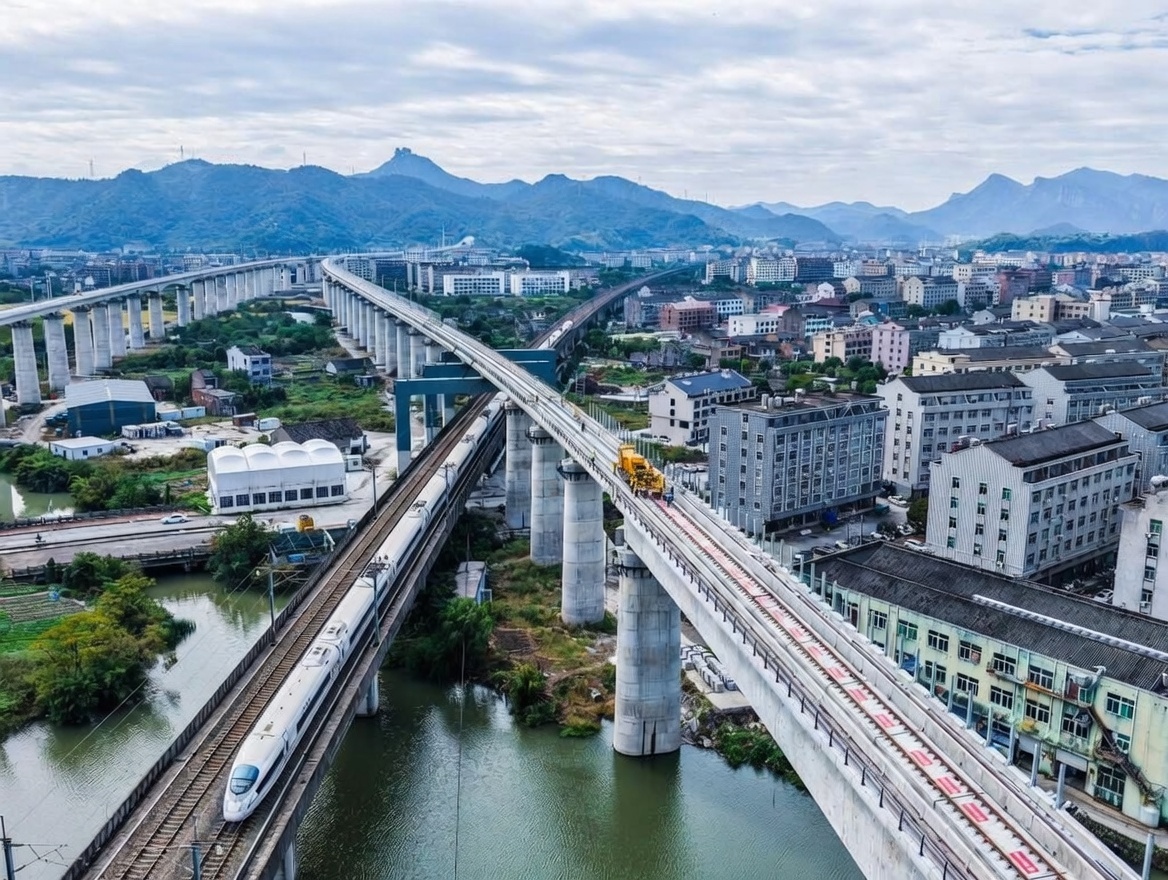 Workers operating at the track laying construction site of the Wenling-Yuhuan section of Hangzhou-Taizhou high-speed railway in Taizhou, east China’s Zhejiang Province, November 5, 2025. /Xinhua
