Uganda needs to Leverage its Bilateral Relations with China to Maintain its Growth Trajectory

By Musiime George

The past year was a mixture of two emotional hues for Uganda following the enactment of the anti homosexuality law. Whereas proponents of the law celebrated and rejoiced in its enactment, critics and activists alike were concerned that the law would unleash an array of rights concerns in Uganda. However, besides this binary of positions, there was a third group of Ugandans who expressed concerns about the country’s ability to deal with the resulting fallout from the passing of this bill into law. As it would turn out, these fears were justified, as the World Bank Group would later in August 2023 issue a statement announcing plans to halt any further funding to Uganda as additional measures and mechanisms for grievance redress were deemed necessary.  Moreover, in the final quarter of 2023, the Biden administration also announced the removal of Uganda from the Africa Growth Opportunity Act (AGOA) citing gross human rights violations as the reason for the decision to exclude Uganda from the trade pact. While all this was evolving, there was growing concerns about the future of the Ugandan economy and the prospects of attaining the growth targets of Vision 2040 of transforming the country from a peasant to a modern and prosperous economy as the fallout from this law cast a dark shadow over the transformational prospects of the country. This would in turn beg the question; is all hope lost for the country’s economic future?

Nature abhors a vacuum: it is a scientifically accepted position that empty spaces are simply not sustainable and the moment they come about, surrounding matter will always rush in to fill them. We can aptly interpolate this principle of science into the area of international relations and development cooperation just the same way and particularly in the Ugandan case as it seeks to address the fallout from last year’s passing of the Anti homosexuality law.  During a Media and Think tanks briefing focusing on the outcomes and future of China-Uganda practical cooperation on March the 28, the Chinese envoy to Uganda H.E Zhang Lizhong reiterated China’s commitment to work with all countries to steer multi-polarity and globalization. Key to this was emphasizing inclusive globalization, which China defines as supporting countries to pursue a development path that is suited to their own national conditions. This is a notion that fits very well with China’s diplomatic principle of non-interference in the internal affairs of sovereign territories.

It is important to note that the People’s Republic of China (PRC) was among the very first countries to establish diplomatic relations with Uganda only nine days after independence. In fact, bilateral relations between both countries have continued to flourish through the years with milestones including but not limited to, large-scale infrastructure projects such as roads, hydropower stations, and cooperation in health, agriculture et cetera. Additionally, Uganda and China have worked together in a diversity of fields covering poverty reduction, education, science and technology, providing assistance and shared experiences to drive comprehensive social and economic development.

Ambassador Zhang Lizhong further reaffirmed China’s continued commitment to joining hands with Uganda in the spirit of cooperation that delivers on the principles of mutual benefit, common development and inclusive progress for both the people of China and Uganda as both countries advance towards building a community with a shared future. As a testament to this, bilateral trade between China and Uganda has been growing progressively  over the last 10 years from $600 million to $1.3 billion. Moreover, by the end of 2023, Uganda’s share of this had grown by 19.6% reaching $70M. Meanwhile, as the trade ratios might indicate a deficit for Uganda, this is a working progress and China,  guided by its strong belief in a win-win outcome is still dedicated to working with Uganda in addressing this imbalance. For example, this is being done through a number of avenues among which are, a zero tariff treatment for up to 98% of export commodities from Uganda on the Chinese market. China is also collaborating with Uganda to stimulate production through cooperation in areas such as infrastructure through the Belt and Road Initiative  (BRI), industrialization, agriculture, health among others.

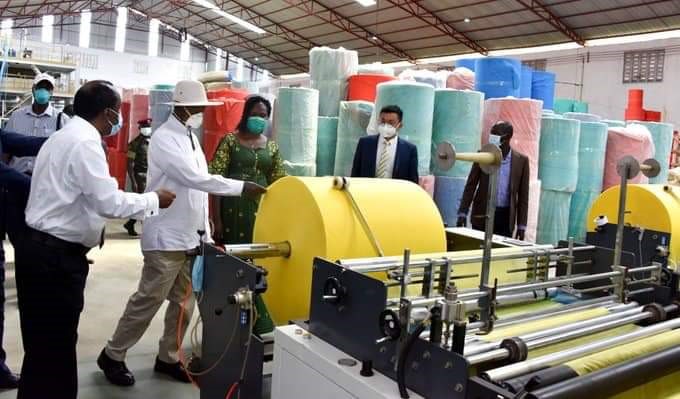
In an effort to spur industrialization, China has invested in numerous multi-million dollar industrial parks including the Liaoshen industrial park, Mukono industrial park, Shandong Industrial Park, Kehong China-Uganda Industrial Park and Sino-Uganda industrial park in Mbale, Eastern Uganda. This coupled with additional support such as the donation of rice farming and processing machinery and equipment worth $2 million to Butaleja district, medical supplies worth $1 million to fight malaria, all of which have a cumulative impact on  the nation’s production capacity are not only likely to increase the country’s export volume but also its ability to meet the local demand. Thus in the presence of zero tariff treatment for Ugandan export commodities on the Chinese market, Uganda stands to gain a lot regarding its efforts to narrow down the trade deficit by leveraging this access to the Chinese market aided by the boost to the country’s industrialization effort. Moreover, coming with all this investment is an increase in the number of Ugandans employed hence improved livelihoods and purchasing power of Ugandans as well, all of which will positively impact on the nation’s GDP along the way.

Therefore, I am among those Ugandans inclined to believe that not all hope is actually lost for Uganda especially as the country deals with its removal from AGOA considering that by June 2023, Uganda’s export to the AGOA market was a paltry $8.2 million in contrast with the over $70 million trade volume with China during the same period. This together with all the other efforts aimed at buttressing Uganda’s production capacity, there is more mileage that can be gained only if Uganda is able to effectively leverage its cooperation and bilateral trade  with China by increasing investment in production as well as diversifying and improving the quality of our export products. For as long as we work dedicatedly to bridge this economic gap,  we shall not only be able to just stay afloat but to continue growing our economy as we march towards the targets of vision 2040.

George Musiime is a research fellow at the Sino-Uganda Research Centre.


Dying Empires and Shifting Powers: Western Nightmares of the Ascendant Dragon

By Moshi Israel

The world is undergoing rapid transformation, a reality of which nearly everyone is acutely aware, thanks in large part to the advanced technologies at our disposal that capture these shifts in real time. This has led to a palpable sense of alarm over the intensity and pace of these changes. Many current and Traditional World powers are coming to terms with a noticeable shift in global political dynamics, as control seems to be gradually eluding their grasp. This situation can be likened to the precariousness of clinging to the sharp edge of a skyscraper to prevent a fall. While this might seem like a natural progression from the viewpoint of the average citizen, from the perspective of established authorities, the scenario unfolds with far-reaching implications.

Observing that the Western bloc is experiencing a decline does not constitute an assault on its integrity, although there is justification for assaulting western integrity. Moreover, such acknowledgments have even been made by Western leaders themselves. Josep Borrell, the European Union’s chief diplomat, has starkly proclaimed that the “era of Western dominance has definitively ended.” However, my perspective is not as bleak as Mr. Borrell’s. I maintain that there is still an opportunity for Western nations to reassess their approach towards global political governance. The essence of Borrell’s argument hints at a potential solution to the swift decline of the West. He cautions against dividing the world into ‘the West against the Rest’, highlighting accusations from many in the ‘Global South of double standards.’ This insight underscores the need for a more inclusive and equitable international framework that eschews divisive narratives.

Regrettably, certain Western governments are persistently engaging in divisive tactics, particularly targeting China. The underlying motivation for such actions, despite various ‘moral’ justifications presented by the West, stems from China’s rapid ascent. A number of Western political analysts and policymakers are unwilling to coexist in a world where China assumes a leading role in political, military, cultural, and economic spheres. They position themselves as the defenders of Western ‘exceptionalism,’ yet often, their views do not reflect the sentiments of the broader populace within their nations. Nonetheless, their relentless quest for perpetual dominance and their constant fixation on the potential threats posed by China’s growth have contributed to a global environment steeped in turmoil.

The global landscape is currently fraught with challenges, from the ascendancy of gangs in Haiti and the humanitarian crisis stemming from the Gaza conflict, to ongoing hostilities in Ukraine and heightened tensions across the Middle East – including in Yemen, Syria, Iran, Iraq, and Lebanon. Additionally, unrest in the Sahel region, renewed conflicts in the Democratic Republic of the Congo, and the looming menace of climate change, seemingly present a formidable agenda for global leaders. Unfortunately, there is no clear plan or indication that all of these crises are being managed cooperatively within the United Nations framework. Instead, everyone is either choosing sides or completely turning a blind eye to these issues, with the notable exception being China which has overly sung the chorus of strategic cooperation to a disinterested crowd.

Recent reports indicate that Niger has severed military relations with the United States, following a similar disengagement from France, which has been increasingly displaced by Russia across Africa. Furthermore, Russia has been actively eroding Western influence globally, while efforts to manage Netanyahu have proven futile, and threats from Iran and North Korea are escalating. As Josep Borrell, European Union’s High Representative for Foreign Affairs noted, the Global South is reevaluating its perspective on the West, and the outlook is far from favorable. The BRICS+ continuous growth is also chipping away at Western dominance. In this context, it is imperative for Western policies to evolve, focusing on genuine promotion of Western exceptionalism of democracy without hypocrisy, moral standards without double standards, Global prosperity with active Global South participation. The West indeed needs to ‘build back better’ but this time with entirely new and different construction material because the existing system is damaged beyond repair.

Many of today’s global crises could be resolved through compromise and negotiation, particularly when the parties involved hold no malice towards each other. Indeed, simplicity often underpins the solution in such scenarios. Notably, among the world’s major powers, China stands out as the most committed to pacifism.

At present, the immediate concerns for Western nations primarily revolve around Russia and Iran. Yet, in a long-term perspective, political leaders in the West have consistently identified China as the most significant security challenge to the prevailing global order. China’s ascendancy is undeniable, and in the context of its cultural symbolism, the dragon—a figure believed in Chinese lore to govern water phenomena—serves as a metaphor for the potential impact of China’s rise on the West. Depending on the West’s approach, China’s advancement could be perceived either as beneficial rainfall or as overwhelming floods.

This raises a critical question: faced with a binary choice between relinquishing global dominance or precipitating a cataclysmic Third World War, what decision will certain Western governments make?

The Writer is a Senior Research Fellow at DWC.


Africa Must Leverage China Cooperation and Elevate or Stay the Arena for Great Power Rivalries

Africa Must Leverage China Cooperation and Elevate or Stay the Arena for Great Power Rivalries

By George Musiime

Today, we live in a very challenging world, a world desperately in need of sound global moral-leadership.  While this might not happen today, Africa is not lacking in potential. The African continent could actually provide this global-leadership, if only it could capitalise on its wealth of God given resources, brilliant citizenry, and development partnerships in its pursuits. However, we cannot provide global leadership, lest we fix our own leadership crises first. The concern of this essay however isn’t about global moral-leadership but rather to adumbrate on the possibility that Africa could actually overcome the challenges and stereotypes it faces today to achieve what all the other civilisation throughout history have been able to accomplish. To put this into perspective, let us take a bird’s eye view of human civilisation through time.

There was a time Egyptians were at the helm of global civilisation, creating engineering marvels such as the pyramids, with worlds flocking to the region to experience and learn from the groundbreaking innovations that were prevalent in the region at the time. Then, there came the Arabs in Baghdad with their scientific discoveries and achievements in Mathematics, philosophy, physics, and astronomy, all of which laid the groundwork for many of the scientific breakthroughs that would follow.  However, human civilisation did not rest in Baghdad or we would still be thousands of years away from where we are today. After the golden age of the Arabs, there came the Europeans and building on the previous knowledge and achievements, they gave us the industrial revolution.  This gave the Europeans so much power that they literally reached a point of sitting around a table in Europe with a map and began to share the rest of the world amongst them, and what an egotistical thing that was! It is no wonder that this would later contribute to the slump in their pace up the hill of civilisation but does the story end here? Of course not, because at the beginning of the 20th century, the United States was mostly an Agricultural country just like Africa is today. It was nothing like France or Britain, yet through deliberately walking the Science and Technology path, it was able to elevate to a point where it has been able to run the world for the past century.

Moreover, following the Second World War and decolonisation in the global south, we have witnessed countries like China take enormous strides that Africa cannot any more, doubt the possibility of economic progress and transformation.

In his famous book “The Evolution of Civilisations” the American Historian Carrol Quigley posits that civilisation is a cyclical phenomenon which might give a reasonable explanation to the earlier passing on of the torch of civilisation from one civilisation to another throughout history. Nonetheless, regardless of some scholars faulting Quigley’s analysis as being too simplistic in as far as explaining the rise and fall of civilisations, he puts forth two points that will be the focus of this essay among the forces behind the rise and fall of civilisations. This essay will discuss these two points in relation to China-Africa relations i.e. the role of what Quigley terms as “the Instrumental Elite,” on one hand and Science and Technology on the other, in the rise of civilisations.

The instrumental Elite are a small group of people wielding enormous influence and having the power to steer the course of a society. Despite usually being a small group, they hold enough power to steer societies to progress, stagnation or destruction depending on their motives, intentions and consciousness.  Once again, one can argue that an instrumental elite with a clear vision is what has enabled China to make so much progress, becoming the world’s biggest economy over the past six decades.

Whereas most of Africa chose western democracy, China chose a different path and built a meritocratic society. Democracy by its nature rewards the popular regardless of their motives, intentions or consciousness unlike meritocracy, which rewards performance. Those that ride on popularity, tend to bring on board their kin and kind and in some unfortunate instances, form administration’s that are so incompetent that they can only get young nations on a crash-course with whatever tragedy is waiting at the end of incompetence avenue! On the contrary, China has adopted a system that rewards doers based on performance. This kind of “the instrumental elite” has enabled China to make huge leaps on the path of economic progress and transformation over such a short period. Moreover, right in there, lies the lesson and probably a model that Africa could borrow and adapt to its own journey to economic transformation.

However, Quigley does not only mention the role of the instrumental elite, he also talks about Science and technology as another factor that fuels the rise of civilisations and only God knows how strongly a deficiency in Science and Technology has held back the continent’s progress. In fact, even with the vast wealth of natural resources, Africa has not been able to make much progress due to a Science and Technology gap created by an education system designed during the colonial era with the goal of providing clerks and at the very best administrators that would implement the colonial model of governance. Therefore, we have ended up with an independent Africa, run according to the colonial rulebook and unable to make much Technological headway for the continent’s transformation. Luckily, through the continent’s friendship with China, a country that aside from its different approach was where Africa is today just a few decades ago gives Africa the hope that the goal is attainable. Additionally, China is not simply sharing skills, knowledge, expertise and technology with the continent but it is also increasing Africa’s productive capacity through investing in infrastructure.

China’s investment in infrastructure on the continent is not just to connect the periphery to the center, which was a model designed with facilitating colonial administration in mind during the colonial period. Chinese backed infrastructure projects aim to connect nations and nation-capitals facilitating cross border and intra-Africa trade and development. Therefore, all that remains now is for Africa’s instrumental elite to take decisive and deliberate actions to steer their different countries in the right direction; and that is the direction of economic transformation.

China brings to its relations with Africa the understanding that economic transformation cannot happen unless there are certain preconditions for economic progress. Conversely, the absence of these preconditions is what has become well known as  “development bottlenecks.” These same bottlenecks have grossly accounted for the continents transformation or the lack thereof. China does not necessarily have to promise Africa development and economic transformation, but through the win-win approach to its dealings with Africa, and investing in crucial infrastructure projects, China is practically setting the stage for Africa’s economic take-off. Therefore, the onus now remains on Africans to choose conscientious and enlightened leaders with the right motivation. More to that, Africa’s leadership requires a paradigm shift from the old-colonial administrator mentality that did not care much about accountability to the citizens and towards leadership that will work towards improving the livelihoods of their citizens, economies of their nations, and the economy of the continent as a whole. This way the continent will be able to advance on the ladder of civilisation, and even assume its position on the big table of the multipolar world.

George Musiime is a Research Fellow at the Sino-Uganda Research Centre.

China-Africa cooperation is more than just a silver lining, it is the blue sky

By George Musiime

In an interview with CGTN last year, Mr. Wu Peng, director general of the department of African affairs in the Chinese foreign affairs ministry summed up the Chinese government’s view of its interactions with Africa in a single memorable statement in which he noted that “Africa is a big stage for international cooperation, not an arena for major power rivalry.” Such is the spirit that directs Chinese foreign policy towards Africa that is based on the five principles of mutual respect for sovereignty and territorial integrity, mutual non-aggression, non-interference in each other’s internal affairs, equality and mutual benefit and peaceful co-existence. It is this overriding principle that has not only made China such a significant development partner for Africa over the past few decades, but also why it will continue to play a key role on the continent.

Towards the end of the first half of the last century, Africa witnessed a wave of awakening that swept across the continent in the form of decolonization struggles, yet soon after the attainment of independence, these flames seemed to have fizzled out. Nevertheless, the cooperation between China and Africa still stayed albeit being with a measured scale of involvement. The turning point however came at the turn of the new millennium when, the then President of the Peoples Republic of China Jiang Zemin, announced China’s “going out strategy” in March 2000 followed by the first Forum on China-African Cooperation (FoCAC) Summit. Following these two events, China’s involvement in Africa began to increase and has continuously been on the raise ever since.

The African continent being home to  majority of the world’s developing countries was suffering from a multitude of challenges and bottlenecks that impeded economic progress across the continent  ranging from disease burden, peace and security, infrastructure deficits and food security among many others.  At the same time, the continent was striving to disentangle itself from this array of development bottlenecks. Meanwhile, the developed world mainly viewed Africa as a problem-riddled continent that only required interventions which would come in the form  of development aid. At the same time, China showed up with a very different perception of the continent. Following the announcement of the going out strategy in 2000, china saw Africa as an opportunity other than a problem needing solving. This was followed by more Chinese companies getting involved in Africa. As a result, the continent saw increasing Chinese investment in infrastructure including highways, railways, power generation plants, industry and manufacturing, agriculture and production etcetera. These investments revitalized the continent’s development efforts, setting Africa on a path to modernization-something that had eluded most of the continent since independence.

Confining myself to the Ugandan context, the fruits of Chinese cooperation with Uganda are far reaching spreading across such areas as infrastructure development, peace and security, food security, trade and general improvement of livelihoods of ordinary Ugandans. In fact, government of Uganda has been able to complete several infrastructure projects under the flagship of the Belt and Road Initiative BRI cooperation including the 183MW Isimba dam and 600MW Karuma power plants adding almost 800MW of clean power sources to the nation’s power generation capacity. Furthermore, there has been several completed road projects in partnership with China including but not limited to the Entebbe Express High way, which has significantly eased travel to and from the Entebbe International Airport, also completed are the Hoima-Kyenjojo, Kakumiro Kyenjojo roads. These roads made transportation of both personnel and equipment to the oil rich Albertine region much easier hence facilitating all manner of ongoing development work being carried out in the region. These and similar projects are responsible for pushing the length of paved roads in Uganda up by 1334Km from 4257.00m in 2016/17 financial year to 5591Km in the 2020/21 financial year. However, one other significant development has happened in the agricultural sector under the South-South Cooperation working with the UN’s Food and Agricultural Organization (FAO). The south-south cooperation, aimed at improving agricultural production capacity through the tri-factor of knowledge, skills and technology transfer and building the capacity of local farmers in Uganda. This project went from demonstration farms in 2012 to the establishment of hubs with the primary focus of increasing agricultural production and value addition. The south-south cooperation has been instrumental in increasing production, ensuring food security, creating more jobs along the agricultural value chain and improving the livelihoods of individual farmers in Uganda.

Therefore, China’s cooperation with Africa has been immensely beneficial to the continent in as far as addressing the different development challenges previously faced by the continent. In fact China has been directly involved in projects aimed at not only addressing the national development goals of the host countries but also helping African Countries  in their quest to attain their targets with regards to the UN’s agenda 2030 whether it be poverty eradication or zero hunger, affordable clean energy or climate action, industry, innovation and infrastructure or sustainable cities etcetera. It does not matter whether one is looking at BRI related road or power projects in Uganda, Wind and solar farms in Ethiopia or South Africa, Railway projects in Kenya or Ethiopia, Housing projects in Tanzania or Angola, it is growing increasingly hard to miss the Chinese hallmark on the current trend of economic growth across the continent.

George Musiime is a research fellow at the Development Watch Centre.

georgemusiime@dwcug.org

GIVING BUSINESS BUSINESS

By Salim Abila Asuman

‘’Imagine this: smooth roads and railway lines weaved through our landscapes, not just connecting places, but stitching dreams to reality. They are not just routes; they are the veins of commerce, making business not just easy, but irresistible. ‘’

Now end that imagination, and let us embark on a journey into reality, the African continent is now the host of the Chinese funded Trans-African Highway network which includes the Caira-Cape Town Highway.

Additionally, the African continent is also a home to the following China funded railway lines.

The Mombasa-Nairobi Standard Gauge Railway (SGR) in Kenya, covering roughly 480 kilometers, its construction began in 2013 and was finished in 2017.

The Addis Ababa-Djibouti Railway, connecting Ethiopia and Djibouti, is approximately 76 kilometers long and was built between 2011 to 2016.

Abuja-Kaduna Railway in Nigeria was completed in 2016, covering roughly 186 kilometers. Construction began in 2011, was completed in 2014 and officially inaugurated for commercial services in 2016.

The Lagos-Ibadan Railway in Nigeria commissioned in 2021 has three major train stations running from Lagos through Abeokuta to Ibadan.

Tanzania-Zambia Railway (TAZARA), Tanzania and Zambia: established with Chinese assistance in the 1970s, approximately 1,860 kilometers, the railway has been operational since the 1970s, with ongoing maintenance and improvements.

Another reality is that Uganda will be home to the Kenya-Uganda Standard Gauge Railway (SGR): the projected length is approximately 273 kilometers, and it is intended to facilitate the transportation of goods from the port of Mombasa to Kampala, then to Kigali, Beni in the Democratic Republic of the Congo, and finally to Nimule and Juba.

Akin to veins these roads and railways lines play a crucial role in the circulatory system of our economy, serving as tubes they pump business into the heart of the economy bringing in and taking out various businesses.

As these roads stretch and railways weave through the vast landscapes, the ripple effects are profound, especially for entrepreneurs daring to dream big, at this point, it is only proper that I delve with you how these investments are not just installing tracks and asphalt, but also paving the way for innovation and expansion.

The arteries of commerce, once clogged by inadequate infrastructure, are now flowing with vigor. Improved roads and railways are facilitating the movement of goods and services, enabling entrepreneurs to tap into previously inaccessible markets and expand their reach.

In today’s interconnected world, connectivity is key and Infrastructure is not just about physical roads and railways; its about connecting people, ideas, and opportunities. Entrepreneurs are leveraging this connectivity to access information, recourses, and markets, empowering them to turn their business ideas into reality.

The journey from idea to reality is often fraught with challenges, but Chinese-funded infrastructure projects are paving the way for innovation and collaboration. By fostering an ecosystem of connectivity and collaboration, entrepreneurs are finding new ways to innovate, collaborate, and succeed in rapidly evolving marketplace.

At the heart of Africa’s development is the prospect of economic growth and progress. These infrastructure investments not only lay the foundations for commercial success, but also for long-term economic growth that benefits every aspect of society.

Homegrown brands that drive industrial growth benefit from enhanced infrastructure, from agricultural products to renewable energy solutions, these brands are pivotal in fostering economic development and connectivity across the continent, including Uganda.

In the agricultural sector, Brands like Kuapa Kokoo in Ghana and Ethiopian Coffee Export Corporation rely on efficient transportation networks for cocoa beans and coffee production, while Uganda Coffee Development Authority, Agrisol Africa Limited and Pearl Dairy Farms Limited expand their market reach.

The textile and apparel industries represented by brands like Dupies African Clothing, ShweShwekini and Nytil Uganda are leveraging improved transport infrastructure to access raw materials and distribute finished products.

In the realm of minerals and resources, African brands like Anglo Gold Ashanti, De Beers, Nigerian National Petroleum Corporation, and Uganda’s Tullow Oil rely on well-maintained roads and railways for efficient mineral and resource transportation.

Telkom, Safaricom, MTN Uganda, and Airtel Uganda are leading providers of telecommunications services, leveraging improved infrastructure to expand networks and reach underserved communities across Africa.

Renewable energy brands like M-KOPA Solar, and GreenPower Overseas Limited capitalize on improved infrastructure to deploy solar panels and home systems in off-grid communities, driving electrification and socio-economic development. Uganda’s renewable energy sector, represented by the brands like SolarNow and Fenix international, are rapidly expanding, benefiting from upgraded infrastructure to expand access to clean energy.

A concise way to say ‘’one gives business business‘’ is that ‘’one supports businesses’’ and China giving business business is a fact that resonates with a profound truth.

China gives businesses business because through Chinese investment and skills focused at developing transportation infrastructure in Africa, one’s company idea can be transformed into a reality, therefore giving their business ideas the business.

Transforming your business idea into a thriving reality is a riveting journey, complete with unexpected twists, exhilarating highs, and yes, even a few hilarious mishaps along the way. From the initial spark of inspiration to the triumphant launch of your brainchild, each step is a chance to unleash your inner visionary and craft into a legacy that echoes far and wide.

And let’s not forget the unsung heroes in this saga – the roads and railways that crisscross the landscape, tirelessly ferrying your goods to eager markets. With these vital arteries in existence, your dreams aren’t just dreams anymore; they’re tangible possibilities waiting to be embraced.

So, as you navigate the exhilarating maze of entrepreneurship, remember to savor every moment, relish every challenge, and above all, keep your sense of humor intact. After all, in the unpredictable world of business, a hearty laugh might just be your most valuable asset. Here’s to chasing dreams, blazing trails, and turning aspirations into epic adventures!

There has never a better time to turn your business ideas into reality and ride the wave of Africa’s transformation, your business will surely get business.


The writer is a lawyer and research fellow at the Development Watch Centre.

Navigating the Trade Imbalance: Increased Cooperation with China Benefits Uganda and Africa

By Shemei Ndawula

Recently, the European Union(EU) Parliament issued a formal complaint against the Chinese People’s Republic regarding its trade deficit with China. This complaint has sparked global debate about the nature and impact of China’s economic engagement with the world especially with  developing nations. While the EU’s concerns are not without merit, in the new multipolar world, the continental body seems to often fallen short of the economic flexibility that previously made it an economic powerhouse.

In this Uganda presents a contrasting perspective; a nation often lauded as the most entrepreneurial in the world,  the potential of China’s unique approach to development in bridging Africa’s infrastructure gap and fostering inclusive economic growth could be the defining factor for our nation’s economic prosperity for the coming decades.

Trade Deficit: A Stepping Stone, Not a Stumbling Block

Uganda’s trade deficit with China is undeniable, with imports significantly exceeding exports. However, unlike the European Union, Uganda’s situation presents a unique opportunity where we can leverage China’s infrastructure development focus to accelerate our  own economic progress.

The Eurocentric model of development aid, often plagued by bureaucratic hurdles and limited tangible outcomes has proven largely ineffective in addressing Africa’s critical needs. In contrast, China’s investment in infrastructure projects like the Kampala-Entebbe Expressway and the Karuma Hydropower Plant directly improve Uganda’s transportation network, energy security, and overall economic activity. These investments create skilled jobs, stimulate local businesses, and lay the foundation for long-term economic growth.

To maximize the benefits of our relationship with China while minimizing the trade deficit, Uganda should adopt a multi-pronged approach by making strategic investments especially in these key areas;

We should further explore our economic diversification by moving beyond the current dependence on exporting raw agricultural commodities and minerals. This can involve processing agricultural goods locally, focusing on value-added products, and exploring latent potential in sectors like tourism in which we are abundantly gifted. With China’s success at poverty alleviation, it provides a potential tourism market of more than a billion people.

Additionally, we should comprehensively develop our national industrial capacity. China owes it’s rise to prowess in manufacturing and industrial development. This prowess through technology sharing can be leveraged to build Uganda’s own industrial capacity.Attracting Chinese companies to establish production facilities in Uganda can also create jobs, facilitate knowledge transfer,and reduce reliance on imported goods.

We will also need to strengthen trade facilitation which is the backbone of bilateral trade.The custom procedural process in the country needs to be streamlined with our foreign embassies and ambassadors. There’s hundreds of Ugandan importers in China facilitating the export of tons of Chinese made goods to the continent every day. The reason this is not two way traffic is because of the bureaucratic and expensive export process within the country. We will certainly need to streamline the export process if we ever hope for our goods to reach the Chinese markets.

The win-win approach which defines China’s foreign policy methods has already seen several Chinese companies setup shop in Uganda an outstanding example being the Chinese industrial hubs in Kapeeka and Mbale catalysing joint ventures between Ugandan and Chinese businesses can unlock new opportunities for both sides. Sharing expertise, resources, and market access would lead to innovative products, improved services, and increased trade flows.

A Balanced Approach: The Key to Success 

While Uganda and other African nations must capitalize on the benefits of their relationships with China, adopting a balanced approach is crucial. Diversifying partnerships beyond China, ensuring fair and transparent trade practices, and promoting responsible investment are essential to safeguarding Africa’s long-term economic interests.

The debate surrounding China’s economic engagement with developing nations is complex and multifaceted. While concerns about trade imbalances tend to look at the traditional indicators imports and exports, Uganda’s experience demonstrates the potential of China’s unique approach to development. By strategically leveraging this partnership, Uganda and other African countries can accelerate their economic growth, bridge their infrastructure gap, and create a more prosperous future for their citizens. Ultimately, the key to success lies in a balanced approach that acknowledges both the benefits and challenges of China’s economic presence while ensuring that Africa’s long-term economic interests are protected and advanced.

Shemei Ndawula is a Research Fellow at the Development Watch Centre.


Uganda-China Relations: Partnership of Equals and Win-Win Cooperation

By Ndunaka Godswill Chikamso

Like many other countries, Uganda has been seeking foreign investment and partnerships to drive economic development and the country has made significant strides towards economic development in recent years, thanks to the support of various international partners. One such partnership that has been growing in significance is China-Uganda Relations.

China and Uganda have a longstanding relationship dating back to the early 1960s when Uganda gained independence. The relationship has been characterized by cooperation in various areas, including trade, infrastructure development, and education. Over the years, China has provided significant assistance to Uganda in the form of aid, loans, and investments opportunities. In 2018, China was Uganda’s largest trading partner, with bilateral trade worth over $1.2 billion. Since then, Beijing remains one of Uganda’s leading trade partners and major source of foreign direct investments (FDI).

With China introducing zero tariff to Ugandan goods which will see Ninety-eight percent of Ugandan goods accessing Chinese market tariff free, trade between the two countries is expected to grow further. Last year, Chinese Ambassador to Uganda, Zhang Lizhong announced the Special Preferential Tariff Treatment of Ugandan Exports to China, explaining that this was in line with commitments made by China at the Eighth Ministerial Conference of the Forum on China Africa Cooperation (FOCAC) held in Senegal last year.

Even before the said Special Preferential Tariff Treatment, China has been investing heavily in Uganda, particularly in infrastructure development projects such as roads, bridges, and power plants. The most notable project is the 51 kilometers Kampala-Entebbe Expressway, which was constructed with a loan from China’s Exim Bank and has greatly improved the country’s transportation sector. Additionally, China has financed the construction of the Karuma and Isimba hydroelectric power plants, which will increase Uganda’s energy capacity and reduce its dependence on fossil fuels. The entry of Chinese construction firms into Ugandan market is always cited as the reason for reducing billing prices for road construction in Uganda. Indeed, at the time when European companies were dominating road construction business, the construction of one kilometer took about 3.1 billion shillings compared to current rate of about 2.1 billion shillings per kilometer.

China has also invested in Uganda’s telecommunications sector, with Chinese companies such as Huawei and ZTE playing a significant role in the country’s development of 4G networks and fibre optic cables. This has greatly improved internet connectivity in Uganda and provided opportunities for innovation and entrepreneurship.

Another sector that China has played a significant role in Uganda’s economic development is supporting the country’s infrastructure especially road and energy sectors which has in turn helped easing transportation of goods and services and also helped in addressing unemployment challenge. In 2014, while closing a two-day Pan African Youth Conference at Serena International Hotel Conference in Kigali Rwanda, President Yoweri Museveni explained that “infrastructure development such as Roads, Electricity and Railway in any country is of importance as it attracts investments and creates jobs for the youths.”

In 2017, while on a visit to Uganda, Christine Lagarde, then Managing Director of the International Monetary Fund (IMF) credited Uganda for what she described as “Uganda has appropriately embarked on a strategy of scaled-up infrastructure investment in the energy and transport sectors to relieve key growth bottlenecks and enhance regional linkages.” Lagarde argued that “focusing on overcoming implementation challenges, including through strengthening public investment management, should help ensure that these investments yield the desired outcomes in terms of higher growth and job creation.”  If critically analysed, the improvement and development of Uganda’s energy and infrastructure sector became possible largely because of China’s assistance.

Today, Africa’s biggest challenge, especially Sub-Saharan region, is poor and aging infrastructure.  A 2022 study by McKinsey and Company concluded that unless addressed, infrastructure deficits in key sectors such as roads and energy will continue to hinder African countries’ economic growth and development especially in Sub-Saharan Africa. The study concluded that while the region is faced with high demand of infrastructure development, there are few partners or investors willing to provided huge amounts needed for such projects. Therefore, China’s readiness to back such projects in Uganda and Africa in general cannot be underestimated.

However, while China’s hand in supporting African countries infrastructure is a big boost, Uganda and other African countries must should only borrow and invest in projects that can easily spur economic development as a way of ensuring easy servicing of loan facilities extended while undertaking such infrastructure projects so that issues such as rising debts critics often point at are avoided.

That said, there are multitudes of opportunities that comes with steady and good relations between China and African countries. The other area with huge potential for cooperation is in the field of agriculture. While China is already working with Uganda in this area especially through FAO-China South-South Cooperation (SSC) in which China has since 2015 been supporting agriculture initiatives in Uganda, if projects under SSC especially its phase III are spread throughout the country, more fruits will be realized in a short period. SSC has potential to spark Uganda’s economic development especially if they work together with Uganda government’s introduced Parish Development Model (PDM).  Uganda is an agricultural country, and there is a need to enhance agricultural productivity and value addition. With her rich experience in modern agriculture, China can provide technical support, expertise, and investment towards Uganda’s agricultural sector.

In conclusion, China has played a significant role in Uganda’s economic development, providing funding and investment for critical infrastructure projects. China’s engagement with Uganda has brought many benefits, including employment opportunities, enhanced energy capacity, and improved connectivity. While this has brought several benefits to the country, including job creation and economic diversification, there are also concerns about debt sustainability, environmental impact, and the impact on local industries and businesses. As Uganda continues to seek foreign investment and partnerships, it will be important to carefully consider the benefits and drawbacks of these relationships and ensure that they are sustainable and equitable.

Ndunaka Godswill Chikamso is a junior research fellow at Sino-Uganda Research Centre and a Medical student Niger Delta University, Nigeria.

China-Uganda Relations: As it Was During Colonial Rule, China Remains a Reliable Development Partner!

By Musanjufu Benjamin Kavubu

China and many African countries have shared a history regarding the sense of imperialism and colonialism. China was not so long ago under the colonial rule of Japan and some of its territories like Hong Kong under Britain. China’s Communist Party set an example and also went ahead to support African independence struggles. Even with its rich history, China can be credited with the front of economic growth that has a basis on the political will of CPC and its leaders from the days of Chairman Mao to to-date where CPC Secretary General and President of China Xi Jinping advocates for building a community with shared prosperity for mankind.

Like every global player for China Africa is part of its economic playground and places like Uganda are both its geopolitical and geo-economic outposts. One may then wonder if Uganda is just a pony on a grander chessboard. It depends on how you watch events and the perceived results. What makes news is Beijing’s economic strategy and it’s in a few cases in the past decades save for its ambitions unify its claimed territory of Taiwan when China’s military strategy has come under the world’s microscope. Even with the military bases in the South China Sea and some off the African coast, the answer is supply chain interests that facilitate its trade with the world. Put differently, China has never been a coloniser and to date, if critically analysed, Beijing bears no such ambitions but rather win-win cooperation where countries world over benefit from a win-win cooperation under world order where each country’s sovereignty is respected!

Unlike the British Empire that is only visible today through a shadow of Common Wealth nations that kicked off with military expeditions and remained in place with the power of the gun and the United States hegemony that has a thirst for energy resources also backed with senseless wars, China has had this supposed strong foothold on the world and places like Uganda with no boots on the ground in terms of soldiers or even private contractors. China chooses economic diplomacy and it has run lately on projects like the famous Belt and Road Initiative (BRI) and Maltiplarism through BRICS a block made up of Brazil, Russia, India China and South Africa which unlike the G7, BRICS advocates for equality of all countries as well as respect for all irrespective of their size or military might.

Nothing has brought criticism to Beijing like the true intentions of the Belt and Road Initiative a project that has seen China seriously considering and supporting developing countries’ infrastructure development loans to among others construct, sea ports, airports, rail line networks and roads from Africa to Americas, from Asia to Europe all aimed to facilitating trade. This development has arguably revolutionized developing countries’ infrastructure development which organisations like world bank have continuously said they receive very low funding despite being key in social-economic development aspect.

Sadly, some people claim BRI is about China taking out raw materials and bringing back low-quality products through its massive web of the supply chain, with other critics of China especially from the West who often cherry-pick and ignore reality and brand China’s generous infrastructure development assistance as “debt trap.”

For a moment picture this China through EXIM bank provides a loan to Uganda to construct a hydropower dam on the Nile River, in the process technology is imported and at the end of it, all rural electrification is achieved which will facilitate industrialisation leading to employment, in turn creating a population with disposable income that is used to develop microeconomics of households that bring further education and research in the academia field. It’s from such initiatives that a real middle class is a bred that will in the end consume quality Chinese products because of the disposable income. The question is who wins? A real middle class that pays taxes will in the long run offset the loan for the dam, a real middle class will trade and create a functional society. A functional society has no appetite for civil war or trade in arms and that will ensure civility and a level of peacetime. That sounds like true economic development!

In the past two decades, Ugandans that speak Mandarin have increased and it’s not because it’s part of the school syllabus even if they are few language schools in Kampala that offer to teach it. The main reason for Mandarin in Africa is the increased scholarships that Beijing is offering. There is a likelihood that every Uganda knows someone close who has travelled to China for education on a fully Chinese government funded scholarship. When these people return after studying, they have contributed to the local academia and thus bettering the educational sector that is very fundamental in economic development. Whatever China’s foreign agenda policy is behind shipping Ugandans to China educating them and sending them back it’s to our society’s advantage in the long run.

China has a thirst and also a shortage for oil in its massive industrialization scheme and on that note, it’s watched carefully through its activities on the energy market. CNOC is one of the partners of Uganda in the oil sector and the company’s efforts can’t be downplayed in the facilitation of black gold’s take-off in the country. It’s a writing on the wall that if the oil sector is handled well by the state and its full potential is realised, then it will overturn the economic prospects of the nation. Today, many Ugandans in Albertine region have already seen fruits from oil sector especially through CNOC’s cooperate social responsibility where social services for communities are looked at as well as employment opportunities! The other most striking example are modern houses CNOC constructed for people affected by oil project in Kingfisher oil field.

Uganda like most African countries will seem like small pieces in China’s economic strategy but the reality these tiny pieces are useful and all need to work. China at some point will even go beyond its comfort zone to ensure these pieces function as expected beyond United Nations Security Council speeches where it’s a permanent member. It is important that the war in Ukraine and the new world order on the horizon led by players like China Kampala maintain a strong relationship with Beijing to realise further economic development.

While China’s critics and Sino-Africa skepticists especially in the West claim that China’s engagement with African countries is guided by what they claim to be Beijing’s “selfish interests” at times with absurd claims that most African countries have received fewer tangible benefits from China relations the reality is that where greatly or otherwise, tangible or otherwise, China-Africa relations are working and wonders are being created! The fact that China respects African countries sovereignty and that these relations are based on equality not the West’s assumed big brother role, African countries should jealously guard these relations! As African countries demand for equality and permanent representation at the UN security Council, it is clear that China at some point will ensure this dream becomes a reality by supporting Africans as they did while Africans fought against brutal colonial rulers.

Musanjufu Benjamin Kavubu is a Junior Research Fellow at Sino-Uganda Research Centre.


Fighting Extreme Poverty: Lessons from China’s Poverty Eradication Initiative

By Balongoofu Daniel

The world bank under the poverty and inequality Platform (PIP) as of march 2023 assessed global poverty from a period of 2020 with special focus on the global south that to a larger extent is victimised by this catastrophe. The prevailing data collected from nations with functional grid systems that track levels of poverty indicate that the global head count ratio increased by 0.1 percent to 8.5 percent resulting into a revision in the number of people living in extreme poverty from 648 million to 659 million additionally from south Asia with about 5 million people, The middle east and North Africa contributing 4 million people resulting into an increase of about 11 million people living in extreme poverty hence forth.

Focusing on sub-Saharan Africa, the provisional data indicates that the global head count ratio as of march 2023 stands at about 86.4 percent and the number of poor people estimated to be about 969 million. This speaks volumes of what needs to be done to check these sharp rising poverty trends especially in this part of the world.

This to occur, countries in Global South may have to learn from other countries where the war against poverty has been successful. For example, picking from China, a self-established model in poverty eradication, African countries can learn more on how to successfully contain poverty. Arguably, China is of a great lesson to the global south and Sub-Saharan Africa in this fight that the nation evolved from a history not alien to the prevailing social-political and economic structure of the sub-Saharan region. Right from atrocities being war torn by both civil wars, the fight against colonialism, food insecurity and a big growing population with limited resources at the time. The nation embarked on a long journey of strategic self-transformation and creating of opportunities that have made it the worlds production hub and the second largest economy.

In February of 2021, president Xi announced that extreme poverty had been eradicated in the nation in what he termed as a miracle. He announced that; “Through combined efforts of the whole party and the entire nation, China has secured a complete victory in its fight against poverty in this important year”.

The unification of China by the CPC in 1949 followed major land reforms that the government under took as the first measure. It should be noted that the period during the 30-year long wars characterised with both civil and fights against the Japanese colonialists at the time which followed a complete institutional and national break down by fighting war lords who divided the nation into territories and taxed the people to fund their wars hence contributing to the acute levels of poverty. The land reforms saw the elimination of the first major institutional obstacle since the state retained exclusive rights to the land that later saw investment in improved farmlands irrigation which gave the peasants modern farming trainings and employment. The land reform also saw a redistribution of land to peasants and tenants who then acquired land which encouraged wide scale agricultural production through cooperatives later in 1953.  The government as well heavily invested in rural education, medical services as major roots and basis that the current 27 trillion dollars economy inherits.

Later during 1978, China registered great success over the poverty elimination fight under the central collective leadership of president Deng Xiaoping that declared poverty as not being socialism therefore the party undertook efforts here to liberalize the Chinese market through opening it up for foreign direct investments and commercial production. This attracted investors with huge capitals that drastically promoted value addition on the locally produced agricultural produce of which the huge population provided a ready market necessary for-profit maximization.

It should be noted that the government as well took strategic reforms to accord the high-tech state-owned enterprises that drove the of value addition initially a level of autonomy that they were to compete with other private enterprises, determine production and supply and drive reinvestment of the profits accumulated. This strategically introduced the capitalistic traits of profit maximization hence gradually abandoning the socialistic home-based production. This resulted into a massive average GDP growth of about 8.2 percent per year on average between 1978 and 2020.therefore as a result, on average there were 18.7 fewer poor people in China since 1978 hence the miracle that president Xi highlighted in his victory speech.

China’s fight against corruption is commendable and cannot be ignored while addressing the fight against poverty. It should be noted that this cancer has greatly undermined the gains of economic development especially in sub–Saharan Africa therefore the global south aught to borrow a leaf from China’s defeat of this vice. From the 1970s when China begun to carry out the policy reforms and opening up, The CPC government at the time took very stringent measures against economic crimes such as smuggling, embezzlement and taking bribes. The road to combating this cancer featured addressing of both the symptoms and the root causes of corruption. Comprehensive treatment and gradual intensification of efforts to eliminate the root causes of economic crimes were deployed and till the 21st century, China has constantly expanded the corruption prevention frame work from special prevention of individual corruption to preventive work and administrative examination with approval, financial management and cadre personal system reforms under the national bureau of corruption prevention to co ordinate the work of combating this vice and holding victims accountable by both the law and national publicity. It should be noted that China has been effective in fighting this vice which has made it swift for the implementation of these poverty eradication programs.

Conclusively, the new battle against poverty is now carried on by president Xi’s tenure. After the tremendous successes in fighting poverty which in saw Beijing announcing it had realized its first centenary goal – building a moderately prosperous society in all respects and president Xi declaring that the country was embarking on what he described as “marching in confident strides toward the second centenary goal of building China into a great modern socialist country in all respects,” he called for implementation of newer strategies to lift the remaining poor to prosperity. The new strategies call for identifying the most vulnerable, then analysis is done on the root causes of poverty. These programs have been decentralized to the lowest political composition of society that help in implementation and accountability to the central government and it should be however noted that the present-day mechanisms involve elements of poverty relief dispatched by the government directly to the affected people among special transformational programs such as electrification and connectivity through roads to encourage economic transformation and productivity. As other countries in the global south such as Uganda come up with programs meant to fight poverty such as Parish Development Model, China offers a rich pool of expertise where we can draw lessons on how to successfully end extreme poverty.

Balongoofu Daniel is a Junior Research Fellow at Sino-Uganda Research Centre