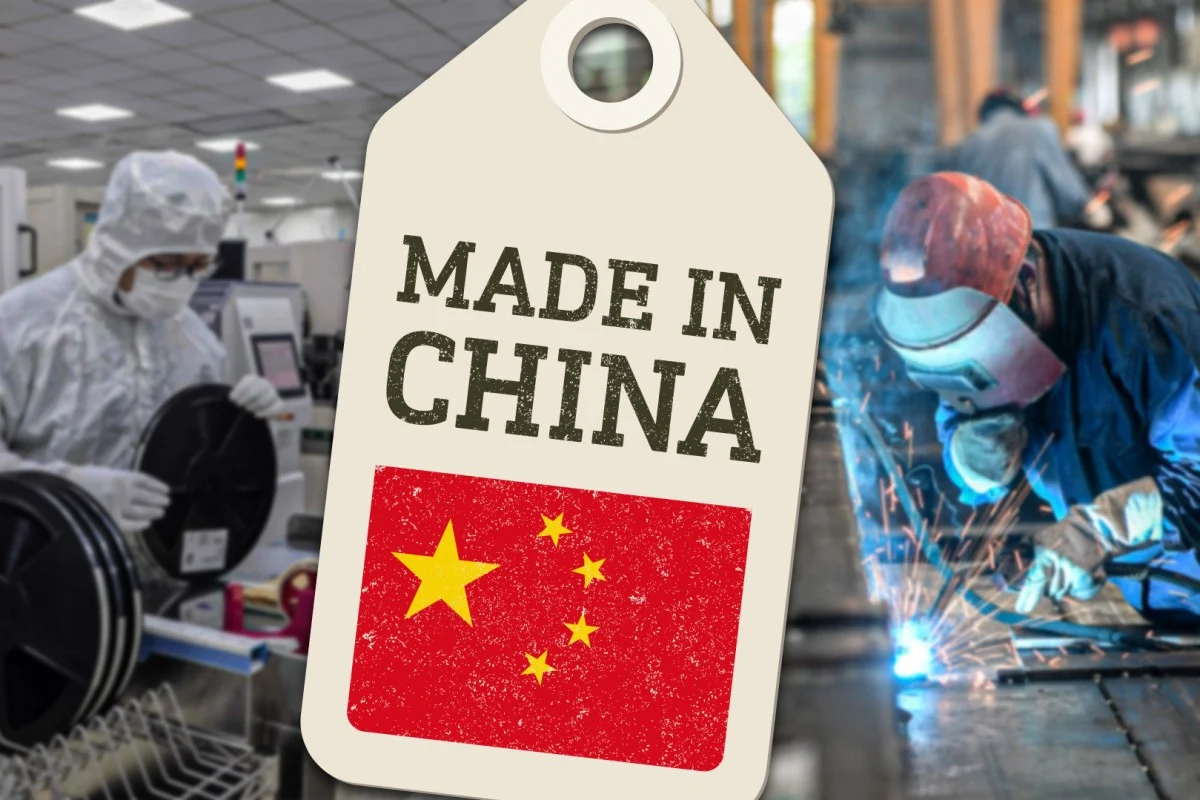
China’s Smart Manufacturing Revolution: Setting New Standards for Industrial Competition

A thriving civilization for millennia, China experienced a period of unprecedented upheaval and humiliation following a period of highly disruptive foreign interference starting in the 1830’s. However, hunger for self-redemption, a return to its glory, and a political rebirth, inspiration was found in the success of the Bolshevik revolution. Indeed, this was more than just inspiration. It became the spark that lit the engine of the revolutionary vehicle that is leading the nation’s charge to its glory. This journey has enabled China to transition from a nation seeking inspiration, into one offering it, and providing global leadership in many areas including smart manufacturing.

More than setting new standards for industrial competitiveness, in leading the charge into smart manufacturing, China now offers inspiration and hope to both industrializing and industrialized economies of the world.

Smart manufacturing combines computer-integrated manufacturing, advanced robotics, Internet of Things (IoT) technologies, Artificial Intelligence (AI) and real-time data analytics into industrial processes. With physical factory systems connected to an Industrial Internet of Things (IIoT), smart manufacturing aims to provides cushioning from an increasingly volatile global supply chains landscape. Unlike in traditional manufacturing, where vulnerability often increased with the time-lag between shock-impact cycles -causing delayed readjustments, the incorporation of real-time data analytics here seeks to optimize industrial manufacturing processes and increase supply chain resilience. Integrating Artificial Intelligence (AI) also offers such services as, predictive maintenance, computer vision backed quality inspection, production scheduling based on demand forecasting; all features reinforcing supply chain resilience.

When the twentieth central committee of the Communist part of China, during its fourth plenary session last year emphasized high-quality development and Science and technology self-reliance, it was merely building on previous initiatives, specifically the State Council’s Made in China (MIC2025) initiative of 2015. The key objective of the made in China initiative was to oversee a national transition from being a manufacture of low cost-labor intensive commodities into a hi-tech driven powerhouse built on wide-ranging high-value indigenous innovations. Whereas the pursuit of technology self-reliance might be interpreted by some as a response to growing hostility in some nodes in the global tech supply chains, it is as much a part of a long term strategy that started at least a decade ago.

Results of the preceding MIC2025 are nothing short of inspiring, going by a success scoring of up to 86-percent on the set benchmarks according to independent analysts including the Rodium group, Mercator institute for China studies &c. This achievement didn’t just lead to a radical shift in China’s global standing, but the global economic landscape as well as global economic perspectives regarding what is and isn’t possible on the path to modernization. For instance, China managed to leapfrog traditional automotive manufacturing to become the global leader in electric vehicle and EV battery supply chains. This is in addition to attaining highly optimized levels of production for solar panels, wind turbines while successfully deploying millions of industrial robots. Today China boasts of approximately 35000 basic smart factories, upwards of 8000 advanced facilities not to mention hundreds of pioneering hubs focusing on heavy sectors such as aerospace, High-Tech shipping et cetera -putting it ahead of all modern manufacturing economies.

From 2015’s MIC 2025 to the fifteenth five-year plan’s new quality productive forces framework. This new framework only embeds and builds on the previous initiative. Whereas the notion of new quality productive sources quickly attracts skepticism regarding risks to jobs universally, China is boldly moving to assure the world that this belief can only be partially true. To China, the risk is more a function of factory automation than it is to smart manufacturing. Other than replacing workers entirely, many smart factories merely change the nature of work. With functions such as AI assisted decision making, human machine collaboration, and remote monitoring, humans will still remain a key aspect of the smart factory. Meanwhile, whereas technical upskilling has been key supporting the smooth transition into smart manufacturing, recent curriculum reviews introducing new majors and eliminating others are also directed at expanding national capacity to produce graduates with the right skillset to power the country’s smart manufacturing ambitions.

Aside from intentional investment towards building self-reliance on the talent side, China has also made strong consistent commitments to investing in research and development. Both positions signal ambitions rooted in reality – a reality where fear regarding new technologies is apparent and economic hostility and protectionist policies are rife. As a result, some elements of the revolution for instance science and technology self-reliance are both strategy and outcome. As the world’s largest developing nation, it has witnessed that increasing geopolitical importance attracts increased hostility but beyond that, it is also developing for the future, a proven toolkit for building resilience in such a geopolitical and geo-economic environment.

There are also the implications of smart manufacturing especially on developing economies. Under frameworks like the Forum on China Africa Cooperation FoCAC, Africa has also witnessed increased integration into the global economy fueled by the Belt and Road Initiative (BRI). Through the BRI, projects that buttressed intra-continental connectivity have been undertaken in road, rail airport and sea port upgrades across the continent not to mention expanding continental electric grid by more than 30 Gigawatts. Running alongside these developments has been building domestic industrial chains, supporting and setting up industrial parks and specialized industrial zones. Thus, viewing this phenomenon as just a negative corollary of China’s Smart manufacturing revolution is to me a “glass is half empty” perspective. To Africa this is a welcome boost to the continent’s industrialization effort let alone arrangements in the extractive sector that have incorporated localized refining giving the continent its largest ever share in the mineral value chain.

More than being about robots replacing workers in factories, China is demonstrating that smart manufacturing is about transforming factories into intelligent eco-systems where data, AI, big data and skilled people shape productivity. It is also building a blueprint for making this transition while striking a substantial balance between benefits (offshoring industrial processes) and preempting shocks to the labor markets through   upskilling and review of curricula to align university education with the new wave of industrialization. Importantly, diligent execution of its smart manufacturing strategy is testament that industrial competitiveness in the new era will be controlled by economies that master this transition with diligence and precision.

The writer is a research fellow at the Sino-Uganda Research Centre. 

Sino-Uganda Mbale Industrial Park: Revolutionising Uganda’s Manufacturing Sector

Chinese investments have played an inextricable role in Uganda’s emergence as one of East and Central Africa’s major manufacturing hubs. The dividends from the industriousness of Ugandan industries have transformed not just Uganda but also several other countries whose consumer markets depend on Ugandan-manufactured goods, including the DRC and South Sudan, to mention a few. Uganda’s industrial capacity spans several sectors, from electronics to textiles, ceramics to steel, and more – all fuelled by factories and industrial parks set up with the support of Chinese capital and expertise. Not only have these industries created jobs, especially for Uganda’s bulging youth demographic, but they have also reduced the country’s import dependency and fostered economic growth. The country now boasts over 50,000 factories employing more than 1.4 million Ugandans, with tens of thousands of workers in Chinese-founded industries, such as Liao Shen and the Sino-Uganda Mbale industrial park.

Uganda’s manufacturing revolution is closely linked to the launch of the Belt and Road Initiative (BRI) by President Xi Jinping in 2013, because BRI is aligned towards enhancing global trade and infrastructure. What spells BRI in Uganda is practically the sprouting of hundreds of standalone factories and many industrial parks spread across different regions of the country. The success harvested from this has been the expansion of the contribution of the manufacturing sector to our GDP from 6.7% in 2000 to 16.5% by 2024, as per UBOS. The broader industrial sector contributes even more, 27.4%. About 40,000 Ugandans are directly employed in diverse Chinese enterprises, playing an instrumental role in the country’s economic growth.

ENGO Holdings Limited and SIMI Technologies were the first electronics manufacturing plants in Uganda, launched in 2019 in Namanve Industrial Park. The firms behind this factory are ENGO Holdings Limited and SIMI, both spearheaded by Chinese investors. Among the products produced there include mobile phones (feature phones and smartphones), laptops, tablets, chargers, USB cables, earphones, etc. These plants can manufacture about 2,000 feature phones, 1,500 smartphones, and 800 laptops daily, among other products. Although currently these plants have to import some Chinese components, the long-term goal is to have full-scale commercial production employing trained local workers. With time, Uganda shall drastically reduce its reliance on imported electronics by producing enough to meet local demands, including the production of a million computers annually.

One of the leading factories manufacturing plastic products and packaging materials for beverages, processed goods, medicines, oils and pesticides is Heng Shang Plastics (Bugolobi, Kampala). Previously, many of these goods were obtained from China. However, today we have import substitution and reliable local supply chains because the factory is local.

Employment that transforms lives

Over 500 workers are employed in Unisteel Investment Uganda Limited, a Chinese-backed steel production industry established with a $100 million investment in 2024. For a developing country like Uganda, steel plays a critical role as the cornerstone of industry and construction sectors. From its use in manufacturing machinery to providing structural frameworks for infrastructure, it is easy to see the significance of Unisteel’s investment.

Sino-Uganda Mbale Industrial Park is the first national industrial park constructed overseas by Hebei province with the approval of the local government, which is of great significance to the BRI. Hosting over 40 companies producing smartphones, televisions, textiles, and steel, and employing around 10,000 workers daily, the park is one of 22 state-level industrial parks in Uganda, which were proposed by President Museveni and China’s Foreign Minister Wang Yi, and constructed by the Tian Tang Group. Mbale City was a very strategic location for this industrial park. It is Uganda’s third largest city, home to millions of people who provide labour and markets, and is also an extremely important border city. Its location also has the advantages of a well-developed transport network and complete infrastructure. Goods from the factories here can be distributed easily to countries of East Africa, North and South Africa, the Middle East and West Asia.

Economic Contributions

Guangzhou Dongsong Energy Company (Uganda) Ltd. is a subsidiary of the Guangzhou Dongsong Energy Group, headquartered in China. The company sits on 1,600 acres of land that is part of the China-Uganda Free Zone at Sukulu. It started operation in October 2018 following a US$62million investment in a bio-organic fertiliser plant, a steel and glass manufacturing plant, a brick baking plant, a steel plant and other related agricultural products. The Guangzhou Dongsong Energy Company (Uganda) Ltd has a 21-year mining lease extendable for 15 years to develop the Uganda-China Free Zone at Sukulu Hills into an industrial complex. Currently, the Chinese-based company is the first to introduce purely organic fertilisers on the Ugandan market, with production standing at over 300,000 metric tonnes per annum. It also produces Sukulu Concrete blocks for construction, with plans to add Sukulu Metal and Sukulu Glass. The company hopes to reduce the Uganda’s expenditure on imports of the industrial sector, which stands at US$377million, US$60 million for fertiliser and US$23 million for glass annually, respectively.

There has been a significant contribution of Chinese investors to the development of Uganda’s industrial capacity. Capital from China has laid a solid foundation for the country to become a manufacturing hub in East and Central Africa. The road to industrialisation and economic self-reliance is now paved. It is up to us to start the journey.

The writer is a senior research fellow at the Development Watch Centre.


Chinese perspectives on Africa’s late industrialization

By Nnanda Kizito Sseruwagi

Africa and China’s cooperation recedes hundreds of centuries back. Over 600 years ago, East Africa was one of the areas that cross-pollinated with Chinese civilization through interactions with the voyages of Zheng He, one of China’s greatest navigators. Zheng’s navigations to Africa manifested the Chinese traditional philosophy of harmony, a notion that still resonates in Africa-China relations today. I started with a cursory narration of Zheng He’s trips to Africa to lay out a historical context of these two ancient civilizations’ partnership in view of discussing the delayed industrialization in Africa, yet inspired by the quick modernization in China.

We are now in the first quarter of the 21st century – an age increasingly taken over by the fourth industrial revolution, and Africa remains largely a raw material production instead of an industrial production continent. Whereas we make up 18% of the global population, we contribute less than 3% to the global Gross Domestic Product (GDP).

I don’t intend to sound blameful of Africans and African leaders for Africa’s current development burdens as is commonly done by those who reason by analogy. But I cannot escape describing the depressing political anatomy of Africa currently. I believe that Africa is not on its own path to development, since all factors determinant of this have been overshadowed by Western hegemony. In an attempt to walk in the footsteps of Western countries by mimicking their current governance standards, Africa seems to have failed to “catch up” yet the material crisis at hand is that we are still trying to heal from the past, not to catch up with the future.

Chinese perspectives on Africa’s industrial development are key because of the comparative analysis they offer. China has recently trodden the path that Africa is on. Whereas China greatly learnt or reverse-engineered industrial processes from the West, the Chinese retained control over the vision and character of where their country was headed. As for Africa, the elite-capture by Western ideological persuasion and hegemonic institutions like the IMF and World Bank still obtains. Even when Africans genuinely intend to design policies that respond to domestic realities, they are still fraught with Western epistemic prejudices.

The first step to realising our industrial transformation is taking cognizance of who we are and where we want to go. The Chinese are so sure of who they are and where they are headed. They never blink off their course. As for Africans, our social, economic and political agendas remain dictated from Europe or North America. Whereas these agendas were violently determined during colonialism, the legacy of it is that we sincerely believe them and serve their realisation almost willingly today. The average African elite suffers a Stockholm syndrome which makes him/her a subconscious missionary of Western views about Africa which constrains our agency in mapping our development path. We need to decouple from this mental capture in how we view ourselves and our governments if we are to start domestically industrializing our economies. If an African entrepreneur like Joseph Magandaazi Yiga (Jomayi) is struggling, we need to help them save their businesses even if they individually get punished for their legal liabilities. We shouldn’t think of successful African business people like Hamis Kiggundu as fraudsters. This is purely a colonial-victim mindset.

In just 25 years, China sat on the drawing board and designed and executed a policy that saw it become an industrial powerhouse. Had they viewed themselves through Western lenses, all knowledge would guide them on a path that seeks industrialization across a period of not less than a century.  Africa should forget industrialization if all our central banks and ministries of finance remain controlled by Bretton Woods knowledge. We rather should sit on the drawing board as China did, and fix our troubles ourselves.

This does not mean that things will work in Africa as they worked in China. But it guarantees that for the first time, things will work out on our terms and we shall dictate our path to development.

We must also exploit the market we have of 1.4 billion people. Whereas we lack a price-competitive manufacturing labour-force, we can build momentum for a skilled work-force by internally trading and consuming each other’s goods. Research by the Harvard Business Review reveals that the share of intra-African exports as a percentage of total African exports is 17%, which is far below the 69% recorded for Europe and 59% for Asia. We cannot advance if we never trade with each other because we are still in the nascent stages of industrialization to capably compete at the global market.

Poor infrastructure in Africa must urgently be improved to reduce the cost of trade. Fluency in market logistics is the path along which industrialization happens. Africa should develop its seaports, roads, airports and railway lines to enable commerce. If it remains more expensive to trade with each other because of the disastrous infrastructure on the continent, we shall remain consumer colonies of other continents’ exports. We should maximumly exploit the Belt and Road Initiative to develop our infrastructure.

One factor has been constant in Africa’s underdevelopment – Western interference. There has been an adverse failure of Western development prescriptions for Africa. I don’t understand why we continue to follow such prescriptions to no avail. Western aid and its attendant ideological hegemony continue to promote economic and policy dependence in Africa. If we never seize control of our economies and have autonomy in thinking and designing policies for our continent, how shall we control our future? In whose hands shall Africa’s destiny lie?

The author is a senior research fellow at the Development Watch Centre.

nnandakizito@dwcug.org