A thriving civilization for millennia, China experienced a period of unprecedented upheaval and humiliation following a period of highly disruptive foreign interference starting in the 1830’s. However, hunger for self-redemption, a return to its glory, and a political rebirth, inspiration was found in the success of the Bolshevik revolution. Indeed, this was more than just inspiration. It became the spark that lit the engine of the revolutionary vehicle that is leading the nation’s charge to its glory. This journey has enabled China to transition from a nation seeking inspiration, into one offering it, and providing global leadership in many areas including smart manufacturing.
More than setting new standards for industrial competitiveness, in leading the charge into smart manufacturing, China now offers inspiration and hope to both industrializing and industrialized economies of the world.
Smart manufacturing combines computer-integrated manufacturing, advanced robotics, Internet of Things (IoT) technologies, Artificial Intelligence (AI) and real-time data analytics into industrial processes. With physical factory systems connected to an Industrial Internet of Things (IIoT), smart manufacturing aims to provides cushioning from an increasingly volatile global supply chains landscape. Unlike in traditional manufacturing, where vulnerability often increased with the time-lag between shock-impact cycles -causing delayed readjustments, the incorporation of real-time data analytics here seeks to optimize industrial manufacturing processes and increase supply chain resilience. Integrating Artificial Intelligence (AI) also offers such services as, predictive maintenance, computer vision backed quality inspection, production scheduling based on demand forecasting; all features reinforcing supply chain resilience.
When the twentieth central committee of the Communist part of China, during its fourth plenary session last year emphasized high-quality development and Science and technology self-reliance, it was merely building on previous initiatives, specifically the State Council’s Made in China (MIC2025) initiative of 2015. The key objective of the made in China initiative was to oversee a national transition from being a manufacture of low cost-labor intensive commodities into a hi-tech driven powerhouse built on wide-ranging high-value indigenous innovations. Whereas the pursuit of technology self-reliance might be interpreted by some as a response to growing hostility in some nodes in the global tech supply chains, it is as much a part of a long term strategy that started at least a decade ago.
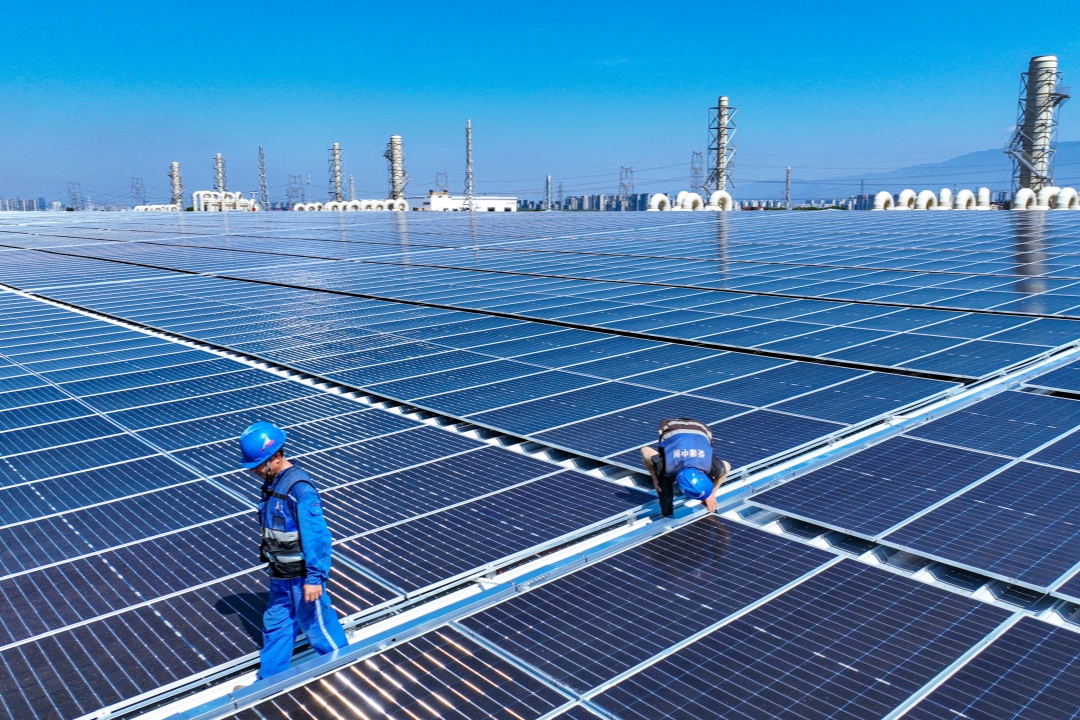
Results of the preceding MIC2025 are nothing short of inspiring, going by a success scoring of up to 86-percent on the set benchmarks according to independent analysts including the Rodium group, Mercator institute for China studies &c. This achievement didn’t just lead to a radical shift in China’s global standing, but the global economic landscape as well as global economic perspectives regarding what is and isn’t possible on the path to modernization. For instance, China managed to leapfrog traditional automotive manufacturing to become the global leader in electric vehicle and EV battery supply chains. This is in addition to attaining highly optimized levels of production for solar panels, wind turbines while successfully deploying millions of industrial robots. Today China boasts of approximately 35000 basic smart factories, upwards of 8000 advanced facilities not to mention hundreds of pioneering hubs focusing on heavy sectors such as aerospace, High-Tech shipping et cetera -putting it ahead of all modern manufacturing economies.
From 2015’s MIC 2025 to the fifteenth five-year plan’s new quality productive forces framework. This new framework only embeds and builds on the previous initiative. Whereas the notion of new quality productive sources quickly attracts skepticism regarding risks to jobs universally, China is boldly moving to assure the world that this belief can only be partially true. To China, the risk is more a function of factory automation than it is to smart manufacturing. Other than replacing workers entirely, many smart factories merely change the nature of work. With functions such as AI assisted decision making, human machine collaboration, and remote monitoring, humans will still remain a key aspect of the smart factory. Meanwhile, whereas technical upskilling has been key supporting the smooth transition into smart manufacturing, recent curriculum reviews introducing new majors and eliminating others are also directed at expanding national capacity to produce graduates with the right skillset to power the country’s smart manufacturing ambitions.
Aside from intentional investment towards building self-reliance on the talent side, China has also made strong consistent commitments to investing in research and development. Both positions signal ambitions rooted in reality – a reality where fear regarding new technologies is apparent and economic hostility and protectionist policies are rife. As a result, some elements of the revolution for instance science and technology self-reliance are both strategy and outcome. As the world’s largest developing nation, it has witnessed that increasing geopolitical importance attracts increased hostility but beyond that, it is also developing for the future, a proven toolkit for building resilience in such a geopolitical and geo-economic environment.
There are also the implications of smart manufacturing especially on developing economies. Under frameworks like the Forum on China Africa Cooperation FoCAC, Africa has also witnessed increased integration into the global economy fueled by the Belt and Road Initiative (BRI). Through the BRI, projects that buttressed intra-continental connectivity have been undertaken in road, rail airport and sea port upgrades across the continent not to mention expanding continental electric grid by more than 30 Gigawatts. Running alongside these developments has been building domestic industrial chains, supporting and setting up industrial parks and specialized industrial zones. Thus, viewing this phenomenon as just a negative corollary of China’s Smart manufacturing revolution is to me a “glass is half empty” perspective. To Africa this is a welcome boost to the continent’s industrialization effort let alone arrangements in the extractive sector that have incorporated localized refining giving the continent its largest ever share in the mineral value chain.
More than being about robots replacing workers in factories, China is demonstrating that smart manufacturing is about transforming factories into intelligent eco-systems where data, AI, big data and skilled people shape productivity. It is also building a blueprint for making this transition while striking a substantial balance between benefits (offshoring industrial processes) and preempting shocks to the labor markets through upskilling and review of curricula to align university education with the new wave of industrialization. Importantly, diligent execution of its smart manufacturing strategy is testament that industrial competitiveness in the new era will be controlled by economies that master this transition with diligence and precision.
The writer is a research fellow at the Sino-Uganda Research Centre.