Uganda’s BRICS Partnership: A Role in Reshaping the Global Order

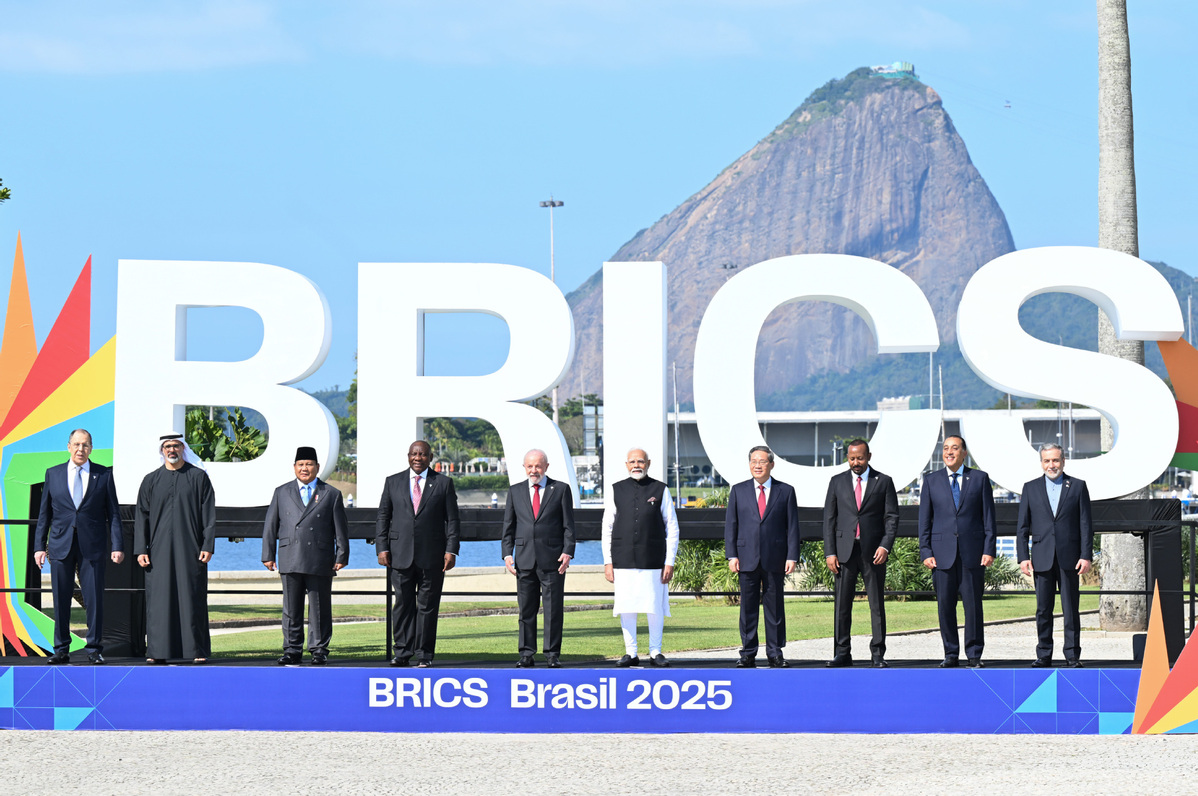
The BRICS summit in Rio was the death knell to the old world order. In a seismic shift of global power diplomacy, 11 countries; with Uganda being the sole representative from East Africa, were formally admitted into the alliance. This bold move is an undeniable vote of confidence into the promise of the alliance to scale inclusive growth and sustainable governance.

The parallel remarks by US President Trump labeling BRICS-aligned nations as “enemies” and threatening 10% tariffs on their exports, underscore the urgency of the BRICS vision of a multipolar world of open markets and mutual prosperity. President Trumps remarks ought to call for a diplomatic response, not retreat. Uganda has the enviable opportunity to leverage its BRICS role as a spur for  economic resilience and regional leadership, ensuring Africa’s voice plays a role in shaping the global agenda within the BRICS framework.

The BRICS alliance was formed on the premise of a single question; why? Why should a single nation’s currency (not backed by anything) be the reserve currency of the entire world? Why must the global power structure be perpetually tilted to favor a select few world powers who lord systems of governance and economic monopolies around the globe? Why must we maintain a global world order that cripples our economies, inflates our trade deficits, and keeps us in a perpetual cycle of non-developmental administrative restructures blind to our cultural diversity? Why must our survival be financed by non performative debts to maintain extractive economies?

BRICS offers a numerical answer of 4.5 billion people. Our partnership with the BRICS offers the Ugandan farmer(seven in 10 Ugandans are engaged in agriculture) an expanded market of 4.5 billion people to sell our coffee and to as well as a myriad of other farm products, the Ugandan entrepreneur joins an expanded economy of 27.35 trillion dollars to explore and for the government a NewDevelopment Bank that will finance not a hamster wheel of neo-colonial extraction but real infrastructural development. Trading in local currencies like the Chinese yuan and South African rand can stabilize incomes for Ugandan investors , freeing them from the evident volatility of dollar dependence.

President Trump’s tariff threats, aimed at BRICS members and partners, challenge our economic ties with the U.S, including vital health programs still reeling from the impact of the early aid cuts by the current administration. This is precisely why Uganda’s BRICS partnership matters both nationally and regionally. It offers a pathway to diversify our alliances, reducing reliance on any single global power and in the growing multipolar world. As a nationalist with an unwavering “America First” principle, President Trump ought to be the strongest proponent of BRICS which is hinged on cultivating independent yet inclusive frameworks for transnational cooperation with core principles of mutual respect, understanding, sovereign equality, solidarity, democracy inclusiveness, collaboration and consensus.

To fully embrace this moment, Uganda must act with strategic foresight. A dedicated BRICS envoy would ensure our priorities—trade equity, climate finance, and global governance reform—are central in the partnership’s high level discussions. As East Africa’s sole BRICS partner, Uganda’s uniquely suited to re-echo the voices of Kenya, Tanzania, and Rwanda and the broader African Union, advocating for a permanent African UN Security Council seat and funding for sustainable energy and knowledge transfer. A national BRICS strategy, shaped by academics, businesses, and communities, would unify our efforts, positioning Uganda as a regional leader. Our history of peacekeeping in Somalia and South Sudan shapes us as continental leaders who can lead on the global stage, bridging divides with diplomacy.

What BRICS brings to the table is partnership based on mutual respect and the highlevel discussion in Brazil was a stark contrast to the Whitehouse Luncheon organised for African heads of states that coincided with the Summit where President Trump is quoted telling the African presidents to “go a bit quicker than this because we have a whole schedule. If I could just have your name and country, that would be great.

BRICS is not a rejection of the West but a complement to it, offering Uganda flexibility to engage multiple partners on diversified fronts. The African Continental Free Trade Area, set to transform regional trade, can work alongside BRICS to strengthen our markets As well as other BRICS member implemented projects like the Belt and Roads Initiative by China which has already spurred significant progress in Africa. As a BRICS partner, Uganda must speak with clarity, advocating for a world order where power is shared, not hoarded. Our BRICS partnership is a call to lead, ensuring East Africa’s aspirations resonate globally.

Shemei Ndawula is a Senior Research Fellow at the Development Watch Center.
BRICS: The Vehicle of Inclusive Development, Tranquillity and Multipolar World

By Allawi Ssemanda

The 15th BRICS Summit is ongoing in South Africa’s city of Johannesburg under the theme BRICS and Africa- Partnership for Mutually Accelerated Growth. The summit comes at a time when the world being tested by challenges such as geopolitical competition, the climate crisis, unilateralism, block confrontation with some countries in blocks promoting own security at the expense of others which critical analysts blame for the ongoing Russia-Ukraine crisis.

This year’s summit theme, gives hope African dream momentum. Almost all the leaders of the grouping which today accounts for 40% of global population and slightly more than 30% of world’s GDP are united and see African allies as equal partners. Also, the group’s success is making many countries court them with hopes of joining and benefiting from inevitable benefits that comes with being a member. More than 40 countries including Nigeria, Ethiopia, Argentina, Saudi Arabia, Iran and United Arab Emirates have expressed interest to join the group. However, BRICS leaders must ensure that the group’s expansion is driven by real reasons and purposeful inclusion by admitting members that align with their “ideal” view of the multipolar world the group wants to build. This means their expansion must be strategic; candidates’ animosity towards the west should never be used as qualification for one to become a member.

This is not to say that the group should not expand. There are more reasons for the BRICS to expand now than ever before. As Chinese ambassador to South Africa, Chen Xiaodong recently observed, “the traditional global governing system has become dysfunctional, deficient and missing in action” while BRICS grouping has stood the test of the time as fierce defenders of international justice.

Also, having countries like Nigeria and Ethiopia as members of BRICS will help amplify African countries voice calling for reforms in the UN more audible. For long, African countries have called for reforms at the UN especially in the formation of the United Nations Security Council UNSC permanent members which African countries view as heavily biased against them.

It should be recalled that in 1945 when it was founded, only four African countries were members. Today, all the 54 African countries are full members of the UN. However, of the 193 member states, only United States of America (USA), United Kingdom, France, Russia and China commonly referred to as the 5P are the permanent members of the UNSC – the organisation’s highest decision-making body. This gives the five countries more powers (veto) when it comes to voting on important issues in the council.

The irony of this is that, Africa whose membership at the UN is close to 28% of the body’s total membership has no major role despite always being the centre of discussion during the council’s work. In 2018 for example, more than 50% of UNSC’s meetings, 60% of their official documents and about 70% of their resolutions contained chapter VII mandates all focused on Africa. This means that without Africa, the UN as a body is arguably incomplete. This is not to say that I don’t recognise the fact that in the UNSC Africa is represented by the so-called A3, a block of three elected African states. It is important to observe that, the A3 countries have no big say at the security council because, none has veto power as opposed to the other five states with permanent membership.

The good news is that all the BRICS founding members c, non is opposed to Africa having a representative at the UNSC with equal powers as it is with the 5P. They are all involved in calling for reforms at the UN including reforming the current financial systems dominated by the Bretton woods institutions which many analysts argue work on whims of the U.S and allies.

Critical analysis of Brazilian President Luiz Inácio Lula da Silva who while defending closer ties with Africa noted that “Brazil is back on the continent it should never have left. Africa offers vast opportunities and enormous potential for growth,” to China and Russia who have been strong advocates of African interests, it is clear that African countries’ interests have strong backing among all the founding members of the BRICS  in their call for reforms in the so-called traditional global governing system.

The current rhetoric among BRICS leaders, there is no doubt that BRICS offers more benefits to Africa than any other grouping today including the G7 which has always promised and when it comes to implementation nothing comes as was the case with their promise during the 2021 G7 summit in Cornwall, England where they promised infrastructure support to African countries under what U.S ruler Joe Biden called “build back better for the world” (B3W) that never materialised before they changed it to another white elephant announced during the 2023 G7 summit in Japan’s city of Hiroshima.

On the eve of the ongoing BRICS summit, Chinese president Xi Jinping published an article in south African major dailies entitled “Sailing the Giant Ship of China-South Africa

Friendship and Cooperation Toward Greater Success” President Xi explained that; “China is ready to work with fellow BRICS partners to act on the BRICS spirit of openness, inclusiveness and win-win cooperation, build consensus on important issues, carry forward our tradition of independent diplomacy, and resolutely uphold international equity and justice. We will urge the international community to refocus on development issues, promote a greater role by the BRICS cooperation mechanism in global governance, and make the voice of BRICS stronger.”

Whether as a group or individual, BRICS countries have in many ways shown their resolve to work with African countries supporting, their social economic development. As President Xi observed in his ‘Sailing the Giant Ship of China-South Africa Friendship and Cooperation Toward Greater Success,’ “I will work with African leaders to bring more active, effective and sustainable development initiatives to Africa, expand cooperation in agriculture, manufacturing, new energy and digital economy, and facilitate Africa’s economic integration, industrialization and agricultural modernization. China will continue to work for substantive progress in African Union’s joining of the G20 this year, and looks forward to a greater role by African countries and the AU in international and regional affairs.”

In conclusion, in all aspects, the BRICS has great potential to grow while helping the entire global south to develop. With their continued push for a multipolar world and calling for reforms in the current global system, the question at the centre is whether the group is willing to overtly challenge the current global system which has arguably given them the platform and more importantly lessons to learn from, or if they will take a step back and fight covertly and and stay fighting within while pushing for the ideal world they dream of. The challenge with the latter is that with this option, they risk to lose their sight through socialisation and thereby abandoning the zeal of building their ideal world.

That said, the future of BRICS and by extension of Africa is bright. With win-win cooperation which BRICS countries support, working together in sincerity will see the alliance growing stronger as the grouping and Africa work together in building of a world with a shared future in the new era for mankind.

Allawi Ssemanda is a senior Research Fellow at the Development Watch Centre


CHINA-AFRICA LEADER’S DIALOGUE AT THE BRICS SUMMIT

By Moshi Israel

The 15th annual BRICS summit in Johannesburg, South Africa covers an important theme of BRICS and Africa; Partnership for Mutually Accelerated Growth, Sustainable Development, and Inclusive Multilateralism. During this summit, the President of China, Xi Jinping will co-chair alongside Cyril Ramaphosa, President of South Africa the China-Africa leaders’ Dialogue as announced by the Chinese foreign ministry.

This dialogue suitably ties into the overall theme of the summit and has the potential to produce serious outcomes for the African leaders that will take part. China is Africa’s biggest trade partner and has strengthened economic and social ties with the continent through the Belt and Road Initiative, FOCAC, South-South cooperation programs, and a plethora of other development programs.

This dialogue is a vital opportunity for the exchange of ideas that could lead to significant changes on the continent. A major priority for African leaders should be a focus on further investment in the transition to digital economies. Africa still lags behind the rest of the world when it comes to the Internet of Things. Key sectors of the African economy such as health, education, transport, and Agriculture would be more productive if digitised.

Many African countries need to take advantage of the Digital Silk Road (DSR); a component of the Belt and Road Initiative (BRI). The DSR is China’s rebranding of its continuous support for technological advancement all over the globe. During the 1990s, Africa experienced a telecommunications revolution and many Chinese firms set their eyes on the continent. The telecommunications revolution was largely due to many African countries liberalizing their telecommunications sectors and upgrading their infrastructure. This development has been driven by the increased use of mobile telephones and broadband for internet access. It is projected that by 2025 there will be about 615 million mobile subscribers in sub-Saharan Africa which is about 50% of the region’s population.

This digital revolution in the telecoms sector has largely been dependent on Chinese firms such as Huawei Technologies, China Telecom, and ZTE which have chipped substantial market share away from non-Chinese companies such as Nokia, Alcatel, Ericsson, and Siemens. Chinese technology firms have played a vital role in building, upgrading, and investing in Telecom’s infrastructure including internet backbone networks, satellites, and undersea cables. These companies offer affordable services and equipment and remain effective and productive.

Since world development is now driven by technology, the digitization of African economies should be higher on the list of priorities when African leaders meet with president xi Jinping. The Digital Silk Road initiative is rarely talked about for instance in a country like Uganda. It is the responsibility of the Ministry of ICT in this country to investigate this issue further and clearly discern opportunities for Uganda’s transition to a digital economy. A push should be made toward isolated individual country technology summits with China’s technology firms, where the youth and other stakeholders are given a chance to engage with these companies.

The citizens in many of the countries that will hold dialogue with the President of China are eagerly waiting for notable outcomes of the summit. It is imperative that African leaders should put the interests of their citizens at the forefront during such impactful deliberations with the continent’s largest trade partner.

Beyond the focus on Digital transition should be a discussion about the need for Africa’s Agricultural products to have a healthy access to the Chinese market. This is naturally conditioned on the quality of products Africans are putting on the market. For instance, the president of Uganda has always championed Uganda as a food basket and advocated for the need for Ugandans to earn from cash crop farming. This dialogue presents a unique opportunity to further this agenda.

Another important issue is that of climate change. African leaders should engage China on the transition to green economies. The latter has been a champion for sustainable development and the fight against climate change and has spent billions of dollars to the cause. A multilateral framework underscoring a combined effort to address climate change issues should be presented by the representatives of African countries during the dialogue. Africa is not the leading polluter in the world but is already suffering the harshest consequences of climate change and global warming. Furthermore, the continent is now faced with the dilemma of industrializing at the expense of the climate or going green at the expense of much needed industrialization and development. However, China could be a reliable partner in striking a balance. Much more investment is required in order for African countries to safely transition to green economies without sacrificing their right to industrialization and economic development.

Finally, the elephant in the room (or not in the room for this matter) should be discussed. This involves the collective west and its reaction to an increasingly pro-china Africa. In an international system based on realpolitik, every country’s interests come first and therefore, partnerships must be formed with this reality in mind. If China is interested in a long-term strategic relationship with Africa, it must offer terms much better and different from the west. And if African countries want to truly benefit from the partnership with China, they must adapt new ways of engaging with china, based on the principles of mutual benefit and placing African interests at the forefront.

The Writer is a Senior Research Fellow with Development Watch Centre


By Musanjufu Benjamin Kavubu

Finally, the 15th annual BRICS summit is happening, and it is taking place on the African continent. There has been a lot of talk about it this time as though it’s happening for the first time but that is because of where the world finds itself at the moment. Ukraine-Russia crisis is impacting everything and the BRICS summit is not unique to the fact after all the “R” in the “BRICS” is at the forefront of what the Kremlin has eloquently blamed on what they call NATO’s eastward expansion spree which threatens Moscow’s national and strategic interests. There is no doubt, this ongoing crisis which the west is fuelling pumping arms into Ukraine has changed public opinion about the current World Order which the BRICS sees as biased to them.

BRICS started in 2001 as BRIC and it got its name from a report by Jim O’Neill who was an economist at Goldman Sachs and he predicted then that Brazil, Russia, India, and China would be the world’s leaders economically by 2050 because of the trajectory the four countries economies where taking. In 2010 South Africa joined to form the current BRICS that the whole world is talking about now which analysts argue it puts the G7 on spot especially that unlike G7, BRICS in all ways stands for the interests of the so-called emerging economies while speaking for entire global south.

Russia’s military operation in Ukraine is not the only reason the 15th BRICS summit is making headlines, but global problems like climate change are key to the agenda and also the over 40 requests from countries to join the formation is keeping the West on its heels.

At the moment, the formation is made up of about a population of 3.2 billion humans that can be also termed a labor force and market, a GDP of $ 24.44 Trillion that seems small compared to the population but an average of $ 7,500 GDP per capita is a dream for many in the global south especially in Africa.

At a time when the world is looking for an alternative to the current world order that is shaped by the US dollar the way BRICS operates seems like the best option going forward.  It’s rumored that Egypt, Algeria, Argentina, and Iran are close to membership then it’s a matter of time before everyone jumps onto the formation. Every developing country would desire this kind of forum that offers consultation and cooperation on significant economic and political issues between member countries and seems to be working.

Through the annual BRICS summit like the 15th South of the African continent, we should expect working groups on areas such as finance, trade, investment, science and technology, and health to set up and they are open to even those countries who are just willing to join. These working groups will then continue to meet as they from time to time identify areas of mutual interest and coordinate their efforts to foster inclusive development a major tenet of the BRICS.

As the formation meets on the African continent BRICS fits the current narrative by African leaders of complete independence from the West’s domination. BRICS members agreed at the start and going forward to strive for inclusive economic growth and to eradicate poverty, to fight unemployment, promote social inclusion, promote innovative economic development based on new technologies like blockchain and develop skills of citizens at the same time strongly cooperating with other countries.

Africa has a chance not to leave anyone behind through the BRICS formation since the ground in the group has proven the antithesis of elitism with its original intention of a restructured political, security, and economic outlook of the world. Africa also has conditions that are in line with the founding members of the BRICS for example fastest growing and emerging economies like Nigeria that is seeking membership, low labor costs that is being brain and muscle drained to Europe, favorable demographics of youths, and natural resources. These conditions need economic cooperation and development through multilateralism to have win-win situations at the end of the day.

To Africa, BRICS through the New Development Bank NDB can offer funding for infrastructure and sustainable development projects as it relives the pressure created by the Bretton Woods systems institutions like the IMF and World Bank that recently decided to stop funding in places like Uganda. For those countries that will go on to attain full membership, BRICS has the Contingent Reserve Arrangement CRA which is a financial safety net that provides liquidity support to members in case of balance of payment difficulties.

As AfCFTA works by boosting intra-African trade from 12% to 30% BRICS through Bilateral and Multilateral areas of trade, investment, technology transfer, Cultural exchange, and matters of security the Free trade Area on the continent can be unstoppable. BRICS along AfCFTA with the free movement of people would bring about people-to-people exchange programs and then foster research and innovation. Cultural exchange, enhance economic and social ties within the formation to create countries that can take on the West. Maybe even the International Criminal Court would be restructured and made to make more sense than being a tool for the West.

Apart from offering hope to Africa and the entire global south BRICS is so important that it offers a workable framework that can be exploited for real and true development that is inclusive. With BRICS bringing Africa on board the world Rebalancing will not be just a song but a reality. As Modi of India, Xi of China, Lula of Brazil, Ramaphosa of South Africa, and Putin is being represented by maybe Lavrov, since he has a war to attend to and just survived a mutiny come together BRICS through the NDB can start the process of de-dollarization in Africa where US designed sanctions are used and hurt most.

By Musanjufu Benjamin Kavubu is a Junior Research Fellow at the Sino-Uganda Research Centre.