The Modern Thucydides Trap: How China’s Rise Challenges American Hegemony

The American political scientist, Graham Allison, popularised the concept famously known as the “Thucydides Trap.” This concept suggests that whenever a rising power threatens to displace an established one, the tension often guarantees a conflict will arise (war), unless deliberate efforts are made to avoid it. The concept borrows its name from Thucydides (c. 460-400 BC), who was an Athenian general, politician and historian who lived through the ferocious Peloponnesian War (431-404 BC) between Athens and Sparta, which, the philosopher Will Durant quips, “Thucydides took part in…and recorded it blow by blow.”

Graham Allison has applied the Thucydides framework to the great-power politics of the 21st Century between China and the United States. He views China as a rapidly ascending power that threatens to displace the United States, which, since 1991, has enjoyed unipolarity following the collapse of the Soviet Union.

Due to China’s rapid rise as a powerful contender in world affairs, there is structural stress it is exerting towards the ruling power, i.e., the United States. This stress could build fear and amplify the risk of miscalculation among America’s foreign policy elite, hence increasing the risk of war. China has made significant advancements in various fields of global dominance. It has modernised its military, most recently unveiling a sixth-generation stealth fighter jet, the Chengdu J-36. Since 2014, it has had the world’s biggest economy in PPP, and it continues to grow by leaps and bounds. It has also expanded its global influence, especially in the global south through the BRICS and BRI structures. China is also leading in the world’s most decisive technologies of the future, including robotics, Artificial Intelligence, clean energy, 5G technology, etc.

Whereas America still reigns supreme in maintaining a military reach unparalleled in history, with its cultural influence stamped on the fabric of almost all societies in the world, and having control over global financial systems through its Bretton Woods institutions, China’s rise still presents a serious challenge to its post-World War II primacy.

Whenever such scenarios arise, argues Allison, having studied 16 out of 20 historical cases, accounting for an 80% occurrence rate in the past 500 years, the likely outcome is always a military conflict, unless there are factors that intervene in the rival groups’ diplomatic camps to solve the crisis.

However, across historical time, new variables have emerged in the 21st century, which may change the context in which we understand the Thucydides trap. Unlike any previous period in history, today’s big powers are armed with nuclear arsenals, are highly interdependent on each other economically, and are closely connected digitally, which, fortunately, might make the possibility of a catastrophic all-out war less likely, as it is less rational.

Also, today, unlike yesterday, the possible outcomes of the Thucydides trap are hinged on non-traditional domains, i.e., cyber warfare, ideological competition, etc. Nevertheless, the flashpoints of rivalry between China and the U.S. are apparent in Taiwan, the South China Sea, on trade disputes, etc.

In our time, the Thucydides trap could manifest as a “digital trap.” This is because the great competition of our world is now shaped by technological supremacy, whereby nations seek to dominate each other in Artificial Intelligence, quantum computing, robotics, and other cyber capabilities. Mutual fear between China and the U.S. of losing an edge over the other in the areas mentioned above could instigate “war by other means” through sabotage, espionage, cyber-attacks, etc, which unfortunately might escalate into broader conflicts. If the ruling elites in the two major powers are smart, they could instead encourage joint ventures and mutual dependency to deter aggression. This is possible, as it has been done in regards to the International Space Station, where astronauts from Russia, China, the USA, and other countries mutually work together.

Environmental pressures due to climate change could also catalyse a new dimension of the Thucydides trap in our time. Natural disasters and resource scarcity could intensify China and America’s competition for resources like arable land and rare earth minerals, which are critical for building green technology. On the flip side, since climate change is a global crisis which no nation could single-handedly solve, the two countries could turn this vulnerability into an area of cooperation on global climate initiatives, which would turn the trap into a web of opportunities for collaboration.

However, the structural inevitability of competition does not make war a predetermined outcome. The two countries’ competition can be translated into collaboration, since they are both highly interdependent. China holds over $1 trillion in U.S. debt. America also heavily depends on Chinese industries for manufacturing its products, while at the same time having China as its biggest export market.

In the heat of the Cold War, after the Cuban Missile Crisis, when the Soviet Union and America came close to a nuclear war, they established a direct phone line between the Kremlin and the White House for leaders of both countries to be able to constantly communicate to avoid any scenarios. This might be the time to do the same for U.S.–China relations. Both countries must prioritise regular high-level dialogue to avoid the Thucydides trap. This is in the interest of the entirety of human civilisation.

The writer is a senior research fellow at the Development Watch Centre.

The International Liberal Order is not Under Attack It’s Just Being Interrogated

Proponents of the International Liberal order have spent much of its lifespan trying to shield it from criticism. They’ve actively masked its shortcomings, dismissing any flaws and Inconsistencies. A fortune has been spent on media influence campaigns and another on military campaigns to re-inforce this ideal, all to keep the rules based order well made up and hide any signs of cracking. Whether these costly efforts to preserve the sanctity of the liberal order were worth it as opposed to facing the reality of its challenges remains an open question. But here we are, it did not work. At least not in the way that the costume designers intended. The make-up still flaked and the cracks still showed. But even then, the ever zealous stylists insisted: the show must go- on.

Now, more countries are asking questions about the undisputed beauty of the rules based order and predictably, those who spent years crafting its reputation and covering up its shortcomings view this mere questioning as an attack. They overreact because deep down they are aware that the package they are marketing is not complete but hoped no one else would notice or even dare to speak up about it. This panic has made China’s genuine interrogation of the liberal order come off as an outright challenge and attack. But China will not relent and the global south has picked up the scent too.

In his book 21 lessons for the 21st century, Yuval Noah Harari argues that many critics of the liberal system point out its problems but fail to offer solutions. On this point, I beg to differ. China has offered a workable solution. It’s not pushing for the overthrow of the liberal system but rather an upgrade. China’s proposal essentially keeps many of the good things about the liberal order; Free trade, international institutions, cultural exchange, sovereignty and non-aggression, democracy and human rights—at least in principle and advocates for it to be more just and inclusive. It recognizes that the fundamental problem of the liberal order lies in its western-centric nature. And this nature automatically breeds structural inequality for all the rest. And that is China’s biggest crime in the eyes of the liberal order’s stylists: insisting that the system live up to its aspirations.

The liberal order has seen inequality widen among and within nations. The gap between the rich and the poor has significantly increased. When it comes to income, the richest 10% globally make 52% of the global income while the poorest half make only 8%. The wealth gap is even more astounding with the richest 10% owning 76% of global wealth while the poorest just owns 2%. This disparity extends to climate injustice. The wealthiest nations emit more greenhouse gases in total and per capita compared to the poorest nations and yet it’s the latter that bear the brunt of the consequences; floods, drought, food insecurity, and displacement.

We have recently gone through a global pandemic that claimed millions and tested the strength of global solidarity and are now facing a global economic downturn coupled with a surge in regional conflicts that risk escalating into something worse. The InfoTech and Biotech sectors are increasingly running out of control of public oversight, unemployment and the threat of future unemployment are on the rise and many countries are now looking to build physical, economic and ideological walls instead of bridges.

China, more than any nation seems to recognize this impasse and is proposing an alternative approach to global political management. China’s current political ideology and system are always misunderstood either deliberately or out of ignorance. The Chinese managed to borrow the best ideas from ideological currents of the modern world; Nationalism, communism and liberalism.

The Chinese are nationalists at the core with a strong identity that they revere. They have adapted a ‘socialism with Chinese characteristics’ that respects their unique identity and national realities and have chosen to participate and contribute to the global liberal order through their opening up and consistent advocacy for the rule of law and respect to international institutions. The Chinese have not made the mistake of assuming that one system is better than all and fits all national contexts. They have applied logic to international relations and let humans control the system instead of having systems control humans. They have chosen ideological pragmatism instead of ideological purity.

Should China continue on its current trajectory, it will avoid the classic trap of ideology. Essentially, humans should inform and shape ideology instead of ideology governing and informing humans. Ideologies should evolve with new experiences, data and moral insight. When ideologies inform humans, they risk becoming too rigid and form into dogma. This creates a system that resists change, punishes dissent and caters to the few. China’s concept of whole process democracy caters to all—this is why it has had a lot of success with lifting millions out of extreme poverty which is arguably the most democratic outcome of our time.

On the other hand, the West’s democratic systems or most liberal democracies allow for endless democratic processes but often produce very undemocratic outcomes. Question is; what’s the point of choosing a leader every four or so years if the life of most citizens remain unchanged or even worsen? I propose we should adapt a system that would give both in a form that respects national contexts.

While the West has managed to democratize to some extent internally, this success has failed to reflect on the international stage. This could simply indicate that while the liberal ideology in its pure form may work most of the time within western societies, it needs some adjustments when applied globally and within different national contexts.

Currently, we are witnessing the logical conclusion of liberalism within western societies. Ironically, it is liberalism itself that enables the rise of illiberal actors, who reject the very system that elevates them. In other words, liberal societies can elect a fascist or communist leader or leaders that generally reject liberal norms. In theory, the system is designed to contain such outcomes or their consequences through checks and balances but what happens when a liberal system fails to contain illiberal ideas or allows for its tenets to be dismantled from within? This is no longer a hypothetical because current upheavals within Europe and the United States indicate we are already at this stage of the equation.

A system that promised progress seems to have hit a wall and can now only offer paralysis. The liberal order is crashing in on itself—stuck in a cycle where the tools of democracy can be used to un make democracy itself. Even worse, the stylists are stuck in a loop. If they push too hard against the flaking of democracy within then they create a whole new monster. They will be viewed by the citizens as resisting or impeding the democratic will of the people—fighting against the very system they advertised as perfect.

So, the choice is no choice at all, let the will of the people prevail no matter how dangerous or fight against the people and hope for the best. It’s a fight to save the aesthetic—an image of a system that has to be seen as working and offering hope to all. But illusions cannot govern forever, eventually the people begin to see through the make-up, the show can no longer go on as usual, the system must either evolve or collapse under the weight of its own contradictions. China is ringing the alarm now, it’s not attacking the liberal order, it’s just ahead of the curve.

The writer is a senior research fellow at the Development Watch Centre


Global Security Initiative: Securing World Peace

Nnanda Kizito Sseruwagi.

The Global Security Initiative is one of China’s multiple International public governance resources. It was conceived by comrade Xi Jin Ping in an effort to secure world peace by trumping dialogue over duel, partnership over divisive-coalition, and mutual benefit over winner-take-all. China has always articulated its vision for the future of mankind as defined by the shared well-being of the global community.

In this, China views its security as a part of the security of the whole world and seeks not to martial military superiority over other countries as a guarantee of its security, rather it aims to ensure that all countries feel safe and respected. While certain countries seem to monopolize international affairs and build their national defenses behind walls of alliances built on military strength, China has sought multipolarity. Multipolarity should not be misunderstood as disarray or division. It speaks clearly to the objectives and principles of the United Nations Charter of upholding universally recognized basic norms of international governance.

The principles expressed in the Global Security Initiative (GSI) are: Commitment to the vision of common, comprehensive, cooperative and sustainable security; Commitment to respecting the sovereignty and territorial integrity of all countries; Commitment to abiding by the purposes and principles of the UN Charter; Commitment to taking the legitimate security concerns of all countries seriously; Commitment to peaceful resolution of differences and disputes between countries through dialogue and consultation; And commitment to maintaining security in both traditional and non-traditional domains.

Africa was keenly considered in the formulation of the principles of the GSI. China detailed ways of supporting our security in the Concept Paper that proposed the initiative in ways that empower us to independently and locally address our security challenges through the African Union and regional organizations.

One of China’s strategies to secure world peace and security is by promoting global development. The GSI is interlinked with other initiatives such as the Global Development Initiative. Many of the challenges destabilizing nations are due to underdevelopment. The struggle over scarce resources condemns countries to fight, although these conflicts sometimes may appear along lines of ethnic, religious or other forms of identity politics. But the root causes are often economic. China seems to understand well the complexity of these security challenges. Therefore, the GSI is designed to boldly confront the root causes of these international crises by encouraging combined international efforts to improve global security governance. This is where the promise for a durably peaceful world lies.

In a world of fast-paced change where not only new but much more complex security challenges emerge every day, it is important to establish mechanisms for international security cooperation. The GSI is already working to harness this cooperation in dealing with counter-terrorism, biosecurity, cybersecurity and other non-traditional domains of security. This cooperation involves exchanges in military academies, and sharing training opportunities to prepare experts who will address the world’s future security risks.

If the world is to have a sustainable security architecture, countries must view their security as indivisibly linked to the security of other countries. Israel will find it difficult to find peace unless Palestine finds peace. All countries are each other’s keepers. They should not make the mistake of pursuing national security at the expense of insecurity in other countries.

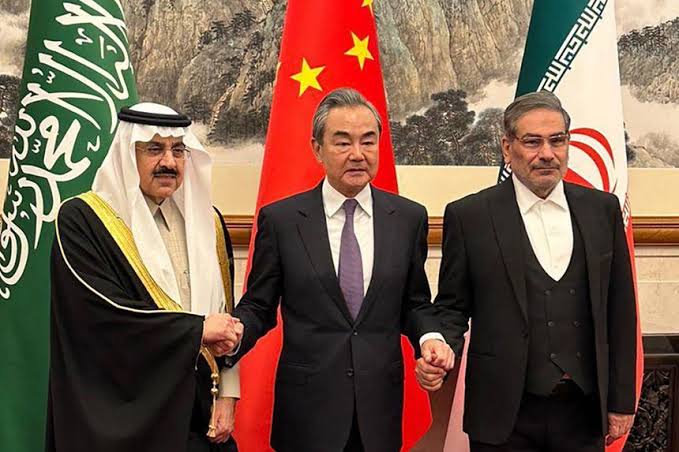
Peaceful dispute resolution is also a central feature of the GSI. China has recently spearheaded talks between Iran and Saudi Arabia which bore reconciliation. This example set in the Middle East inspired good neighborliness in that corner of the world. There are always peaceful solutions to all of the world’s security troubles. The GSI sees to it that conflicting parties always attempt these solutions. In that spirit, China has called for the de-escalation and finding of a political settlement to the Ukraine crisis; facilitated peace talks to solve the conflicts in northern Myanmar, and published a Position Paper alongside pushing the U.N. Security Council to adopt the very first resolution on the Palestinian-Israeli conflict since it erupted.

Does the global security order need reform? I think yes. It needs to be changed. It is not sustainable to have one global hegemon suspended over the rest of the countries in the world as the dominance of the United States increasingly feels. A more multipolar world is desirable. If international security is national security in the global arena, then all nations deserve to feel secure in the global system. As tempting as it may be, a country with the biggest military fist should not have the final say on international matters/matters of other countries. It is unacceptable that some countries should sit on the global security table while others are merely on their menu. We need inclusive global security. The GSI promises that.

Skeptics have held that these initiatives by China are simply high-voltage propaganda platitudes through which China seeks to establish its global interests. But besides this cynicism, there have been practical fruits harvested from implementing both the Global Security Initiative as well as the Global Development Initiative. And as our president – Yoweri Museveni once remarked, if the Chinese betray the spirit in which our engagement with them has blossomed, they will face similar resistance as we served colonialists. This sentiment was equally shared by one of China’s former leaders, Deng Xiaoping. So, sorry skeptics, for now, we are good.

The author is a senior research fellow at the Development Watch Centre.
Non-Aligned Movement Offers us Hopes for a Multipolar World

By Nnanda Kizito Sseruwagi.

The world’s bipolar power structure which had determined the security policies of the two global powers, the USA and USSR, collapsed with the disintegration of the Soviet Union in 1991. This left America as the sole power with global dominance. I think that the inherent structure of unipolarity and the U.S.’s strategic position as the unipolar moral whip of Western neo-liberal democratic principles threatens any prospects for world peace and makes conflict likely. However, I also observe that the Non-Aligned Movement (NAM) is steadily pushing against the U.S.’s unipolarity, and promises to collapse it without dissenting into war as is normally feared by hegemonic stability theorists.

Unipolarity is where a single state exerts military and economic power, and social and cultural influence over other states and eradicates competition on the landscape of international relations. The prevailing global geopolitical dispensation rests on the United States’ institutional and ideological dominance, with an international order expediently designed after the Second World War to sustain America’s primacy in great power politics. But that privilege is about to change with the collaboration of NAM’s 120 member states with China and Russia.

Whereas the American hegemonic order seems secure against would-be hegemonic challengers like China and Russia, NAM seems to perennially and steadily resist and challenge the liberal basis of U.S. hegemony, which is presented as a transparent, democratic political system. Supported by but not absorbed by China and Russia, members of NAM are making it harder for America to enjoy its cherished post-war world order.

I am inclined to agree with one of the world’s leading experts in the field of security studies, Prof. Barry Possen, who argues that unipolarity is in decline and that the world is shifting towards multipolarity. Multipolarity is where power is distributed among several states with similar amounts of power/influence. A great political scientist and international relations scholar of global repute, John Mearsheimer, shares a more controversial view, arguing that America’s liberal international order was flawed from its inception and thus destined to collapse.

America designed a world order where world states had to yield their decision-making authority to American-controlled international institutions. However, since the majority of states organized under NAM now greatly care about their sovereignty, autonomy and national identity, they have rebelled against and outgrown the US’s policing. America’s self-righteous hubris as the world’s policeman, and the hypocrisy with which it preaches and enforces Western liberal-democratic values ostracized it from the global south, hence indirectly propping up its nemesis, China. However, China has not yet marshalled sufficient power to contend with America to the point of toppling it from unipolarity to bipolarity. And for China’s strategic stability as an influential world power, it might never push the U.S. to that tipping point.

As the largest grouping of states worldwide after the American-dominated United Nations, and with its hallowed principles of mutual non-aggression, mutual non-interference in domestic affairs, equality and mutual benefit, and peaceful co-existence, and with China closely tied to supporting these principles, the Non-Aligned Moved seems to pose a serious challenge to the Hegemonic Stability Theory (HST). Therefore, it is no longer persuasive for proponents of the US’s unipolarity to claim that the international system will be destabilized to a clashing point of war (Thucydides trap) if America ceases to enjoy the place of a single hegemon.

Proponents of the HST usually rely on the Pax Britannica (the period of relative peace between great powers when the British Empire enjoyed global hegemonic dominance) and Pax Americana (where relative peace was experienced in the world after the end of World War II when the United States became the world’s dominant economic, cultural, and military power) as evidence for the stability of hegemony. However, they forget that the central mechanism in hegemonic stability theory which revolves around the provision of public goods by a powerful actor has been disproved by China, which has extended public goods to the majority of global southern countries without exercising hegemony, and most importantly, while supporting the principles of non-alignment.


Members of NAM are most likely to further dilute the U.S.’s influence as a sole global power by endorsing, supporting and even joining multipolar institutions and initiatives like BRICS (Brazil, Russia, India, South Africa and other countries), and the Belt and Road Initiative (BRI)- a global infrastructure development strategy adopted by the Chinese government in 2013 to invest in more than 150 countries and international organizations. The highlight and promise of BRICS is its attempt to redesign the global financial architecture and liberate it from the tyranny of America’s Bretton Woods institutions. It is unimaginable for the U.S. to retain its unipolarity if its financial web is torn apart with the support of NAM for BRICS and other like institutions.

For all the criticisms that might be levelled against the NAM, it has stood the test of time. Its member states are loosely and flexibly bound together by enduring principles that seem simple but whose strength lies in their simplicity. By declining to take positions with any power bloc, NAM members might be the biggest architects of global peace since the Second World War. They have pursued and promoted amicable coexistence on the international stage, exposing Western moral hubris in the ongoing genocide against Palestinians by Israel, and many other conflicts. This stance has challenged the unipolar posture of America in the world and demonstrated a desire and possibility for a more multipolar international system.

The writer is a lawyer and Research Fellow at the Development Watch Centre.


The Multilateral Trading System: The U.S Should Stop Undermining Global Practice

By Alan Collins Mpewo

It is not in doubt that the United States of America (US) has is always doing their best to stabilize global economy through various measures for selfish gains. Indeed, the US was among the spearhead as of what has popularly in recent times to be known as the Multilateral Trading System that has wide reception globally. This game after the second world that had seen an increase in various shortfalls especially during and shortly after the Cold war with the Soviets. The inception of this system lead to a finality of the General Arrangement on Tariffs and Trade. The Multilateral Trading System also saw the birth of the Uruguay Round sometime in 1980. Because of the growing conflict in the economies of scale between the competing blocs of the West and the Eastern globe there was need to set up formal rules to follow during international trade and business. Because of this, the United States was one of the founding members of the World trade organisation and consequently part of the formulation committee over the World trade organisation rules that would later bind all existing partners States at the time and those that would later in the near future adopt and assent to the World trade organisation. Countless achievements have been since achieved by the World Trade Organization due to the recognisable leadership over the United States of America. It therefore goes without saying that the United States of America has made its solid contribution to the growth and periodic stabilisation of the world’s economy.

Most important under the World Trade Organization rules was and still remains the dispute resolution mechanisms that have constantly been explored by the various parties whenever conflicts arise. The United States of America has without a doubt being on the forefront of always making sure that no more devastating consequences arise which would greatly affect majority of the global stakeholders in dangerously unimaginable levels. It should therefore be understood That’s that the United States of America has made various contributions as aforementioned herein, it has also in equal measures benefitted from the Multilateral Trading System. It is therefore safe to state that the system has been important in elevating various economies globally. The role played by the United States of America remains pivotal given that it is the world’s leading economy and ranks among the top three investment Nations in the world. Understanding that comes with major implications on how it exercises its dominance and authority in the various circles to which it trades and has power.

It is not bad for any Nation to come up with policies that seek to put it first ahead of other global key players’ interests. The United States of America in 2017 also came up with a major slogan and policy formulation along that line of “America first.” However, while it is a noble thing to do, friction and antagonism has since ruptured between the United States of America’s internal policies and the aspirations of other global actors under the Multilateral Trading System. The U.S has constantly deviated from the very ideas to which it was a founding state. Its trade protectionist policies have rather been hurting other trade stakeholders by closing the windows to trade information and active participation on the American soil. From commencing with ideas of globalisation, the Multilateral Trading System has now come into an uncertain trade abyss and now every country does as it wishes under the current structures of global economics.

Among other things that explain the above State of affairs is the constantly unchecked bullying through its hegemonic tendencies that are used to exert unwarranted sanctions and dominance through the guise of “National Security.” In other instances, depending on how it chooses to act or react to other countries, it uses the connotation of “Human Rights.” It has been seen with the Middle East and due to the sanctions and blockages there has been deprivation of equity, debt, and investment in many countries because trade diplomacy ends up as a victim. Additionally, dispute resolution and settlement mechanisms have also been greatly undermined by the United States of America. An example can be cited before 2022 when the United States of America blocked the requisite appointments of the new members to the Appellate body. That alone has paralysed the various efforts by concerned countries in trying to resolve the different disputes that have been arising on an appeal point of view. The United States of America holds a very important vote and by December 2022, it has refused the outcries from the other members of the World Trade Organization to have the Appellate body constituted for purposes of dispute resolution. While Article 17.2 of the Dispute Settlement Understanding gives the legal reception for the appointment of the members to the Appellate body, enforcement has been stalled by the United States of America. By February 2023, 29 appeals are still pending as a consequence of US’s actions.

Some other practices have included, offending export control, often undermining other members’ legitimate industrial policies, unwarranted sanction measures, economic coercion, disrupting industrial and global supply chains, among many other. Other strong economies and lead actors like China and Mexico and the World Trade Organization have constantly called out the United States of America over the above practices but the endeavours have met unresponsiveness. And therefore, while the U.S’ reaction remains an impediment, if unchecked, the once booming Multilateral Trading System is a route of demise.

Alan Collins Mpewo, is a Law and Senior Research Fellow, Development Watch Centre.

NOTE: This article was first published by the Development Watch Centre