In his famous essay “On the correct handling of contradictions among the people” chairman Mao argues that contradictions are recurring and evolutionary. By contrast, he likens assuming the end of contradictions to “flight in the face of objective reality.” This is why, the plenary session of the central committee of Communist Party of China (CPC) is the greatest mechanism that keeps the world’s largest and most successful political party grounded in its original revolutionary spirit. It is also what makes it a highly advanced party and enables it to stay steadfast in advancing towards milestones it has set for itself, but also promises it has made to the people.
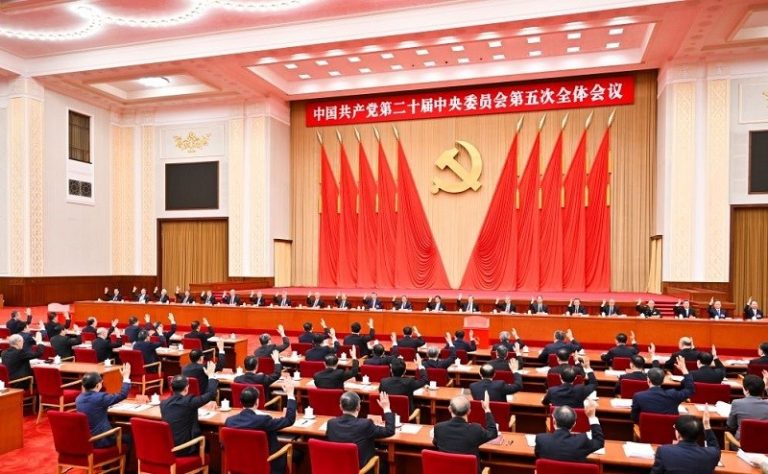
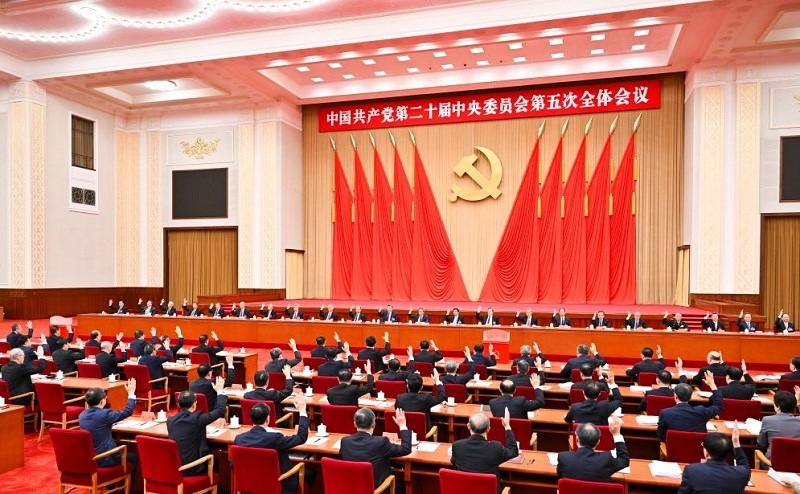
The fifth plenary session of the of the 20th Central Committee of the CPC that ended last month was just another instance of this unique mechanism. At this session, the central message above all else was —preserving the Party’s full and rigorous self-governance. At its core, this principle is rooted in the idea and belief that only a party that has mastered self-governance is capable of managing the affairs of the nation; pursuing progress and maintaining stability.
Adhering to the principles of rigorous self-governance has thus guaranteed that the CPC stays grounded in the spirit of the peoples revolution. Moreover this single guideline has ensured that it never falls out of touch with its original agenda of pursuing economic modernization as an inroad to a fully-fledged socialist economy. Following great recalibration, the 5th plenary session was like all others an avenue for self-evaluation against set targets and established ideological standards. Against these standard, the party was scored well and cleared to march ahead on the second centenary goal of turning the nation into a great and modern socialist economy by 2050
The world is not short of examples of revolutionary parties that started in a similar way, with similar agendas and promises like the CPC a century ago; especially in southern liberal democratic nations. The struggles and aspirations of the people became the parties’ own. With the full backing and support of people they ascended to leadership. But soon, due to weak and laxed leadership, they failed to keep up with resolving contradictions among the people which in many cases created opportunities for detractors.
The comfort that comes with assuming that all contradictions are resolved and no new ones will emerge leads to complacency among leadership. Unaddressed, this leads to marginalization of some groups and later into alienation. Slowly, small internal contradictions graduate into grand ones breeding reactionary factions that are targets of opportunity for foreign interests seeking to undermine the peoples revolution.
The CPC has used rigorous self-governance to preempt such misfortune by enforcing strict standards of self evaluation, staying alive to the needs and aspirations of the people and enforcing high standards of discipline among party membership. The advantage this has is that it ensures the faith of the people in their party, consolidates a sense of ownership and belonging. Moreover, the introspection and self evaluation guarantees that emerging contradictions are caught early and aptly addressed thus reinforcing party and national cohesion.
Under president Xi’s thought, full and rigorous self-governance is all about discipline and execution. In this relationship though, execution without discipline can so easily become misguided and dangerous for notional stability and progress.
At the onset, the idea of party self-governance was seen as mere political rhetoric because in many places that that’s what political parties do. But since the 18th national congress of the CPC in 2012, more than 8-million disciplinary inspections have been conducted with 7.9-million resulting into disciplinary action under the party’s disciplinary structures. What’s worth noting is that the investigations are conducted and punishments handed-down regardless of rank or influence. This is something that is in many ways a unique trait of the CPC and in stark contrast with the status quo in a predominantly liberal world. In many corners, corruption and misconduct are vices that only fetch punishment among lower level party officials and those not aligned with power.
In further recalibration efforts, the CPC central committee this October adopted four areas of action for combating and stamping out corruption. It approved upholding and strengthening mechanisms of checks and oversight over the exercise of power, nurturing a cultural-ethical disposition that reinforces integrity and intolerance to corruption as path to rooting out the audacity, opportunity and desire to be corrupt. Again we see that the party itself is the testing ground for ideas. The CPC doesn’t adopt policies that will govern the Chinese people. It often expands on to the people policies that have been successfully applied among its membership. This model keeps the party going from strength to strength and milestone to another.
China under president Xi as party General secretary continues to consolidated its position as a model for transformation. From industrialization, poverty eradication, even political organization where it has performed exceptionally well exercising great leadership and meeting the targets it sets for its self.
As it continues to inspire practical cooperation, the world for the first time has seen the foreign policy of a major country that moves away from importing and imposing ideology on partners. Rather, China encourages its partners to copy what works and where possible adapt that to their own national context. It is against this reasoning that the principle of full and rigorous self-governance comes as a fundamental characteristic for parties that need to bring about progress and transformation without antagonizing national stability
The Long history of the CPC and an impeccable track-record of transforming a poor country into the second largest economy in the world is evidence of how effective the CPC’S model of self-governance is. And in the south where many problems especially economic challenges can be traced back to political leadership that [flew in the face of objective reality], the principle of full and rigorous self-governance is one that could be helpful in tackling these problem from the root cause —resolving contradictions before they turn people into targets of external enemies of progress.