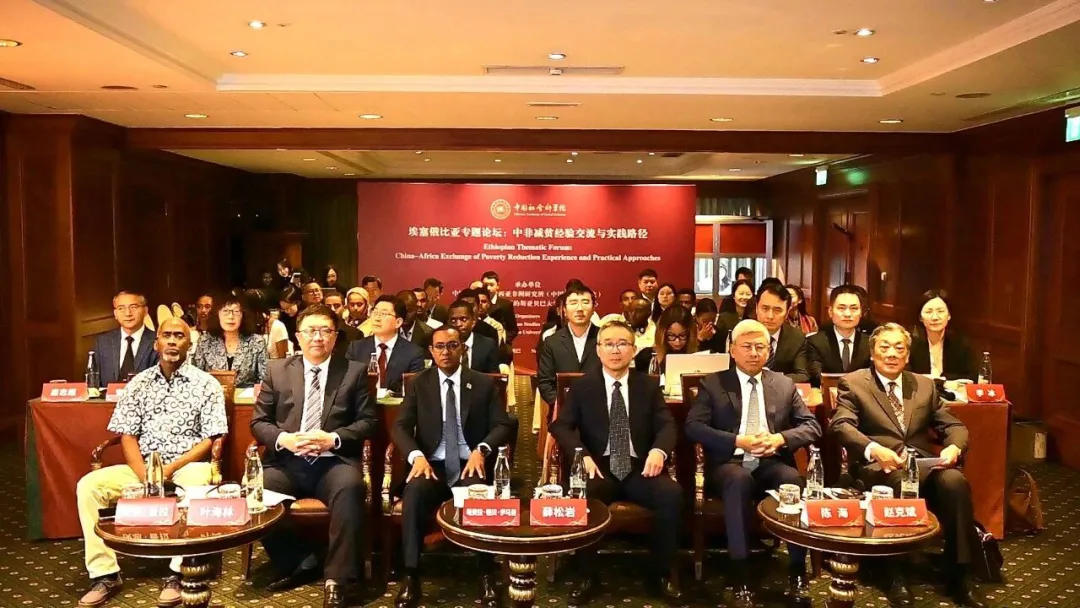
On Saturday 21st November, I had the privilege of representing the Development Watch Centre at a high level China-Africa exchange forum on poverty reduction hosted by the Chinese Academy of Social Sciences (CASS), the newly inaugurated China-Africa Research Center at Addis Ababa University, and the Institute of West-Asian and African Studies (IWAS) in the Ethiopian capital. Overall, the half-day event can be summarized as one that stayed true to its theme (China-Africa Exchange of Poverty Reduction Experience and Practical Approaches) by facilitating the forging of numerous viable solutions.
Starting off the first session, Xue Songyan the Secretary General of CASS pointed out that even though ending poverty was a global challenge, each country has to devise approaches to the issue that match its own unique circumstances. For China, he said, the leadership resolved to make fighting poverty a top priority as well as putting people at the centre stage of modalities aimed at fighting it. H.E Chen Hai, Beijing’s Ambassador to Ethiopia picked up from there this time to articulate the ideals behind his homeland’s approach towards ending poverty in Africa. Elaborating on the win-win principle thus, the diplomat used the example of “smiling children” a programme that has received recognition from President Abiy Ahmed for among others, providing food at school to African children.
Addis Ababa’s former ambassador to China, Tefera Derbew Yiman spoke next taking time in his remarks to unpack the far-reaching implications of poverty on the lives of the people going through the phenomenon and the communities they inhabit alike. Not only is the very dignity of the poor undermined by the scourge according to Mr. Derbew, but also repel effects such as social instability can at times arise in the areas where this section of society dwells. Kwesi Prah an Associate Professor at the University of South Africa then extended the complexities of poverty in Africa even further contending that until the historical realities that underpin contemporary institutions say banks and insurance companies were addressed, it was going to be impossible to resolve the matter at hand.
The second half of the forum rotated on scholarly input and it was kicked off by An Chuying an Associate Editor of the Journal of West Asia and Africa. During her presentation, she shared insights into how China had gone about helping the most disadvantaged parts of her population including through alliances fostered between the country’s Eastern and Western regions i.e. provinces in the former category provided assistance not least in the form of technologies to help bring prosperity to their fellow country men and women. Relatedly, Loice Grace Maingire of the Southern African Research and Documentation Centre talked about how Juncao projects had transformed the lives of many Zimbabweans by introducing highly adoptable and quality crops like mushrooms and livestock grass. At the same time, Ms. Maingire decried instances of economic growth numbers on the national level that fail to trickledown to Africans of lower ranks.
As for Wang Yu, the Deputy Head and Associate Research Fellow of the Urban-Rural Relations Research Division (CASS), she called for an outlook that takes into account the fact that poverty can never be overcome once and for all. To illustrate this, she used the example of the Covid-19 pandemic upon whose emergence a big pool of individuals across the world were sunk back into miserable livelihoods. It is immediately after Ms. Yu that yours truly spoke and the topic of my discussion was the informal sector in Africa. Citing a 2025 report by UNESCO which found that only 9% of the African population obtained higher education, I indicated that a lot could be accomplished if the China-Africa partnership focused on improving the productivity of individuals who have no documentation to show in the job market.
Three more academics stepped to the podium before this segment of the forum was brought to a close. Professor Yuan Wu an Associate Research Fellow at IWAS emphasized the fact that in order to alleviate poverty, African countries have to highly invest in manufacturing. Zhang Chunyu also an IWAS Associate Research Fellow equally made recommendations focused on improving the African industry. In particular, he zeroed down on digitization giving examples of how innovations in digital banking promote financial inclusion. Finally, Lu Yinglin a colleague of both Wu and Chunyu at IWAS gave a critical analysis of the pitfalls that have befallen donors’ attempts to redress poverty in Africa over the years. Despite the large sums of aid dispatched to the continent, Ms. Yinglin showcased that little has been gained from it. Her argument therefore, was that understanding the factors at play was just as important (if not more) as the boots-on-the-ground work.
The conference closed with a speech by the Vice President of the China Africa Institute, Mr. Tang Zhichao. Upon revisiting the main outcomes from the names highlighted above the VP affirmed that the same would become a stone added to the long standing relationship between China and Africa in their common cause towards economic development. As I left Addis Ababa the next day, I could not agree more.
Joshua Kingdom is a lawyer and a Research Fellow at the Development Watch Centre