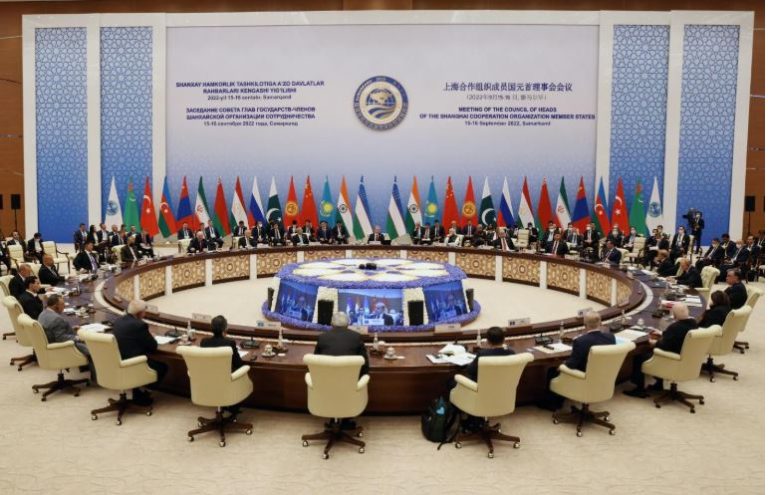
Today, 1st September marks one year since President Xi Jinping first unveiled the Global Governance Initiative (GGI) to the world. Speaking to attendees of the Shanghai Cooperation Organization Plus meeting last year, the Chinese statesman’s remarks (and subsequently the proposals advanced therein) at the time can only be looked back upon as becoming more prescient today.
President Xi’s address advanced five tenets that have now been concretized by the GGI concept paper as the initiative’s “core principles” the first of the batch being a commitment to sovereign equality. The idea is that when relating, nations ought to respect one each other “regardless of size, strength or wealth.” This means among others, that no country should poke its nose into the domestic affairs of another and that when participating in activities that involve multiple states, the parties involved should do so as equals.
Unfortunately, since the launching of GGI, there has been numerous instances on the world stage by those who see themselves as most powerful and therefore, having the right to play arbiters of who does what including when the issues at hand rise outside their countries’ borders. Perhaps the most extreme example here was the ousting of Venezuela’s Nicolás Maduro by the current United States administration. In an operation dubbed “Absolute Resolve” (AR), the United States army laid siege on the presidential palace in Caracas in the morning hours of 3rd January, 2026 the result of which was the abduction of both the then President of Venezuela and his wife Cilia Flores. Unsurprisingly, the ousting drew wide condemnation from political leaders in the region including their excellences; Gabriel Boric (Chile), Claudia Sheinbaum (Mexico), and Luiz Inácio Lula da Silva (Brazil). The United Nations Human Rights Office did not mince words either explaining that AR undermined the very foundations of global security.
Most disturbingly, AR is far from being a stand-alone act. From President Trump’s rhetoric but also from military interventions he has orchestrated elsewhere, the emerging patterns are there for everyone to see. While the ongoing war with Iran has hit a stalemate to much of his frustration thus, one worries what the US head of state could have done if he had had his way. To remind ourselves, it is the same world leader who in April this year took to his Truth Social account writing that “A whole civilisation will die tonight, never to be brought back again.” Most people agree that this is but a genocidal statement (a crime that is outlawed by the Rome Statute). For GGI, it is here that core principle 2 comes in as it is all about adherence to the rule of law. In asserting that international law has to be “upheld unwaveringly”, the Global Governance Initiative’s concept paper makes no exception for any individual or actor on this matter.
GGI has also been crafted to avoid a common pitfall for many otherwise good causes i.e. implementation. This is possible because of core principle five: “commitment to real results.” On this front, the initiative seeks to bolster international organizations particularly the United Nations through championing reforms that these institutions urgently need in order to match the challenges of our age. For instance, GGI highlights the persisting neglect of the interests of the global south by the aforementioned platforms. Other concerns raised by the initiative are misdiagnosis of the problems at hand with much of the focus being placed on “symptoms” rather than the “root causes” as well as the sluggishness with which pressing needs are handled. Indeed, the concept paper’s background indicates that “the U.N. 2030 Agenda for Sustainable Development is seriously lagging behind.”
That said, unlike UN members who have only dwelt on the system’s downsides with some going as far as withdrawing their membership from a host of its agencies, Beijing’s approach under GGI has been that of carrot and stick. In that sense, China’s attitude can be seen as criticism done not for its sake but because GGI’s architects view the United Nations as integral to the realization of the initiative’s goals and that consequently, its betterment directly translates into success for them too. To this end, core principle three reads in part as follows; “The U.N. is the core platform for practicing multilateralism and advancing global governance, whose role must be enhanced, not weakened.” This stance of realism is driven in part by a deep appreciation of history. Crucial in this case, is an understanding that the UN was established in the aftermath of a bitter war of global magnitude. The Global Governance Initiative hence carries within it an exercise of precaution. Eighty years later, GGI insists that diplomacy remains the wisest path to take in the pursuit of humanity’s common interests.
Beautiful as it is in theory, GGI ultimately has to be judged by what it has accomplished on ground. For most endeavours of this stature, it often requires anywhere between two and five years before a proper picture of the direction that they are taking begins to take shape. In testament of the Global Governance Initiative’s triumph however, we do not have to wait this time around. The full details of the milestones that GGI has arrived at in her first twelve months can be found in the State Council Information Office’s June 2026 white paper titled “More Just and Equitable Global Governance: China’s Principles, Proposals and Actions.” To give the reader an idea of what I mean though, two of these achievements are; Beijing being the biggest contributor of troops to UN peace keeping missions amongst the permanent members of the Security Council and the country’s establishment of the China-UN Global South-South Development Facility in September last year alongside the UN.
In the year that followed the unveiling of GGI, the initiative has become more relevant (not less). As the international community continues to debate about the course that things should take moving forward, GGI has presented diplomats the world over with a model to learn from. Importantly, as this piece has argued, the Global Governance Initiative’s way of doing things does not just look elegant. It has already garnered significant momentum an attribute that has in turn enabled it to bring forth meaningful results in its short life span.
Joshua Kingdom is a lawyer and a Research Fellow at the Development Watch Centre